
Foundayo side effects
Foundayo side effects, in plain English
Foundayo side effects are mostly digestive, with nausea, constipation, diarrhea and vomiting leading the list, and they are most common while the dose is being stepped up. This guide covers what the orforglipron label and trials report, what's different about a daily pill, the red flags that need urgent help, and how to keep a record your prescriber can use.
On this page
- The most common Foundayo side effects
- When Foundayo side effects happen, and when they ease
- What's different about a daily pill
- One by one: what may help and when to call
- Less talked-about Foundayo side effects
- Serious side effects of Foundayo (orforglipron)
- Who should not take Foundayo
- How Foundayo compares with other GLP-1 medicines
- Foundayo side effects in the UK
- Tracking Foundayo in Handle
- Questions to ask your prescriber
- Questions people ask
- Sources
In short
- The most common Foundayo (orforglipron) side effects are nausea, constipation, diarrhea, vomiting, indigestion and stomach pain; in the 72-week trials behind the label, nausea affected 26–35% of people on Foundayo against 10% on placebo.1
- Of people who had a stomach side effect, 60% reported mild ones, 36% moderate and 4% severe, and nausea, vomiting and diarrhea were more common while the dose was being stepped up, then decreased over time.1
- Overall, 8% of people stopped Foundayo because of side effects (6–10% depending on the dose), against 3% on placebo.1
- The label's serious warnings include pancreatitis, gallbladder problems, kidney problems from dehydration and severe stomach problems, plus a boxed warning about thyroid C-cell tumors.1
- Foundayo isn't in Handle's medicine list yet, but you can add it under "Something else" and use the free daily check-in to keep a record for your prescriber.
The most common Foundayo side effects
Foundayo's label pools two 72-week, placebo-controlled trials: ATTAIN-1, in adults with obesity or overweight and no diabetes, and ATTAIN-2, in adults with type 2 diabetes. In all, 3,155 adults took Foundayo.1 The table lists the side effects reported by at least 5% of them and more often than on placebo.
| Side effect | Placebo | 5.5 mg | 9 mg | 17.2 mg |
|---|---|---|---|---|
| Nausea | 10% | 26% | 34% | 35% |
| Constipation | 9% | 20% | 27% | 24% |
| Diarrhea | 11% | 21% | 23% | 25% |
| Vomiting | 4% | 13% | 21% | 24% |
| Indigestion | 4% | 12% | 16% | 13% |
| Stomach pain | 7% | 13% | 14% | 14% |
| Headache | 7% | 8% | 9% | 9% |
| Bloating | 3% | 7% | 9% | 8% |
| Tiredness (fatigue) | 4% | 6% | 7% | 9% |
| Burping | 1% | 6% | 8% | 8% |
| Heartburn or reflux (GERD) | 2% | 6% | 6% | 7% |
| Gas | 2% | 5% | 6% | 6% |
| Hair loss | 2% | 4% | 4% | 5% |
Source: Foundayo prescribing information, Table 1.1 The trials tested an investigational formulation of orforglipron, which the label reports as equivalent Foundayo doses; the journal papers use the investigational doses, 6, 12 and 36 mg.1,3,4 The dose columns are trial groups, not a guide to your dose.
In the same two trials:
- had at least one stomach side effect, depending on the dose, against 37% on placebo1
- 60–69%
- of people with a stomach side effect had mild ones; 36% had moderate and 4% severe ones1
- 60%
- stopped Foundayo because of side effects (6–10% by dose), against 3% on placebo1
- 8%
- stopped because of stomach side effects, against 0.7% on placebo1
- 3–6%
In the separate trial papers, adverse events led 5.3–10.3% of people on orforglipron to stop in ATTAIN-1 (2.7% on placebo), and 6.1–9.9% in ATTAIN-2, in people with type 2 diabetes (4.1% on placebo).3,4
When Foundayo side effects happen, and when they ease
The label gives no week-by-week timeline, and nobody can predict yours. It does describe a pattern.
- Starting outA low start
Foundayo comes in six strengths, from 0.8 mg to 17.2 mg. Labels start low and step up gradually; your prescriber sets the steps.1
- During each step upWhen they were most common
Nausea, vomiting and diarrhea were more common during the dose-escalation period.1 The weeks after a change are the ones most worth writing down.
- The months that followUsually easing
Those effects then decreased over time.1
- If it doesn't settleTell your care team
The Medication Guide asks you to tell your healthcare provider about stomach problems that are severe or won't go away, and to tell them right away about nausea, vomiting or diarrhea that doesn't go away.1
What's different about a daily pill
Foundayo, approved by the FDA in April 2026 for weight management, is a once-daily tablet you can take at any time of day, with or without food.1,2,7 Its label sets no fasting, water or waiting rules:1 orforglipron is a small-molecule GLP-1 medicine rather than a peptide,3 and the FDA describes it as a pill that doesn't need to be taken on an empty stomach.2 How that compares with the Wegovy pill is covered in Foundayo vs Wegovy.
The label's practical rules are short: it says to swallow the tablet whole, without breaking, crushing or chewing it, and not to take more than one tablet a day.1 For missed doses, Foundayo's Medication Guide has its own rule, including for a longer gap, so ask your prescriber or pharmacist rather than guessing. Handle records what happened and never tells you to catch up.
Two more label points are easy to miss. Orforglipron is broken down mainly by the enzyme CYP3A4, and the label lists interactions with some medicines, including clarithromycin, carbamazepine, ritonavir and simvastatin, so tell your prescriber and pharmacist about everything you take.1 And Foundayo may make birth control pills taken by mouth work less well: the label advises switching to a non-oral method, or adding a barrier method, for 30 days after starting and for 30 days after each dose increase.1
One by one: what may help and when to call
General, non-drug measures only, from the Medication Guide; your care team can advise on anything more.
- Nausea (26–35% vs 10% on placebo).1 Drinking fluids matters: the Medication Guide says it helps reduce your chance of dehydration.1 Ask your care team whether changing what or how much you eat might help, and call them if nausea stops you eating or drinking, or doesn't go away.
- Constipation (20–27% vs 9%).1 One of the most common effects on Foundayo. Ask your care team whether more fiber and fluids would suit you, and call them if it's severe or won't go away.
- Diarrhea (21–25% vs 11%).1 Keep drinking: the Medication Guide says fluids help lower your chance of dehydration, which can lead to kidney problems. Tell your care team right away if it doesn't go away.1
- Vomiting (13–24% vs 4%).1 Vomiting can lead to dehydration, so ask your care team how best to keep fluids up.1 Tell your care team right away if vomiting doesn't stop or you can't keep fluids down.
- Indigestion, heartburn and burping. Indigestion (12–16% vs 4%), reflux (6–7% vs 2%) and burping (6–8% vs 1%) were all more common than on placebo.1 Ask your care team whether changes to your meals might help. The label says nothing about smell: "sulfur burps" is not a label term.
- Stomach pain, bloating and gas. Stomach pain (13–14% vs 7%), bloating (7–9% vs 3%) and gas (5–6% vs 2%).1 Severe stomach pain that won't go away is different: see the red flags below.
- Headache (8–9% vs 7%).1 Only a little more common than on placebo. If you also use insulin or a sulfonylurea, headache can be a sign of low blood sugar.1
- Tiredness (6–9% vs 4%).1 Worth mentioning to your care team if it's new or doesn't lift.
In Handle
Record how the pill feels, in seconds a day
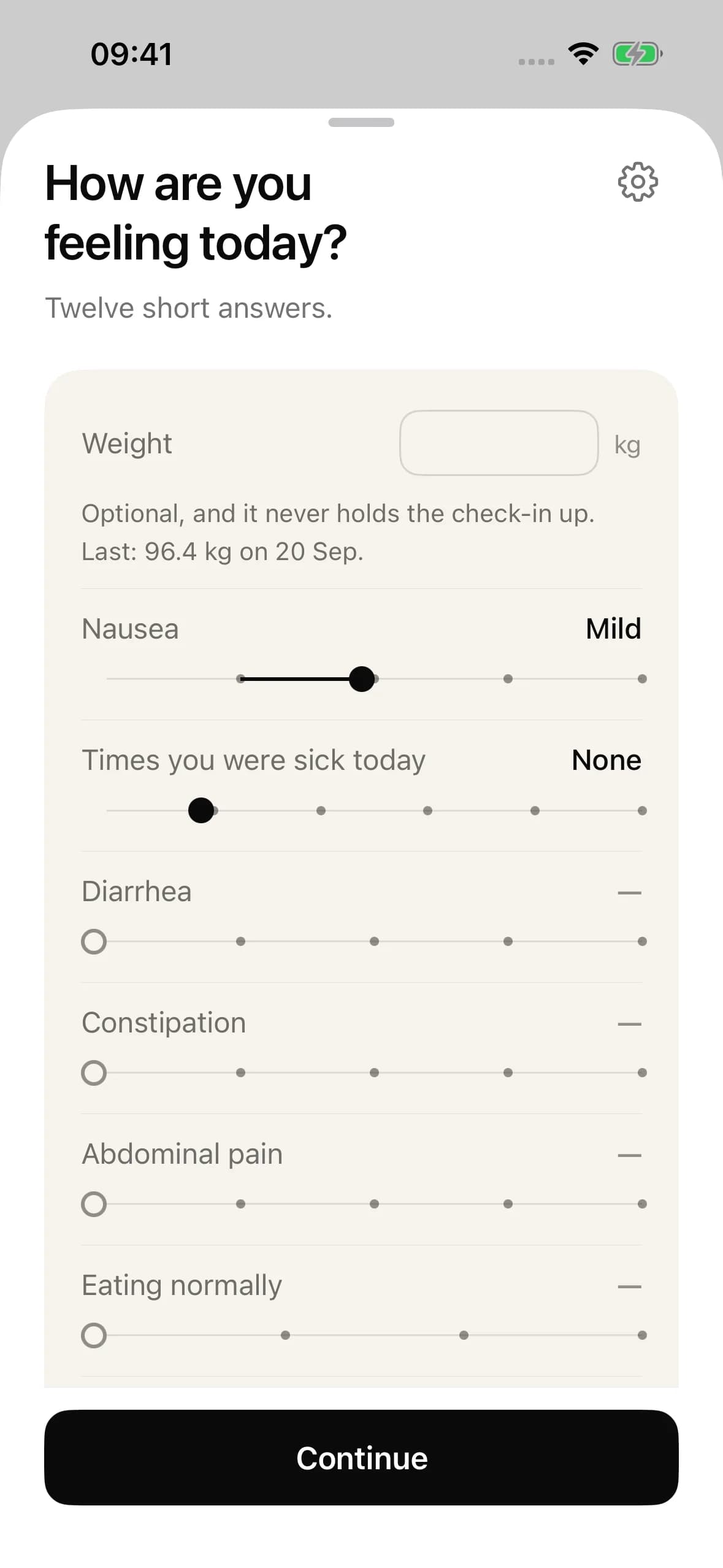
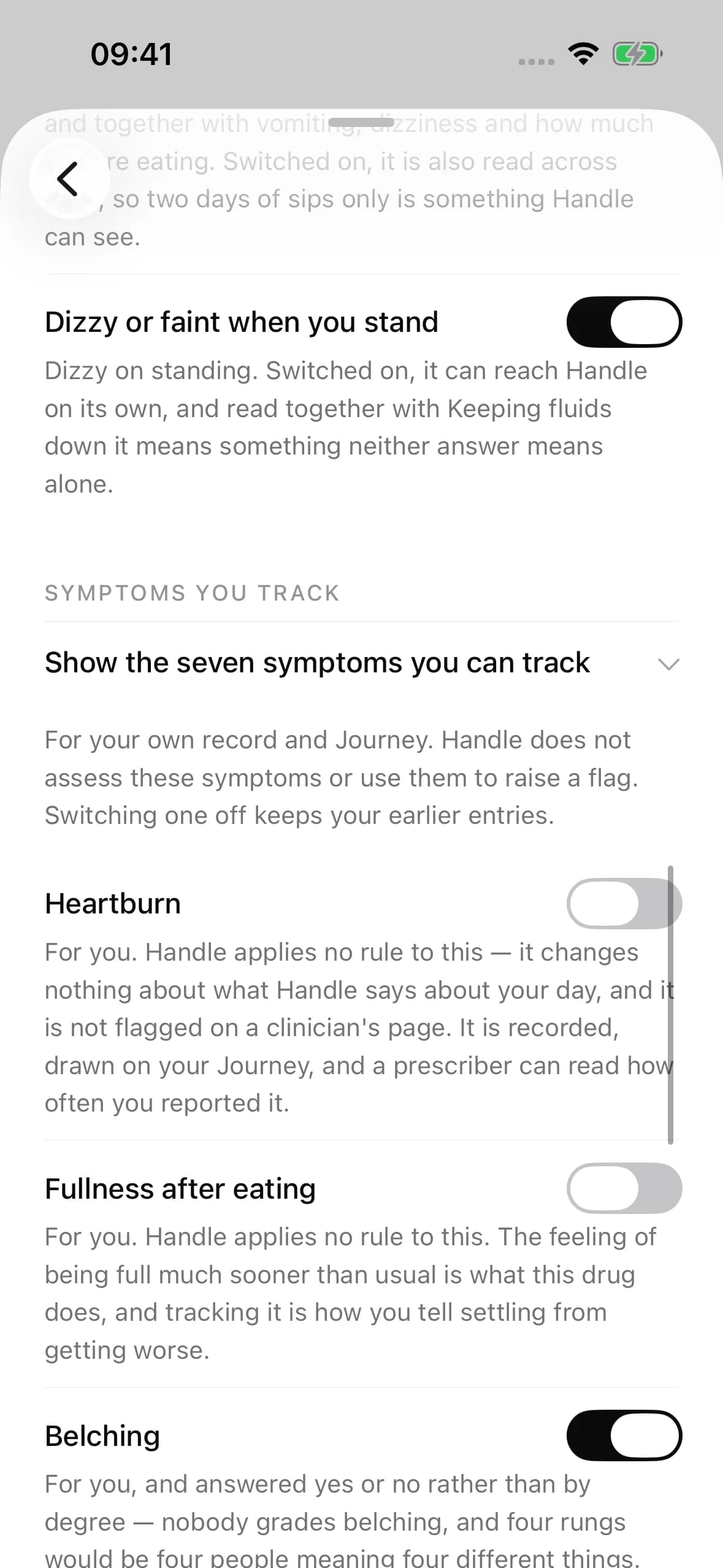
Handle's daily check-in asks about nausea every day, plus the symptoms you switch on, such as constipation, diarrhea, vomiting or stomach pain. Add up to six tracked symptoms, like belching, heartburn, headache or fatigue, or one in your own words. It stays the same short card whatever you answer.
Handle never diagnoses, and it is not a monitoring or emergency service. If a symptom worries you, contact your care team directly.
- Works for a daily pill as well as a weekly injection
- Turn questions on or off at any time
- Missed a day? Add it later, up to 30 days back
Less talked-about Foundayo side effects
Beyond the stomach, this is what the label says about the effects people often ask about.
- Hair loss. Reported by 4–5% of people on Foundayo against 2% on placebo, and more often by women (7%) than men (0.9%); on placebo the figures were 3% and 0.7%.1
- Dizziness and low blood pressure. Dizziness affected 4% against 3%. Low blood pressure affected 2% against 0.5%, and 4% of people on Foundayo who also took blood-pressure medicines.1
- A faster heartbeat. A fast heart rate (tachycardia) was reported by 3% against 0.9%, and average heart rate rose by 4–5 beats per minute, against 0.5 on placebo.1
- Taste and skin changes. Changes in taste affected 0.9% against 0.3%, and altered skin sensation (dysesthesia) 0.3% at 9 mg and 1% at 17.2 mg, against 0.1% on placebo.1
- Liver. Liver problems are not among the label's warnings, but the label says Foundayo is not recommended for people with severe liver impairment.1
- Mood. Foundayo's label has no warning about suicidal thoughts.1 In January 2026 the FDA asked for that warning to be removed from the GLP-1 labels that carried it, after a review found no increased risk, and it still asks you to report new or worsening depression or unusual changes in mood.5
- Muscle and lean mass. The label says orforglipron lowers body weight with greater fat mass loss than lean mass loss.1 Lean mass is not the same thing as muscle.
Serious side effects of Foundayo (orforglipron)
Serious side effects are less common, and each has signs worth knowing. These are the label's main warnings.
- Pancreatitis. Confirmed in 6 people on Foundayo (0.14 people per 100 years of use) against 1 on placebo (0.04).1 The warning sign is severe stomach pain that won't go away; see the red flags below.
- Gallbladder problems. Gallstones in 1% against 0.7%, and acute gallbladder inflammation in 0.4% against 0.3%.1
- Kidney problems from dehydration. Acute kidney injury in 0.2% against 0.05%.1 Nausea, vomiting and diarrhea can cause the fluid loss behind it.1
- Severe stomach problems. About 3% against 1%, and Foundayo is not recommended for people with severe gastroparesis.1
- Low blood sugar. Mainly with insulin or a sulfonylurea: in ATTAIN-2, 2% of people with type 2 diabetes had a reading below 54 mg/dL against 0.2% on placebo, and 7% of those also taking a sulfonylurea did.1
- Allergic reactions. Reported in 0.5% against 0.3%.1
- Eye changes in type 2 diabetes. The label warns about diabetic retinopathy complications in people with type 2 diabetes; report any change in your vision.1
- Food in the lungs under anesthesia. Rare reports in people taking GLP-1 medicines. Tell every healthcare provider you take Foundayo before surgery or sedation.1
Who should not take Foundayo
Foundayo carries a boxed warning about thyroid C-cell tumors.1 Its wording is unusual: orforglipron is not active in rats or mice and did not cause tumors in rodents, and while it does act on the human GLP-1 receptor, the label says the human relevance of the thyroid tumors seen in rodents with this type of medicine has not been determined.1
The label says not to take Foundayo if you or a family member has had medullary thyroid carcinoma (MTC), if you have multiple endocrine neoplasia syndrome type 2 (MEN 2), or if you've had a serious allergic reaction to orforglipron or its ingredients. Tell your provider about a lump or swelling in your neck, hoarseness, trouble swallowing or shortness of breath.1
It isn't recommended with other GLP-1 medicines, or for people with severe gastroparesis or severe liver impairment, and its safety and effectiveness in children have not been established.1 The label also warns of possible harm to an unborn baby and says Foundayo isn't recommended while breastfeeding, so tell your prescriber if you're pregnant, planning a pregnancy or breastfeeding.1
How Foundayo compares with other GLP-1 medicines
The labels themselves say side-effect rates from different medicines' trials can't be compared directly,1 and Foundayo has not been tested head-to-head against the Wegovy pill for weight loss.
One head-to-head trial is in type 2 diabetes. ACHIEVE-3 compared orforglipron with oral semaglutide at Rybelsus doses, not the Wegovy pill, in 1,698 adults over 52 weeks, open-label: 8.7% and 9.7% stopped orforglipron because of adverse events, against 4.5% and 4.9% on oral semaglutide.6
For the wider picture, see Foundayo vs Zepbound, our pages on Zepbound side effects and Wegovy side effects, or the full list of GLP-1 medications.
Foundayo side effects in the UK
The MHRA authorised Foundayo on 10 August 2026, making the UK the first country in Europe to approve it, for weight management and, unlike in the US, for type 2 diabetes too.7 It is not currently available on the NHS while NICE evaluates it, and you can report suspected side effects to the MHRA's Yellow Card scheme.7
Tracking Foundayo in Handle
Foundayo isn't in Handle's medicine list yet. Add it under "Something else" with its name, the amount your prescriber set and a daily schedule; logging doses, the check-in, weight, food, Journey and the Premium report then work the same way. Our Foundayo tracker guide walks through it, and the GLP-1 side effect tracker checklist covers what to note.
Handle PremiumPremium
Give your prescriber the whole picture
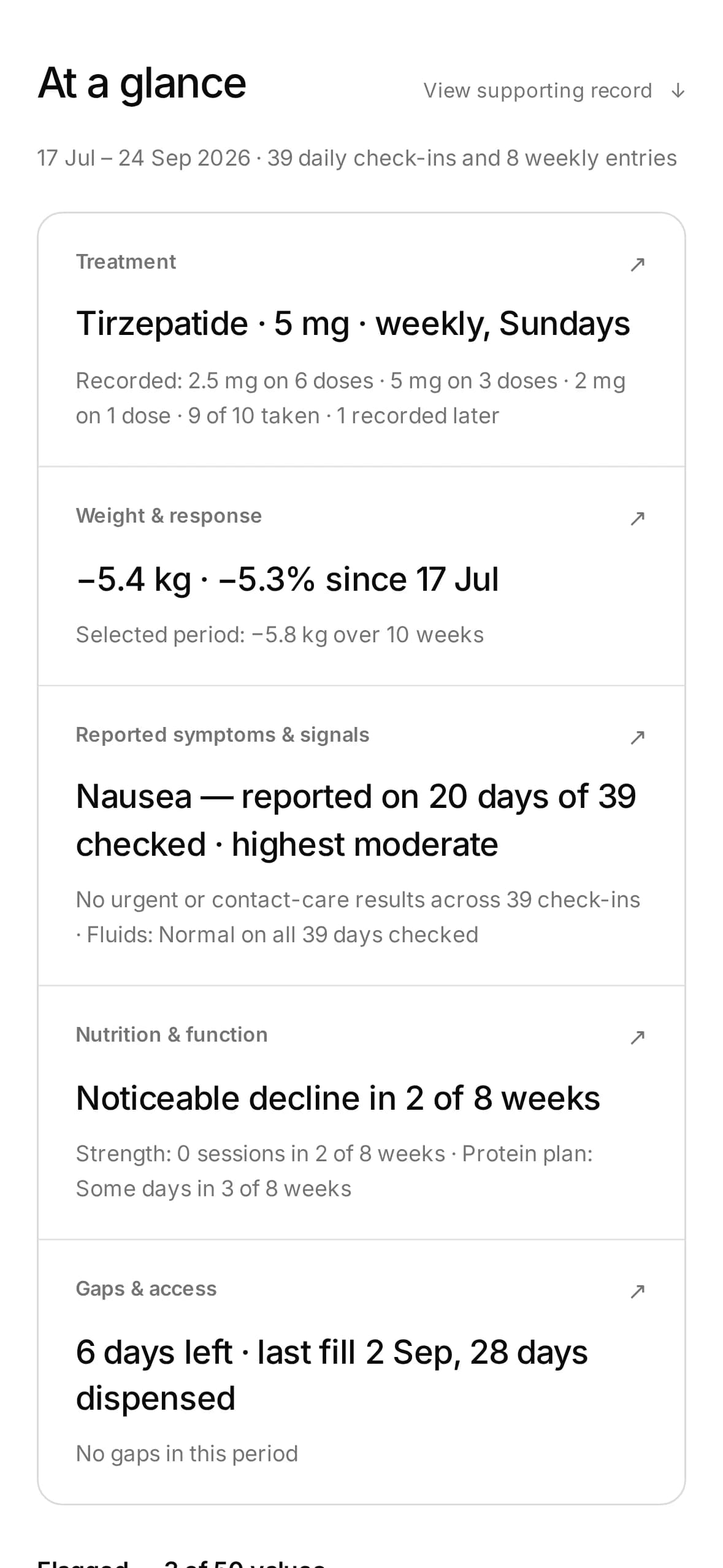
The consultation report, a Premium feature, brings together your Foundayo record including each change of strength, symptom summaries, weight history, nutrition and activity, and an optional note about what you want to discuss, so your clinician can see the pattern quickly. More on preparing for a GLP-1 doctor appointment.
- Shared as a secure link you can revoke at any time
- Your private daily notes are never included
- Your clinician needs no account to read it
Premium is an optional subscription in the iPhone app.
Questions to ask your prescriber
- Which side effects should I call you about, and which can I manage at home?
- What should I do if I can't keep fluids down?
- Do any of my other medicines interact with Foundayo?
- I use the contraceptive pill. What should I use alongside it, and for how long?
- What should I do if I miss a dose, or several days? Foundayo's instructions have their own rule.
For side effects across the whole class of medicines, see our overview of GLP-1 side effects.
Questions people ask
What are the most common side effects of Foundayo?+
Nausea, constipation, diarrhea, vomiting, indigestion and stomach pain. In the 72-week trials behind the label, nausea affected 26–35% of people on Foundayo against 10% on placebo, constipation 20–27% against 9%, and vomiting 13–24% against 4%.1 Most people who had stomach side effects reported mild or moderate ones.1
How long do Foundayo side effects last?+
There's no fixed timeline. The label says nausea, vomiting and diarrhea were more common during the dose-escalation period and decreased over time.1 If a side effect is severe or won't go away, tell your healthcare provider, and tell them right away about nausea, vomiting or diarrhea that doesn't go away.1
Does orforglipron cause hair loss?+
It can. In the trials behind the label, hair loss was reported by 4–5% of people on Foundayo against 2% on placebo, and more often by women (7%) than men (0.9%); on placebo the figures were 3% and 0.7%.1 If you notice it, mention it at your next appointment.
Does orforglipron cause constipation?+
Yes, it's one of the most common side effects: 20–27% of people on Foundayo reported constipation, against 9% on placebo.1 Ask your care team whether more fiber and fluids would suit you. Tell your care team if it's severe or won't go away, as the Medication Guide asks.1
Does Foundayo make you tired?+
Some people report it: fatigue affected 6–9% of people on Foundayo against 4% on placebo, and headache 8–9% against 7%.1 If you also take insulin or a sulfonylurea, weakness, drowsiness or headache can be signs of low blood sugar, so mention them to your care team.1
Does orforglipron cause muscle loss?+
The label says orforglipron lowers body weight with greater fat mass loss than lean mass loss.1 Lean mass is not the same thing as muscle, and a body-composition result isn't a measure of strength. If muscle or strength worries you, it's a good question for your care team.
Can orforglipron cause pancreatitis?+
It can, though it was uncommon in the trials: pancreatitis was confirmed in 6 people on Foundayo (0.14 people per 100 years of use) against 1 person on placebo (0.04).1 The Medication Guide says to call your healthcare provider right away about severe stomach pain that won't go away, with or without nausea or vomiting; you may feel it from your stomach through to your back.1
Does Foundayo affect the liver?+
Liver problems are not among Foundayo's label warnings. The label does say Foundayo is not recommended for people with severe liver impairment, and orforglipron is broken down mainly by the enzyme CYP3A4, which is why some other medicines interact with it.1 Tell your prescriber about any liver condition before you start.
Does Foundayo have fewer side effects than injections?+
The evidence can't answer that yet. The labels warn that side-effect rates from different medicines' trials can't be compared directly, so fair comparisons need head-to-head trials.1 One head-to-head trial, ACHIEVE-3, compared orforglipron with oral semaglutide in type 2 diabetes, not with an injection.6 Ask your prescriber how the options compare for you.
Can I track Foundayo in Handle?+
Yes. Foundayo isn't in Handle's medicine list yet, so add it under "Something else" with its name, amount and daily schedule. Doses, the daily check-in, weight, food, Journey and the consultation report, a Premium feature bought in the iPhone app, then work the same way. Handle never diagnoses and never suggests a dose.
Sources
- Eli Lilly and Company, via DailyMed (U.S. National Library of Medicine). Foundayo (orforglipron) tablets — Prescribing Information, effective July 29, 2026.
- U.S. Food and Drug Administration. FDA Approves First New Molecular Entity Under National Priority Voucher Program, April 1, 2026.
- The New England Journal of Medicine (Wharton et al.), via PubMed. Orforglipron, an Oral Small-Molecule GLP-1 Receptor Agonist for Obesity Treatment, 2025.
- The Lancet (Horn et al.), via PubMed. Orforglipron, an oral small-molecule GLP-1 receptor agonist, for the treatment of obesity in people with type 2 diabetes (ATTAIN-2): a phase 3, double-blind, randomised, multicentre, placebo-controlled trial, 2025.
- U.S. Food and Drug Administration. FDA Requests Removal of Suicidal Behavior and Ideation Warning from Glucagon-Like Peptide-1 Receptor Agonist (GLP-1 RA) Medications, January 13, 2026.
- Eli Lilly and Company, via PR Newswire. Lilly's oral GLP-1, orforglipron, delivered superior blood sugar control and weight loss compared to oral semaglutide in head-to-head type 2 diabetes trial published in The Lancet, February 26, 2026.
- Medicines and Healthcare products Regulatory Agency (UK). UK first in Europe to authorise orforglipron for weight management and type 2 diabetes, August 10, 2026.
Written by the Handle team from the sources above, last checked on September 23, 2026. How we write: our editorial policy. Spotted something out of date? Tell us at [email protected].
Handle supports recording and conversations with your care team. It does not diagnose, and it never tells you to start, change, skip or stop a dose. This page is general information, not medical advice. Always follow your prescriber and your medicine's instructions for use.