
Wegovy side effects
Wegovy side effects, from the pen to the pill
Wegovy side effects are mostly digestive: nausea, diarrhea, vomiting and constipation, which the label says were reported most often while the dose was being stepped up. This guide covers the weekly injection, the higher 7.2 mg dose and the daily Wegovy pill, with each figure from the label or the trial behind it, plus what can help and when to get help.
On this page
- The most common Wegovy side effects
- Wegovy pill side effects
- Wegovy HD (7.2 mg): side effects at the higher dose
- When Wegovy side effects start and ease
- Common side effects, and what can help
- Less talked-about Wegovy side effects
- Serious Wegovy side effects
- Long-term Wegovy side effects, and stopping
- Who should not take Wegovy
- Tracking Wegovy side effects for your prescriber
- Questions to ask your prescriber about Wegovy
- Questions people ask
- Sources
In short
- The most common Wegovy side effects are stomach and bowel problems. In the 2.4 mg weight-management trials, 44% of people reported nausea, 30% diarrhea, 24% vomiting and 24% constipation, against 16%, 16%, 6% and 11% on placebo.1
- The label says these reactions were most frequently reported during dose escalation, and in the STEP 1 trial nausea and diarrhea were typically mild to moderate and subsided with time.1,4
- Less common effects include tiredness (11% against 5%), belching (7% against under 1%) and hair loss (3.3% against 1%), which the label links to weight reduction.1
- The label says the Wegovy pill's common side effects were similar to the injection's; in its trial, 74.0% of people on the pill had a stomach or bowel side effect, against 42.2% on placebo.1,3
- Serious risks are uncommon but include pancreatitis, gallbladder disease, kidney injury from dehydration and serious allergic reactions, and the label has a boxed warning about thyroid C-cell tumors seen in rodents.1
The most common Wegovy side effects
From Wegovy's US prescribing information: three placebo-controlled weight-management trials (STEP 1, 2 and 3) in adults, with 2,116 people on Wegovy 2.4 mg for up to 68 weeks. Every reaction here was reported more often than on placebo.1
| Side effect | Placebo (1,261 people) | Wegovy 2.4 mg (2,116 people) |
|---|---|---|
| Nausea | 16% | 44% |
| Diarrhea | 16% | 30% |
| Vomiting | 6% | 24% |
| Constipation | 11% | 24% |
| Stomach (abdominal) pain | 10% | 20% |
| Headache | 10% | 14% |
| Fatigue | 5% | 11% |
| Indigestion (dyspepsia) | 3% | 9% |
| Dizziness | 4% | 8% |
| Bloating (abdominal distension) | 5% | 7% |
| Belching (eructation) | under 1% | 7% |
| Flatulence | 4% | 6% |
| Reflux (GERD) | 3% | 5% |
| Hair loss | 1% | 3% |
Source: Wegovy prescribing information, Table 3.1 The full table also lists gastroenteritis, gastritis, low blood sugar in type 2 diabetes and altered skin sensation. Any stomach or bowel side effect: 73% on Wegovy, 47% on placebo.1 Rates from different trials can't be directly compared.
Wegovy pill side effects
The Wegovy pill is semaglutide taken as a once-daily tablet. In the US it is approved for weight management in adults, and to lower the risk of heart attack, stroke and cardiovascular death in adults with established cardiovascular disease and obesity or overweight.1 It's taken on an empty stomach in the morning with up to 4 ounces of plain water, waiting at least 30 minutes before eating, drinking or taking other oral medicines.1
The label doesn't give the pill a side-effect table of its own. It says the types and frequency of common side effects in the pill's 64-week trial, OASIS 4, were similar to the injection's, and adds a few pill-specific figures: severe stomach side effects in 2% on the pill against none on placebo, gallstones in 2.5% against 1%, and altered skin sensation in 5% against none.1 In the published trial, 74.0% on the pill had a stomach or bowel side effect, against 42.2% on placebo.3
In the UK, the Wegovy tablet was approved in June 2026, and at the time the regulator said it wasn't available on the NHS.9 The pill isn't in Handle's medicine list by name yet: add it under "Something else" with its name, amount and daily schedule, and doses, the check-in, weight, food and the report work the same. Compare the two forms in Wegovy pill vs injection.
What people reported in the Wegovy pill trial
OASIS 4 enrolled adults with obesity or overweight and without diabetes. These are the stomach and bowel events, headache and fatigue among the events reported by at least 5% of a group, as posted on ClinicalTrials.gov.2
| Side effect | Placebo (102 people) | Wegovy pill 25 mg (204 people) |
|---|---|---|
| Nausea | 18.6% | 46.6% |
| Vomiting | 5.9% | 30.9% |
| Constipation | 9.8% | 20.1% |
| Indigestion (dyspepsia) | 8.8% | 18.1% |
| Diarrhea | 8.8% | 17.6% |
| Headache | 8.8% | 11.8% |
| Belching (eructation) | 2.0% | 10.3% |
| Upper stomach pain | 2.0% | 8.8% |
| Reflux (GERD) | 4.9% | 7.8% |
| Stomach (abdominal) pain | 3.9% | 7.4% |
| Fatigue | 1.0% | 7.4% |
Source: OASIS 4 results on ClinicalTrials.gov, non-serious adverse events from week 0 to week 71.2 These are registry counts, not label figures, so they can't be lined up directly against the injection table. In the label, 6.9% on the pill and 5.9% on placebo stopped because of adverse reactions (section 6.1), most often stomach side effects: 3.4% against 2%.1
Wegovy HD (7.2 mg): side effects at the higher dose
Wegovy's label now includes a 7.2 mg weekly dose for adults, sold as Wegovy HD. In two 72-week trials, STEP UP and STEP UP T2D, these side effects were reported by at least 2% on 7.2 mg and more often than on both 2.4 mg and placebo.1
| Side effect | Placebo | Wegovy 2.4 mg | Wegovy 7.2 mg |
|---|---|---|---|
| Nausea | 13% | 35% | 39% |
| Vomiting | 6% | 16% | 22% |
| Altered skin sensation (dysesthesia) | 0.3% | 6% | 22% |
| Constipation | 8% | 19% | 20% |
| Stomach (abdominal) pain | 7% | 9% | 12% |
| Fatigue | 5% | 9% | 11% |
| Headache | 7% | 8% | 9% |
| Dizziness | 1% | 5% | 6% |
| Hair loss | 1% | 3% | 6% |
| Flatulence | 2% | 2% | 4% |
Source: Wegovy prescribing information, Table 4 and section 6.1 (303 people on placebo, 304 on 2.4 mg, 1,311 on 7.2 mg).1 Dysesthesia means altered skin sensation, such as burning or skin pain; 18% of the people who had it on 7.2 mg did not report recovering during the trial. Hair loss on 7.2 mg was reported by 8.4% of women and 0.2% of men.1
When Wegovy side effects start and ease
The label describes a pattern rather than a timetable, and your own weeks may differ.
- Starting outThe dose starts low
Wegovy's label starts with a low dose and steps up gradually, a schedule meant to reduce the risk of stomach side effects. Your prescriber sets the steps.1
- While the dose is stepped upMost reports come now
Stomach and bowel reactions "were most frequently reported during dosage escalation," the label says.1
- The months afterThey usually settle
In STEP 1, one of the 68-week trials behind Wegovy's approval, nausea and diarrhea were "typically transient and mild-to-moderate in severity and subsided with time."4
- If they don't settleTalk to your prescriber
In the 2.4 mg trials, 6.8% stopped Wegovy because of side effects, against 3.2% on placebo, most often because of nausea (1.8%), vomiting (1.2%) or diarrhea (0.7%).1 If side effects are hard to live with, tell your prescriber; decisions about your dose are theirs to make with you.
Common side effects, and what can help
General, non-drug measures that apply to the injection and the pill alike. They don't replace your care team's advice, and none of them involves changing your medicine.
- Nausea (44% against 16%).1 Try smaller meals eaten slowly, and go easy on fried or greasy food.11 Our guide to what to eat on Wegovy and Ozempic sets out what Novo Nordisk suggests. Call your care team if it stops you eating or drinking.
- Vomiting (24% against 6%). Take regular sips of fluid.11 The Medication Guide says drinking fluids helps reduce your chance of dehydration, which the label links to kidney injury.1 Call your care team if you can't keep fluids down.
- Diarrhea (30% against 16%). Keep drinking through the day to replace what you lose, and call your care team if it's severe or doesn't settle.1
- Constipation (24% against 11%). Fluids and fiber-containing foods such as fruit, vegetables and whole grains can help;12 ask your care team what suits you. Severe constipation and bowel blockage have been reported since approval, so call them if it's severe or comes with stomach pain.1
- Bloating, indigestion and burping. Ask your care team whether smaller, plainer meals might help. Stomach pain that is severe or won't go away needs urgent attention; see the warning signs below.
Check with your prescriber or pharmacist before taking any other medicine for side effects.
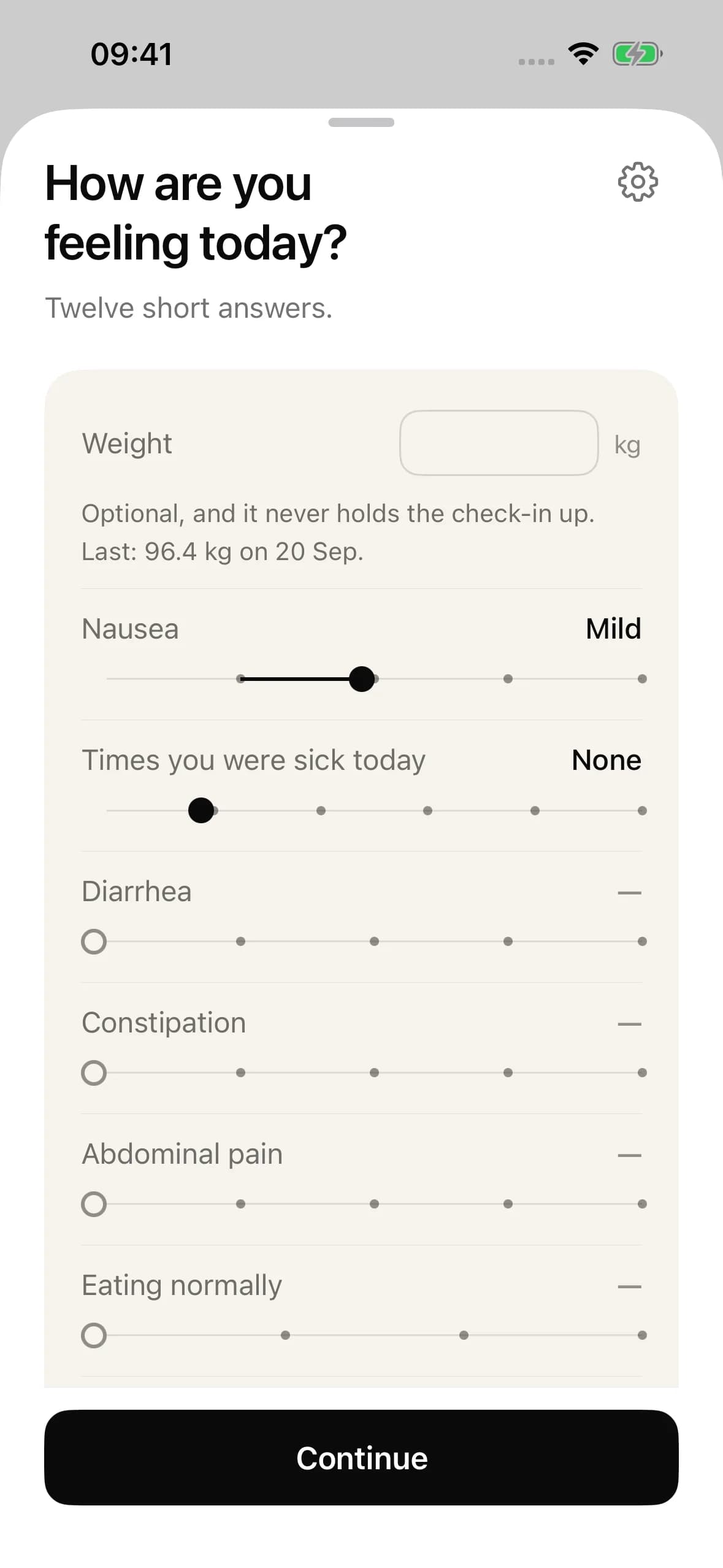
In Handle
Keep a daily note of how you feel
Handle's check-in asks about nausea every day, plus the symptoms you switch on, such as diarrhea, constipation or vomiting. It's the same short card whatever you answer, so it fits into a busy morning.
Handle records what you report and never diagnoses. It is not a monitoring or emergency service: if a symptom worries you, contact your care team, and if you feel very unwell, get medical help straight away.
- Works the same for the weekly injection and the daily pill
- Track up to six more symptoms, such as belching or headache, or add one in your own words, like skin sensitivity
- Missed a day? Add it later, up to 30 days back
Less talked-about Wegovy side effects
Figures are for the 2.4 mg injection unless stated, with placebo in brackets.
- Hair loss. 3.3% (1%): 4% of women and 0.9% of men. The label says hair loss was associated with weight reduction, and it was reported more often on 7.2 mg (5.8%).1 No label describes it as sudden or permanent.
- Tiredness and headache. Fatigue was reported by 11% (5%) and headache by 14% (10%).1
- Dizziness, low blood pressure and fainting. Dizziness: 8% (4%). Low-blood-pressure events: 1.3% (0.4%), and fainting: 0.8% (0.2%). The label says some were related to stomach side effects and fluid loss.1
- Burping. Belching (eructation) was reported by 7%, against under 1% on placebo.1 "Sulfur burps" isn't a label term, and the label says nothing about smell.
- Taste changes. A change in taste (dysgeusia) was reported by 1.7% (0.5%).1
- Skin sensitivity. Altered skin sensation (dysesthesia), such as burning or skin pain: 2% (1%) on 2.4 mg, 22% on 7.2 mg, and 5% on the pill against none on placebo.1
- A faster heart rate. Heart rate rose by an average of 1 to 4 beats per minute. At some visit, 26% on Wegovy had a rise of 20 or more, against 16% on placebo.1
- Injection-site reactions. 1.4% (1%), and the label asks you to rotate injection sites with each dose.1 See Ozempic and Wegovy injection sites.
Serious Wegovy side effects
Uncommon, but listed as warnings on the label. Figures are from the adult trials: on Wegovy, then on placebo.
- Pancreatitis. Acute pancreatitis, including fatal cases: persistent or severe stomach pain, sometimes spreading to the back, with or without vomiting. Confirmed cases were uncommon: 0.2 per 100 patient-years on Wegovy, against under 0.1 on placebo.1
- Gallbladder disease. Gallstones in 1.6% (0.7%) on the injection and 2.5% (1%) on the pill, and gallbladder inflammation in 0.6% (0.2%). The label says the difference held even after accounting for how much weight people lost.1
- Kidney injury from dehydration. 0.4 cases per 100 patient-years on Wegovy, against 0.2 on placebo. Most reported cases followed nausea, vomiting or diarrhea that led to dehydration.1
- Low blood sugar. In people with type 2 diabetes (STEP 2), 6.2% had a reading below 54 mg/dL, against 2.5% on placebo. The risk is higher with insulin or a sulfonylurea, and your prescriber may adjust those medicines.1
- Serious allergic reactions. Anaphylaxis and angioedema have been reported. A previous serious reaction to semaglutide or any ingredient means Wegovy isn't for you.1
- Severe stomach and bowel problems. Reported by 4.1% (0.9%) on the injection and 2% (none) on the pill, and bowel blockage and severe constipation have been reported since approval. Not recommended with severe gastroparesis.1
- Eye complications in type 2 diabetes. Diabetic retinopathy was reported by 4% on Wegovy against 2.7% on placebo in STEP 2, a trial in adults with type 2 diabetes.1
- Aspiration during anesthesia. Rare reports of stomach contents entering the lungs during general anesthesia or deep sedation. Tell your healthcare providers you take Wegovy before any planned surgery or procedure.1 Guidance on what happens next differs between countries; in the UK, the regulator advises patients not to stop treatment without first discussing it with their doctor.8
- NAION. EU and UK regulators list this optic nerve condition, which can cause sudden loss of vision, as a very rare side effect of semaglutide, affecting up to 1 in 10,000 people. It isn't in the US label.6,7
- Thyroid C-cell tumors (boxed warning). Seen in rodents; it's unknown whether semaglutide causes them in humans. Tell your care team about a lump in your neck, trouble swallowing, shortness of breath or hoarseness that won't go away.1
Mood: a warning removed in 2026
Until February 2026, Wegovy's label included a warning about suicidal thoughts and behavior.1 The FDA asked for it to be removed after an analysis of 91 placebo-controlled trials with 107,910 patients found no increased risk of suicidal thoughts or behavior, or of related problems such as anxiety or depression.10
The FDA still asks people to tell their health care professional about new or worsening depression, suicidal thoughts, or unusual changes in mood or behavior.10
Long-term Wegovy side effects, and stopping
The longest data in the label come from SELECT, which followed adults with cardiovascular disease, on Wegovy or placebo, for a median of 41.8 months: 16% stopped the study medicine because of an adverse event, against 8% on placebo.1 In that trial, more hip and pelvis fractures were reported on Wegovy in women (1% against 0.2%) and in people aged 75 and over (2.4% against 0.6%), and kidney stones in 1.2% against 0.8%.1
After stopping, weight tended to come back. In STEP 4, people switched from Wegovy to placebo after 20 weeks regained 6.9% of their body weight over the next 48 weeks, while those who continued lost another 7.9%.1 In the STEP 1 extension, people regained about two-thirds of the weight they had lost within a year of stopping; the trial's lifestyle program ended at the same time.5
Regain after stopping was the average experience in these trials, so it isn't a personal failure. It's a signal worth discussing with your prescriber, who can help you plan any change.
Who should not take Wegovy
- Anyone with a personal or family history of medullary thyroid carcinoma (MTC), or with multiple endocrine neoplasia syndrome type 2 (MEN 2). This is the boxed warning.1
- Anyone who has had a serious allergic reaction to semaglutide or any ingredient in the injection or tablet.1
- People already taking another semaglutide medicine or any other GLP-1 medicine: the label says combining them isn't recommended.1
- People with severe gastroparesis, for whom it isn't recommended.1
- Children and teenagers: the injection is approved for weight management from age 12, but not at the 7.2 mg dose, and the pill isn't approved for anyone under 18.1
- If you're planning a pregnancy, talk to your prescriber early: the label advises stopping Wegovy at least 2 months beforehand. Breastfeeding isn't recommended while taking the pill.1 Our Wegovy half-life guide explains how long semaglutide stays in the body.
- Never share a Wegovy FlexTouch pen with anyone else.1
Tracking Wegovy side effects for your prescriber
Side effects are easiest to talk about when you can show them. A short daily record makes the pattern visible: which weeks, how often, how bad, and what else was going on.
Handle keeps your Wegovy doses (with injection sites, if you use the pen), your daily check-in, weight and food on one timeline. It shows them side by side and doesn't claim that one explains another. See our GLP-1 side effect tracker guide, set up your plan with the Wegovy tracker, or read about GLP-1 side effects across the class.
Handle PremiumPremium
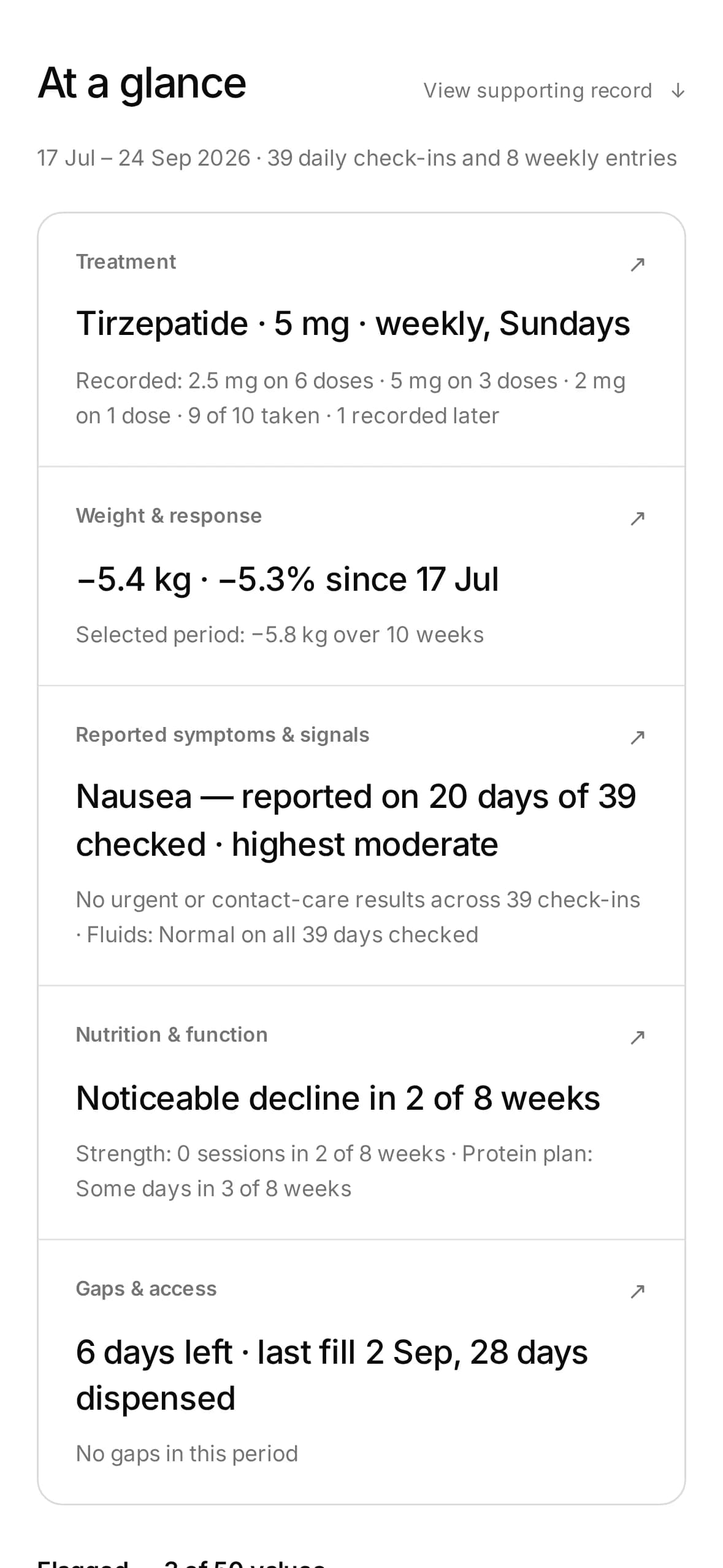
Hand your prescriber the whole picture
A consultation report gathers your Wegovy record, including any switch between the injection and the pill, with symptom summaries, weight history, nutrition and activity, and an optional note about what you want to discuss.
- Share a secure link, and revoke it any time
- Your private daily notes are never included
- Your clinician needs no account to read it
Premium is an optional subscription in the iPhone app.
Questions to ask your prescriber about Wegovy
Useful at the start and after any change. If you're weighing options together, Zepbound vs Wegovy, Mounjaro vs Wegovy, Ozempic vs Wegovy and Foundayo vs Wegovy set out the facts side by side.
- Which side effects should I call you about, and which can I manage at home?
- What should I do if I can't keep fluids down?
- Would the injection or the pill fit better with my routine and my other medicines?
- Do any of my other medicines, such as insulin or a sulfonylurea, need a closer look?
- I have a procedure coming up. Who should I tell, and what applies to me?
Questions people ask
What are the most common side effects of Wegovy?+
Nausea, diarrhea, vomiting, constipation and stomach pain. In the 2.4 mg weight-management trials, 44% reported nausea, 30% diarrhea and 24% each vomiting and constipation, against 16%, 16%, 6% and 11% on placebo.1 Headache, tiredness, indigestion, dizziness, bloating and belching were also more common than on placebo.
When do Wegovy side effects start?+
The label doesn't give a day-by-day timeline. It says stomach and bowel reactions were most frequently reported during dose escalation, the weeks when the dose is being stepped up.1 In STEP 1, nausea and diarrhea were typically mild to moderate and subsided with time.4 Recording how you feel from the first dose makes any pattern easier to show your prescriber.
What are the side effects of the Wegovy pill?+
Much like the injection's. The label says the pill's common side effects were similar in type and frequency to the injection's.1 In its trial, OASIS 4, the results posted on ClinicalTrials.gov show nausea in 46.6% on the pill against 18.6% on placebo, and vomiting in 30.9% against 5.9%.2 The label adds pill-specific figures for severe stomach side effects, gallstones and altered skin sensation.1
Does Wegovy make you tired?+
It can. In the 2.4 mg trials, fatigue was reported by 11% on Wegovy against 5% on placebo, and by 11% on the 7.2 mg dose.1 In the pill trial's results on ClinicalTrials.gov, it was 7.4% against 1.0%.2 Tell your care team if tiredness is new, severe or getting worse.
Does Wegovy cause hair loss?+
Hair loss is listed: 3.3% on 2.4 mg against 1% on placebo, more often in women (4%) than men (0.9%), and 5.8% on 7.2 mg. The label says it was associated with weight reduction.1 It also says the pill's common side effects were similar to the injection's. No label describes hair loss as sudden or permanent.
Does Wegovy cause headaches?+
Headache was reported by 14% on Wegovy 2.4 mg against 10% on placebo, and by 9% on 7.2 mg against 7%.1 In the pill trial's results on ClinicalTrials.gov, it was 11.8% against 8.8%.2 Tell your care team if headaches are severe, new for you or keep coming back.
Does Wegovy cause constipation or diarrhea?+
Both are among the most common side effects: diarrhea was reported by 30% against 16% on placebo, and constipation by 24% against 11%, in the 2.4 mg trials.1 Drinking fluids helps reduce the chance of dehydration, and fluids and fiber-containing foods can help with constipation.1,12 Call your care team if either is severe or doesn't settle; severe constipation and bowel blockage have been reported since approval.1
Can Wegovy cause blindness?+
Two different eye issues are discussed. In a trial in people with type 2 diabetes, diabetic retinopathy was reported by 4% on Wegovy against 2.7% on placebo.1 Separately, EU and UK regulators list NAION, an optic nerve condition that can cause sudden loss of vision, as a very rare side effect of semaglutide; the US label doesn't.6,7 Sudden vision loss needs urgent help.
What side effects do teenagers get on Wegovy?+
In STEP TEENS, a 68-week trial in 12 to 17-year-olds, nausea was reported by 42% on Wegovy against 18% on placebo, vomiting by 36% against 10%, and gallstones by 3.8% against none.1 Hair loss, belching and rash were also more common than on placebo.1 The pill isn't approved for anyone under 18.
Sources
- Novo Nordisk, via DailyMed (U.S. National Library of Medicine). Wegovy (semaglutide) injection and Wegovy (semaglutide) tablets — Prescribing Information, effective June 18, 2026.
- ClinicalTrials.gov (U.S. National Library of Medicine), NCT05564117. Efficacy and Safety of Oral Semaglutide 25 mg Once Daily in Adults With Overweight or Obesity (OASIS 4): study results.
- Wharton S et al., New England Journal of Medicine, via PubMed. Oral Semaglutide at a Dose of 25 mg in Adults with Overweight or Obesity (OASIS 4), 2025.
- Wilding JPH et al., New England Journal of Medicine, via PubMed. Once-Weekly Semaglutide in Adults with Overweight or Obesity (STEP 1), 2021.
- Wilding JPH et al., Diabetes, Obesity and Metabolism, via PubMed. Weight regain and cardiometabolic effects after withdrawal of semaglutide: The STEP 1 trial extension, 2022.
- European Medicines Agency. PRAC concludes eye condition NAION is a very rare side effect of semaglutide medicines Ozempic, Rybelsus and Wegovy, June 6, 2025, revised June 13, 2025.
- Medicines and Healthcare products Regulatory Agency (UK), Drug Safety Update. Semaglutide (Wegovy, Ozempic and Rybelsus): risk of Non-arteritic Anterior Ischemic Optic Neuropathy (NAION), February 5, 2026.
- Medicines and Healthcare products Regulatory Agency (UK), Drug Safety Update. GLP-1 and dual GIP/GLP-1 receptor agonists: potential risk of pulmonary aspiration during general anaesthesia or deep sedation, January 28, 2025.
- Medicines and Healthcare products Regulatory Agency (UK). First GLP-1 tablet for weight loss approved in the UK, June 11, 2026.
- U.S. Food and Drug Administration, Drug Safety Communication. FDA Requests Removal of Suicidal Behavior and Ideation Warning from Glucagon-Like Peptide-1 Receptor Agonist (GLP-1 RA) Medications, January 13, 2026.
- NHS. Feeling sick (nausea), last reviewed November 17, 2023.
- NHS. Constipation, last reviewed October 26, 2023.
Written by the Handle team from the sources above, last checked on September 23, 2026. How we write: our editorial policy. Spotted something out of date? Tell us at [email protected].
Handle supports recording and conversations with your care team. It does not diagnose, and it never tells you to start, change, skip or stop a dose. This page is general information, not medical advice. Always follow your prescriber and your medicine's instructions for use.