
Zepbound vs Wegovy
Zepbound vs Wegovy, side by side
Comparing Zepbound vs Wegovy? Both are approved in the US to help adults lose weight and keep it off, and one trial, SURMOUNT-5, has compared their medicines directly at weight-management doses. Here's what that trial and the two labels show, how the pens, vials and the Wegovy pill differ, and what to ask your prescriber. We never recommend one over the other.
On this page
- Zepbound vs Wegovy at a glance
- Is Zepbound better than Wegovy?
- How each one works
- Zepbound vs Wegovy for weight loss: the SURMOUNT-5 trial
- What each label's own trials showed
- Zepbound vs Wegovy side effects
- Zepbound vs Ozempic
- Oral Wegovy vs Zepbound
- Doses and forms: facts, not instructions
- Cost and coverage
- Switching between Zepbound and Wegovy
- Questions to bring to your prescriber
- Questions people ask
- Sources
In short
- Zepbound is tirzepatide from Eli Lilly, which activates the GIP and GLP-1 receptors; Wegovy is semaglutide from Novo Nordisk, which activates the GLP-1 receptor only.1,2
- Both are approved in the US for long-term weight management in adults with obesity, or overweight with a weight-related condition; Zepbound is also approved for obstructive sleep apnea with obesity, and Wegovy for lowering heart risk in people with heart disease, for a liver disease called MASH and for children 12 and older.1,2
- In SURMOUNT-5, a 72-week head-to-head trial in 751 adults with obesity, or overweight with a weight-related condition, and without type 2 diabetes, average weight change was −20.2% on tirzepatide (10 or 15 mg) and −13.7% on semaglutide (1.7 or 2.4 mg), counting everyone randomized.3
- Wegovy also comes as a daily pill and, since March 2026, a 7.2 mg weekly dose; SURMOUNT-5 tested neither.2,6
- Digestive side effects are the most common with both, and which one suits you depends on your health, your other conditions and your coverage: a decision to make with your prescriber.1,2
Zepbound vs Wegovy at a glance
| Zepbound | Wegovy | |
|---|---|---|
| Made by | Eli Lilly and Company | Novo Nordisk |
| Medicine | Tirzepatide1 | Semaglutide2 |
| How it acts | Activates the GIP and GLP-1 receptors1 | Activates the GLP-1 receptor2 |
| Approved in the US for | Weight management in adults with obesity, or overweight with a weight-related condition; moderate to severe obstructive sleep apnea in adults with obesity1 | Weight management (adults, and children 12 and older with obesity); lowering heart risk in adults with heart disease and obesity or overweight; MASH liver disease with moderate to advanced scarring (accelerated approval)2 |
| How it's taken | Injection once a week, any time of day, with or without meals1 | Injection once a week on the same day, any time of day, with or without meals; or a tablet once a day2 |
| Strengths | 2.5, 5, 7.5, 10, 12.5 and 15 mg1 | Injection 0.25, 0.5, 1, 1.7, 2.4 and 7.2 mg; tablet 1.5, 4, 9 and 25 mg2 |
| Forms | Single-dose pen or vial, multi-dose vial, four-dose KwikPen1 | Single-dose pens (including 7.2 mg Wegovy HD), single-dose syringes, four-dose FlexTouch pen, tablets2 |
| Half-life | About 5 to 6 days1 | About 1 week2 |
| Storage | Fridge; a single-dose pen or vial can spend up to 21 days in total at up to 30 °C1 | Fridge for single-dose pens and syringes (up to 28 days at 8 to 30 °C if needed); FlexTouch pen up to 56 days after first use; tablets at room temperature2 |
| SURMOUNT-5, 72 weeks | −20.2% average weight change (10 or 15 mg)3 | −13.7% average weight change (1.7 or 2.4 mg)3 |
| Most common side effects | Nausea, diarrhea, vomiting, constipation, stomach pain, indigestion1 | Nausea, diarrhea, vomiting, constipation, stomach pain, headache2 |
| Boxed warning | Thyroid C-cell tumors seen in rodents1 | Thyroid C-cell tumors seen in rodents2 |
From the US labels effective August 28, 2026 (Zepbound) and June 18, 2026 (Wegovy injection and tablets), except the SURMOUNT-5 row, which is from the trial report: adults without type 2 diabetes, counting everyone randomized. None of this is a dose to take; your prescriber sets that.
Is Zepbound better than Wegovy?
It depends on what you need it for. Each has something the other doesn't.
Zepbound
tirzepatide
- More weight loss on average in SURMOUNT-5, the one head-to-head trial at weight-management doses: −20.2% on tirzepatide (10 or 15 mg) against −13.7% on semaglutide (1.7 or 2.4 mg) at 72 weeks, in adults without type 2 diabetes, counting everyone randomized.3
- Approved for moderate to severe obstructive sleep apnea in adults with obesity, the first drug treatment option for certain patients, in FDA's words.1,8
- Comes in vials as well as pens, including a four-dose multi-dose vial.1
Wegovy
semaglutide
- Approved to lower the risk of heart attack, stroke and cardiovascular death in adults with heart disease and obesity or overweight.2
- Approved for children 12 and older, and for MASH liver disease with moderate to advanced scarring.2
- Available as a daily pill as well as a weekly injection, and at a 7.2 mg dose approved in March 2026.2,6
How each one works
Both act on receptors for hormones made in the gut. Semaglutide activates the GLP-1 receptor; tirzepatide is a single molecule that activates two, GIP and GLP-1.1,2 Zepbound's label calls GLP-1 a natural regulator of appetite and calorie intake, and says nonclinical studies suggest GIP "may further contribute": laboratory evidence, not proof of an extra effect in people.1
Both labels say the weight lost is more fat than lean mass.1,2 Tirzepatide's half-life is about 5 to 6 days and semaglutide's about 1 week, which is why both are weekly injections.1,2
Zepbound vs Wegovy for weight loss: the SURMOUNT-5 trial
SURMOUNT-5 is the trial that compared the two medicines at weight-management doses. It randomly assigned 751 adults in the US and Puerto Rico who had obesity, or overweight with high blood pressure, abnormal blood fats, sleep apnea or heart disease, and who did not have type 2 diabetes. They took the highest dose they tolerated of tirzepatide (10 or 15 mg) or semaglutide (1.7 or 2.4 mg) once a week for 72 weeks, with diet and activity counseling in both groups.3,4
It was open-label, so everyone knew which medicine they took, and it was funded by Lilly, which makes Zepbound.3 89.3% on tirzepatide received at least one 15 mg dose, and 92.8% on semaglutide at least one 2.4 mg dose.4
SURMOUNT-5 results at 72 weeks
| Average result | Tirzepatide (Zepbound's medicine) | Semaglutide (Wegovy's medicine) |
|---|---|---|
| Change in body weight3 | −20.2% | −13.7% |
| Weight lost4 | 22.8 kg (50.3 lb) | 15.0 kg (33.1 lb) |
| Change in waist size3 | −18.4 cm | −13.0 cm |
| Lost at least 10%4 | 81.6% | 60.5% |
| Lost at least 15%4 | 64.6% | 40.1% |
| Lost at least 20%4 | 48.4% | 27.3% |
| Lost at least 25%4 | 31.6% | 16.1% |
| Stopped because of an adverse event4 | 6.1% | 8.0% |
Treatment-regimen estimand: everyone randomized is counted, whether or not they kept taking their medicine. The weight and waist differences were statistically significant (P<0.001).3 Lilly notes the trial was not designed to compare safety.4 ClinicalTrials.gov lists higher milestone percentages because it counts only people with week-72 data; the two sets shouldn't be mixed.5
In plain terms, people on tirzepatide lost about 20% of their body weight on average and people on semaglutide about 14%, and more people on tirzepatide reached every milestone: 31.6% lost at least a quarter of their weight, against 16.1% on semaglutide.3,4 These are averages, not promises.
What SURMOUNT-5 did not test: people with type 2 diabetes, the Wegovy pill, or Wegovy's 7.2 mg dose, which FDA approved in March 2026, after the trial.3,6
What each label's own trials showed
Each medicine was also tested against placebo in adults with obesity or overweight. These rows are separate trials with different people and lengths, so compare each result with its own placebo, not with other rows.
| Trial | Population | Length | Average weight change vs placebo |
|---|---|---|---|
| SURMOUNT-1 (Zepbound) | No diabetes | 72 weeks | −15.0% to −20.9% (5 to 15 mg) vs −3.1%1 |
| SURMOUNT-2 (Zepbound) | Type 2 diabetes | 72 weeks | −12.8% (10 mg), −14.7% (15 mg) vs −3.2%1 |
| STEP 1 (Wegovy 2.4 mg) | No type 2 diabetes | 68 weeks | −14.9% vs −2.4%2 |
| STEP 2 (Wegovy 2.4 mg) | Type 2 diabetes | 68 weeks | −9.6% vs −3.4%2 |
| STEP UP (Wegovy 7.2 mg) | Obesity, no type 2 diabetes | 72 weeks | −18.8% (7.2 mg), −15.5% (2.4 mg) vs −3.9%2 |
| OASIS 4 (Wegovy pill 25 mg) | No diabetes | 64 weeks | −13.6% vs −2.4%2 |
As printed in each US label, from analyses that count people who stopped treatment. Only SURMOUNT-5 compares the two medicines directly at weight-management doses.
Zepbound vs Wegovy side effects
Digestive side effects lead for both, and both labels say they were reported most often while the dose was being stepped up.1,2 In SURMOUNT-5, nausea (43.6% vs 44.4%), diarrhea (23.5% vs 23.4%) and constipation (27.0% vs 28.5%) were close; vomiting was less common on tirzepatide (15.0% vs 21.3%), and injection-site reactions more common (8.6% vs 0.3%).5
Each label also has its own table from placebo-controlled weight trials. They come from different trials and populations, and the labels say rates can't be directly compared between medicines.1,2
Zepbound label: 72-week weight trials
| Side effect | Placebo | 5 mg | 10 mg | 15 mg |
|---|---|---|---|---|
| Nausea | 8% | 25% | 29% | 28% |
| Diarrhea | 8% | 19% | 21% | 23% |
| Vomiting | 2% | 8% | 11% | 13% |
| Constipation | 5% | 17% | 14% | 11% |
| Stomach pain | 5% | 9% | 9% | 10% |
| Indigestion | 4% | 9% | 9% | 10% |
| Injection-site reactions | 2% | 6% | 8% | 8% |
| Fatigue | 3% | 5% | 6% | 7% |
| Hair loss | 1% | 5% | 4% | 5% |
| Belching | 1% | 4% | 5% | 5% |
SURMOUNT-1 and SURMOUNT-2 pooled (Zepbound prescribing information, Table 1). Stopped because of an adverse reaction: 4.8%, 6.3% and 6.7% on 5, 10 and 15 mg, against 3.4% on placebo.1
Wegovy label: 68-week weight trials
| Side effect | Placebo | Wegovy 2.4 mg |
|---|---|---|
| Nausea | 16% | 44% |
| Diarrhea | 16% | 30% |
| Vomiting | 6% | 24% |
| Constipation | 11% | 24% |
| Stomach pain | 10% | 20% |
| Headache | 10% | 14% |
| Fatigue | 5% | 11% |
| Indigestion | 3% | 9% |
| Belching | under 1% | 7% |
| Hair loss | 1% | 3% |
STEP 1, 2 and 3 pooled (Wegovy prescribing information, Table 3). Stopped because of an adverse reaction: 6.8%, against 3.2% on placebo.2
Label differences worth knowing
- Higher-dose Wegovy: in the 72-week trials of the 7.2 mg dose, 22% of people on 7.2 mg reported dysesthesia (altered skin sensation, such as burning or skin pain), against 6% on 2.4 mg and 0.3% on placebo.2
- Heart rate: Wegovy's label has a heart-rate warning (average rises of 1 to 4 beats per minute); Zepbound's reports an average rise of 1 to 3.1,2
- The contraceptive pill: Zepbound's label advises switching to a non-oral method, or adding a barrier method, for 4 weeks after starting and after each dose increase. Wegovy's label has no such instruction.1,2
- Shared warnings: pancreatitis, gallbladder problems, kidney problems from dehydration and severe stomach side effects; both ask you to tell your care team before surgery or sedation.1,2
- Hair loss: both labels say it was associated with weight reduction.1,2
More in Zepbound side effects and Wegovy side effects.
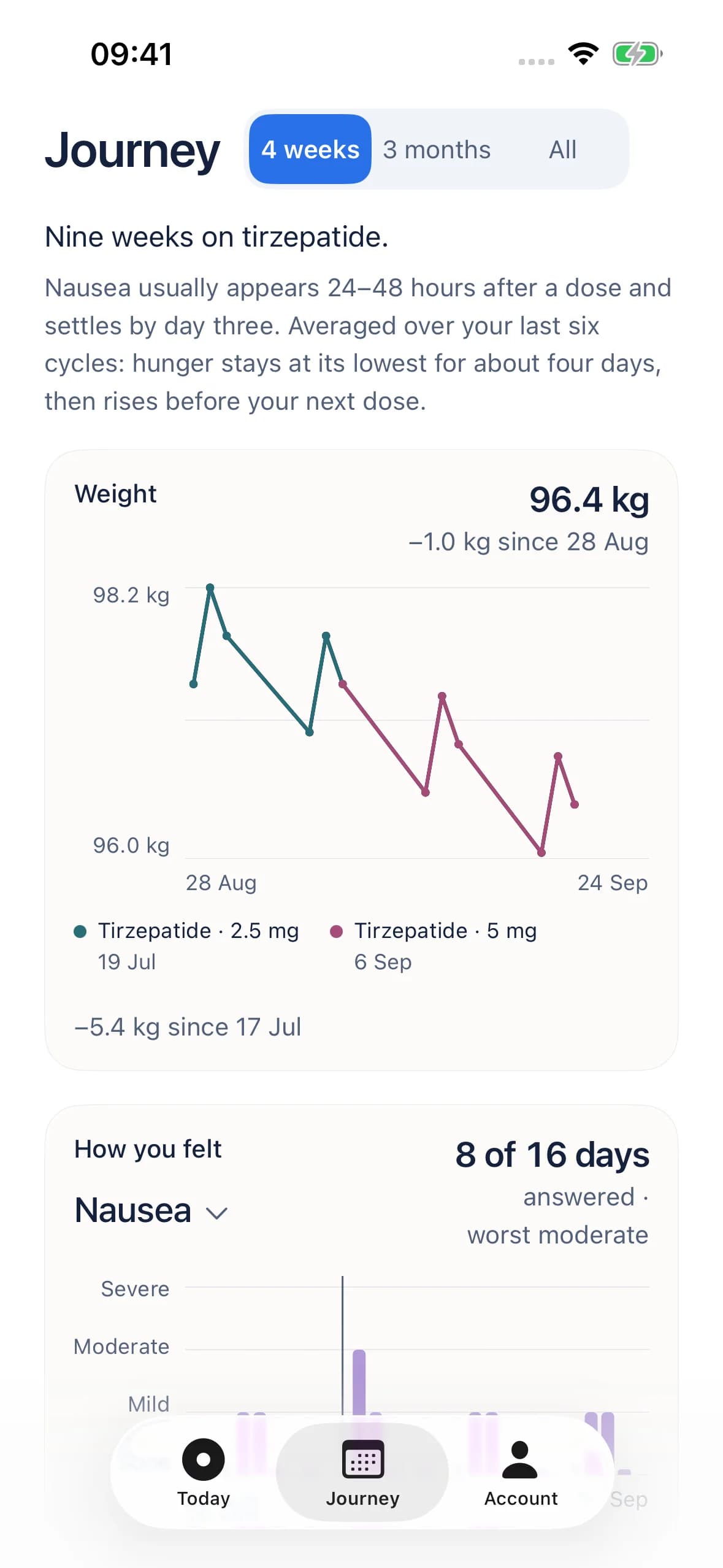
In Handle
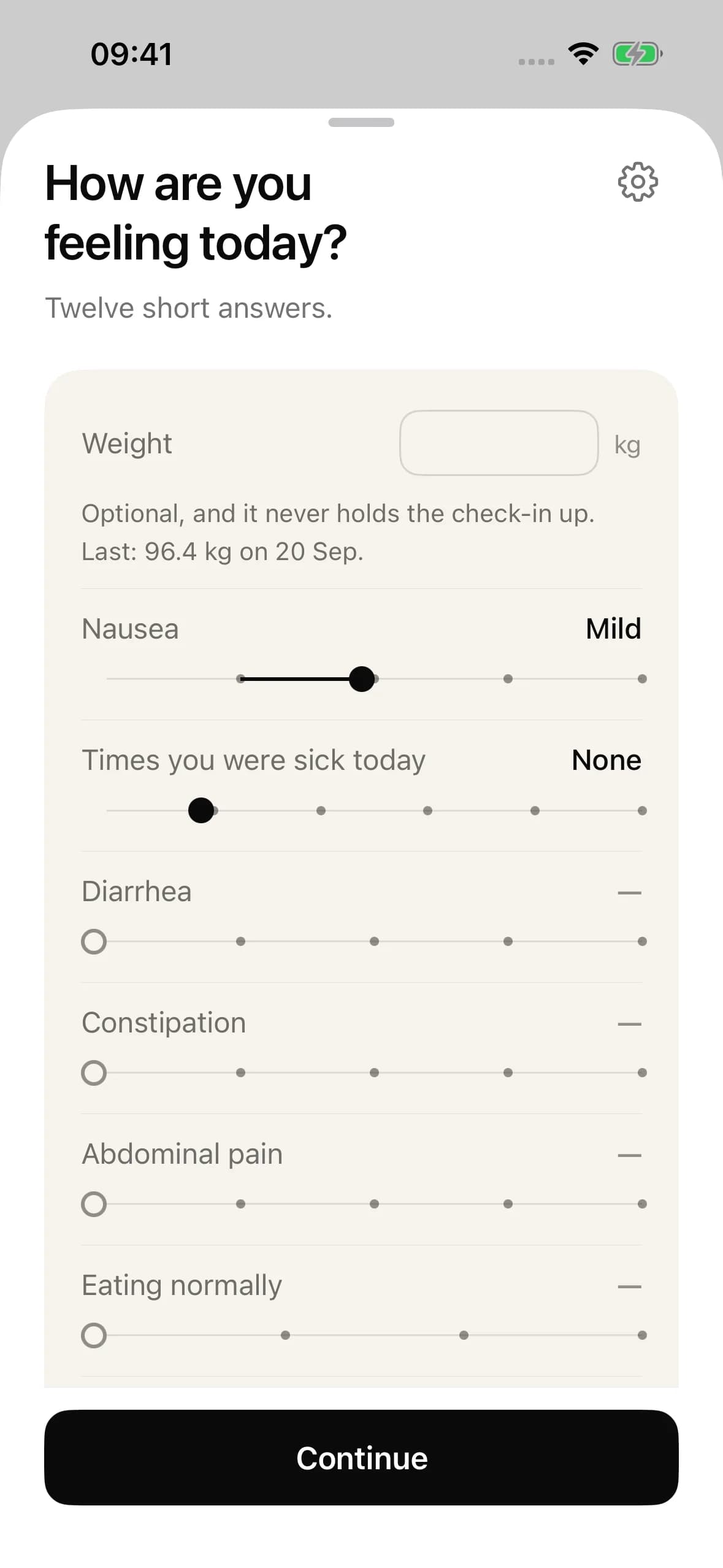
Note how the first weeks feel, in a few taps
Handle's daily check-in asks about nausea every day, plus the few symptoms you choose, such as vomiting, constipation or belching. It stays the same short card, whatever you answer.
Some answers, such as severe nausea, come with a clear next step, like contacting your care team. Handle never diagnoses, and it is not a monitoring or emergency service: if you feel very unwell, contact your clinician or emergency services directly.
- Nausea every day; other symptoms if you switch them on
- Up to six extra tracked symptoms, or one in your own words
- Missed a day? Add it later, up to 30 days back
Zepbound vs Ozempic
Ozempic is semaglutide too, but it is approved for type 2 diabetes rather than weight management, in strengths from 0.25 to 2 mg.9 Zepbound's diabetes counterpart is Mounjaro, the same tirzepatide.10 The two molecules were compared in type 2 diabetes in SURPASS-2: over 40 weeks, HbA1c fell by 2.0 to 2.3 points and weight by 7.6 to 11.2 kg on Mounjaro (5 to 15 mg), against 1.9 points and 5.7 kg on semaglutide 1 mg.10 See Mounjaro vs Ozempic for more.
Comparing all three, Zepbound vs Wegovy vs Ozempic, starts with the brand map. Every brand is in our guide to GLP-1 medications.
| Brand | Medicine | Approved in the US for | Taken as |
|---|---|---|---|
| Zepbound | Tirzepatide | Weight management; obstructive sleep apnea1 | Weekly injection |
| Wegovy | Semaglutide | Weight management; lowering heart risk; MASH2 | Weekly injection or daily pill |
| Ozempic | Semaglutide | Type 2 diabetes; lowering heart and kidney risks9 | Weekly injection |
| Mounjaro | Tirzepatide | Type 2 diabetes; lowering heart risk10 | Weekly injection |
Saxenda (liraglutide 3 mg), another Novo Nordisk weight-management injection, is being discontinued in the US, with last shipments due in late January 2027.11 In the UK there is no Zepbound brand: tirzepatide for weight is sold as Mounjaro, so UK readers may want Mounjaro vs Wegovy.
Oral Wegovy vs Zepbound
The Wegovy pill, oral semaglutide 25 mg, was approved in the US on December 22, 2025, for adults.7 Its label says to take it once a day on an empty stomach in the morning with up to 4 ounces of water, then wait at least 30 minutes before eating, drinking or taking other medicines by mouth.2 In its own 64-week trial, OASIS 4, adults without diabetes lost 13.6% of their weight on average, against 2.4% on placebo.2
SURMOUNT-5 compared the injections, so it says nothing directly about the pill, and the OASIS 4 figure can't be ranked against Zepbound's trials. The pill is for adults only and isn't approved for MASH.2 See Wegovy pill vs injection, or Foundayo vs Zepbound for another daily pill.
The Wegovy pill isn't in Handle's medicine list yet. Add it under "Something else" with its name, amount and daily schedule, and doses, check-ins, weight, food, Journey and the consultation report work the same way.
Doses and forms: facts, not instructions
Zepbound comes in six strengths, 2.5 to 15 mg, as single-dose pens or vials, or four-dose multi-dose vials and KwikPens.1 Wegovy injections come as single-dose pens from 0.25 to 7.2 mg, single-dose syringes up to 2.4 mg, and a four-dose 2.4 mg FlexTouch pen; the pill comes in 1.5, 4, 9 and 25 mg.2
Both labels start low and step up gradually, and your prescriber sets the steps. Milligrams don't translate between the two molecules, so there is no equivalent dose. Each product has its own missed-dose rule, and even Wegovy's injection and pill rules differ, so ask your prescriber or pharmacist. Handle records what happened and never tells you to catch up.
Cost and coverage
Prices and coverage change often and vary by plan, so we don't quote them; your insurer or pharmacy can tell you what applies. Because each medicine has several approved uses, coverage may depend on why it's prescribed: weight management, sleep apnea or heart risk, for example.1,2
Switching between Zepbound and Wegovy
Whether to switch, when, and at what dose is your prescriber's decision; there's no conversion between the two molecules. Both labels say they are not recommended together with another GLP-1 medicine.1,2
Worth recording around a switch: the date, amount and site of your last dose of one and your first dose of the other, how you feel in the first weeks, and your weekly weight trend. The Zepbound tracker and Wegovy tracker pages show how Handle records each.
In Handle
One record across a switch
When your prescriber changes your medicine, update your plan and carry on. Every earlier dose stays in the same history, and Journey draws your dose as a step line beneath your weight, so the week the medicine changed is easy to find.
Handle shows these side by side and leaves the interpretation to you and your prescriber. It never says one caused the other.
- Zepbound, Wegovy and other GLP-1 medicines by name
- Doses before and after a switch, in one history
- Weight as weekly averages, never a score
Questions to bring to your prescriber
Useful whichever medicine you're offered. A consultation report, part of Premium in the iPhone app, can bring your own record to the same conversation; see preparing for a GLP-1 doctor appointment.
- Which approved use applies to me: weight, sleep apnea, heart risk or liver disease?
- Would a weekly injection or a daily pill suit my routine and my other medicines better?
- What result would tell us this is working, and when will we review it?
- Which side effects should I call you about, and which can I manage at home?
- Does my coverage differ between the two, and would that change if we switched?
- I use the contraceptive pill, or I'm planning a pregnancy. What should I know?
Questions people ask
Is Zepbound better than Wegovy?+
On average weight loss, tirzepatide came out ahead in the one head-to-head trial at weight-management doses: in SURMOUNT-5, in adults without type 2 diabetes, weight changed by −20.2% on tirzepatide (10 or 15 mg) against −13.7% on semaglutide (1.7 or 2.4 mg) over 72 weeks, counting everyone randomized.3 But Wegovy has approvals Zepbound doesn't, including lowering heart risk in people with heart disease, MASH and use from age 12, and it comes as a pill.2 Which is better for you is a decision to make with your prescriber.
How much weight do people lose on Zepbound vs Wegovy?+
In SURMOUNT-5, adults without type 2 diabetes lost 22.8 kg (50.3 lb) on average on tirzepatide (10 or 15 mg) and 15.0 kg (33.1 lb) on semaglutide (1.7 or 2.4 mg) over 72 weeks, and 64.6% against 40.1% lost at least 15% of their weight, counting everyone randomized.4 Those are averages from one trial, not a prediction for any one person.
Which has fewer side effects, Zepbound or Wegovy?+
Neither clearly. In SURMOUNT-5 (adults without type 2 diabetes, 72 weeks), nausea was reported by 43.6% on tirzepatide and 44.4% on semaglutide; vomiting was less common on tirzepatide and injection-site reactions more common.5 6.1% and 8.0% stopped because of an adverse event, but the trial wasn't designed to compare safety.4 For both, stomach side effects are most common while the dose is stepped up.1,2
Is Zepbound the same as Mounjaro?+
Yes, it's the same medicine, tirzepatide, from Eli Lilly, sold under two names in the US: Mounjaro for type 2 diabetes and Zepbound for weight management and obstructive sleep apnea.1,10 In the UK, Mounjaro covers weight management too. Compare them in Mounjaro vs Zepbound.
What's the difference between Wegovy and Ozempic?+
Both are semaglutide from Novo Nordisk. Wegovy is approved for weight management, plus heart risk and MASH, with injections from 0.25 to 7.2 mg and a daily pill. Ozempic is approved for type 2 diabetes, plus heart and kidney risk, from 0.25 to 2 mg.2,9 See Ozempic vs Wegovy.
Is the Wegovy pill as effective as Zepbound?+
SURMOUNT-5, the head-to-head trial, compared tirzepatide with Wegovy injections, not the pill.3 In its own 64-week trial in adults without diabetes, the pill lowered weight by 13.6% on average, against 2.4% on placebo.2 Figures from separate trials can't be ranked against each other, so ask your prescriber how the options fit you.
Does Wegovy 7.2 mg compare with Zepbound?+
Not directly. The 7.2 mg dose (Wegovy HD) was approved in March 2026, after SURMOUNT-5, which used semaglutide up to 2.4 mg.3,6 In the STEP UP trial, adults with obesity and without type 2 diabetes lost 18.8% on 7.2 mg, 15.5% on 2.4 mg and 3.9% on placebo over 72 weeks; across the 7.2 mg trials, which also included people with type 2 diabetes, 22% on 7.2 mg reported dysesthesia.2
Can I switch from Wegovy to Zepbound?+
Your prescriber can switch you, and decides when and at what dose; there's no conversion between the two medicines. Record your last Wegovy dose, your first Zepbound dose, how you feel in the first weeks and your weight trend. Handle keeps both medicines in one history, so the change is easy to show.
Can Handle track Zepbound and Wegovy?+
Yes. Both are in Handle's medicine list, and the Wegovy pill can be added under "Something else" with its daily schedule. Log each dose and injection site, answer a short daily check-in, and keep weight, food and fluids alongside. If you switch, both medicines stay on one record. All of that is free.
Sources
- Eli Lilly and Company, via DailyMed (U.S. National Library of Medicine). Zepbound (tirzepatide) injection — Prescribing Information, effective August 28, 2026.
- Novo Nordisk, via DailyMed (U.S. National Library of Medicine). Wegovy (semaglutide) injection and tablets — Prescribing Information, effective June 18, 2026.
- Aronne LJ et al., New England Journal of Medicine 2025;393:26–36, via PubMed. Tirzepatide as Compared with Semaglutide for the Treatment of Obesity (SURMOUNT-5), May 11, 2025.
- Eli Lilly and Company (press release). Zepbound (tirzepatide) showed superior weight loss over Wegovy (semaglutide) in complete SURMOUNT-5 results published in The New England Journal of Medicine, May 11, 2025.
- ClinicalTrials.gov (U.S. National Library of Medicine). A Study of Tirzepatide (LY3298176) in Participants With Obesity or Overweight With Weight Related Comorbidities (SURMOUNT-5, NCT05822830): results.
- U.S. Food and Drug Administration. FDA Approves Fourth Product Under National Priority Voucher Program, Higher Dose Semaglutide, March 19, 2026.
- Novo Nordisk (press release). FDA approves Novo Nordisk's Wegovy pill, the first and only oral GLP-1 for weight loss in adults, December 22, 2025.
- U.S. Food and Drug Administration. FDA Approves First Medication for Obstructive Sleep Apnea, December 20, 2024.
- Novo Nordisk, via DailyMed (U.S. National Library of Medicine). Ozempic (semaglutide) injection — Prescribing Information, effective June 1, 2026.
- Eli Lilly and Company, via DailyMed (U.S. National Library of Medicine). Mounjaro (tirzepatide) injection — Prescribing Information, effective August 27, 2026.
- Novo Nordisk (NovoMedLink). Saxenda (liraglutide) Injection 3 mg Official Physician Site: discontinuation notice, accessed September 23, 2026.
Written by the Handle team from the sources above, last checked on September 23, 2026. How we write: our editorial policy. Spotted something out of date? Tell us at [email protected].
Handle supports recording and conversations with your care team. It does not diagnose, and it never tells you to start, change, skip or stop a dose. This page is general information, not medical advice. Always follow your prescriber and your medicine's instructions for use.