
Mounjaro side effects
Mounjaro side effects, by the numbers
Mounjaro side effects are mostly digestive, and they are most common while the dose is being stepped up. This guide sets out what the label and the trials actually report, how often each effect happened compared with placebo, what may help, when to call your care team, the red flags that need urgent help, and how to keep a record your prescriber can use.
On this page
- The most common Mounjaro side effects
- Tirzepatide side effects in the weight-management trials
- When Mounjaro side effects happen, and when they ease
- Common side effects, one by one: what helps and when to call
- Less talked-about Mounjaro side effects
- Serious side effects of Mounjaro
- Who should not take Mounjaro
- Mounjaro side effects in women: contraception, pregnancy and hair loss
- Long-term Mounjaro side effects, and stopping
- Mounjaro jab side effects in the UK
- Keeping a record your prescriber can use
- Questions to ask your prescriber about side effects
- Questions people ask
- Sources
In short
- The most common Mounjaro (tirzepatide) side effects are nausea, diarrhea, decreased appetite, vomiting, constipation, indigestion and stomach pain; in the type 2 diabetes trials behind the label, nausea affected 12–18% of people on Mounjaro against 4% on placebo.1
- In the 72-week weight-management trials of tirzepatide (sold as Zepbound in the US, and as Mounjaro for weight loss in the UK), stomach side effects were more frequent: nausea affected 25–29% against 8% on placebo.2,8
- Most nausea, vomiting and diarrhea was reported while the dose was being stepped up and decreased over time; in the diabetes trials, 3.0–6.6% of people stopped Mounjaro because of stomach side effects, against 0.4% on placebo.1
- Less common but serious: severe stomach pain that won't go away can signal pancreatitis, and the label also warns about gallbladder problems, dehydration leading to kidney problems, serious allergic reactions and, based on studies in rats, thyroid tumors.1
- Handle's free daily check-in keeps a record of how you feel that you can show your prescriber, and it never tells you what dose to take.
The most common Mounjaro side effects
These are the side effects on Mounjaro's label, from two placebo-controlled trials in adults with type 2 diabetes (SURPASS-1 and SURPASS-5), in which 718 people took Mounjaro for an average of 36.6 weeks.1 Each figure is the share of people who reported the effect at least once.
| Side effect | Placebo | 5 mg | 10 mg | 15 mg |
|---|---|---|---|---|
| Nausea | 4% | 12% | 15% | 18% |
| Diarrhea | 9% | 12% | 13% | 17% |
| Decreased appetite | 1% | 5% | 10% | 11% |
| Vomiting | 2% | 5% | 5% | 9% |
| Constipation | 1% | 6% | 6% | 7% |
| Indigestion (dyspepsia) | 3% | 8% | 8% | 5% |
| Stomach pain | 4% | 6% | 5% | 5% |
| Burping (eructation) | 0.4% | 3.0% | 2.5% | 3.3% |
| Gas (flatulence) | 0% | 1.3% | 2.5% | 2.9% |
| Reflux (GERD) | 0.4% | 1.7% | 2.5% | 1.7% |
Source: Mounjaro prescribing information, Table 1; the last three rows come from the text of the same section.1 Across all stomach side effects, 37.1–43.6% of people on Mounjaro reported at least one, against 20.4% on placebo.1 The dose columns are trial groups, not a suggestion of which dose suits you.
Tirzepatide side effects in the weight-management trials
If you take Mounjaro for weight loss, as people in the UK can, tirzepatide's weight-management trials are the closer match.8 In the US the same medicine is sold for weight management as Zepbound (see Mounjaro vs Zepbound), and its label pools SURMOUNT-1, in adults without diabetes, and SURMOUNT-2, in adults with type 2 diabetes: 2,519 adults treated for up to 72 weeks.2
Stomach side effects were more common here: 56% of people on each dose had at least one, against 30% on placebo.2 The two sets of trials differed in who took part and for how long, so read the tables separately, not as a head-to-head.
Weight-management trials (SURMOUNT-1 and SURMOUNT-2)
| Side effect | Placebo | 5 mg | 10 mg | 15 mg |
|---|---|---|---|---|
| Nausea | 8% | 25% | 29% | 28% |
| Diarrhea | 8% | 19% | 21% | 23% |
| Vomiting | 2% | 8% | 11% | 13% |
| Constipation | 5% | 17% | 14% | 11% |
| Stomach pain | 5% | 9% | 9% | 10% |
| Indigestion | 4% | 9% | 9% | 10% |
| Injection-site reactions | 2% | 6% | 8% | 8% |
| Tiredness (fatigue) | 3% | 5% | 6% | 7% |
| Burping | 1% | 4% | 5% | 5% |
| Hair loss | 1% | 5% | 4% | 5% |
| Dizziness | 2% | 4% | 5% | 4% |
Source: Zepbound prescribing information, Table 1 (reactions in at least 2% of people and more common than on placebo).2 The full list is on our Zepbound side effects page.
When Mounjaro side effects happen, and when they ease
The label gives no day-by-day timeline, and nobody can predict yours. It does describe a pattern.
- While the dose is stepped up
- After each changeWorth writing down
The weeks after a change are the ones most worth noting: how you felt, and what you managed to eat and drink.
- The months that follow
- If it doesn't settleTell your care team
The Medication Guide asks you to tell your healthcare provider about stomach problems that are severe or won't go away, and to tell them right away about nausea, vomiting or diarrhea that doesn't go away.1
Common side effects, one by one: what helps and when to call
General, non-drug measures only (the figures are in the tables above). The NHS says a pharmacist or doctor may be able to advise on reducing side effects that bother you or don't go away,12 and none of this replaces advice from your prescriber.
Nausea
Nausea, a queasy, unsettled stomach, was the most reported side effect in both sets of trials.1,2 What may help: drinking fluids, which the Medication Guide says helps reduce your chance of dehydration,1 and avoiding alcohol, which the NHS says can increase nausea and vomiting.12 Ask your care team whether changing what or how much you eat might help. Our guide to what to eat on Mounjaro sets out what Lilly and the NHS suggest for nausea. Call your care team if nausea stops you eating or drinking, or doesn't go away.
Diarrhea
What may help: keep drinking. The Medication Guide says fluids help reduce your chance of dehydration, which can lead to kidney problems.1 Call your care team right away if diarrhea doesn't go away.
Constipation
What may help: ask your care team whether more fiber and fluids would suit you. Call your care team if constipation is severe or won't go away; severe constipation, including fecal impaction, and bowel blockage have been reported since the medicine was approved.1
Vomiting
What may help: avoiding alcohol, which the NHS says can increase vomiting,12 and asking your care team how best to keep fluids up. Call your care team right away if vomiting doesn't stop or you can't keep fluids down.
Indigestion, reflux and burping
What may help: ask your care team whether changes to your meals might help. Call your care team if symptoms are severe or won't go away.
Decreased appetite
Partly how the medicine works: the Zepbound label describes GLP-1 as a natural regulator of appetite and calorie intake.2 It still matters if eating less means too little food or fluid, and a simple food and drink record makes that easy to show your care team.
Stomach pain
Mild discomfort is one thing; severe pain that won't go away is a red flag, covered below.
In Handle
Note symptoms as they happen, not weeks later
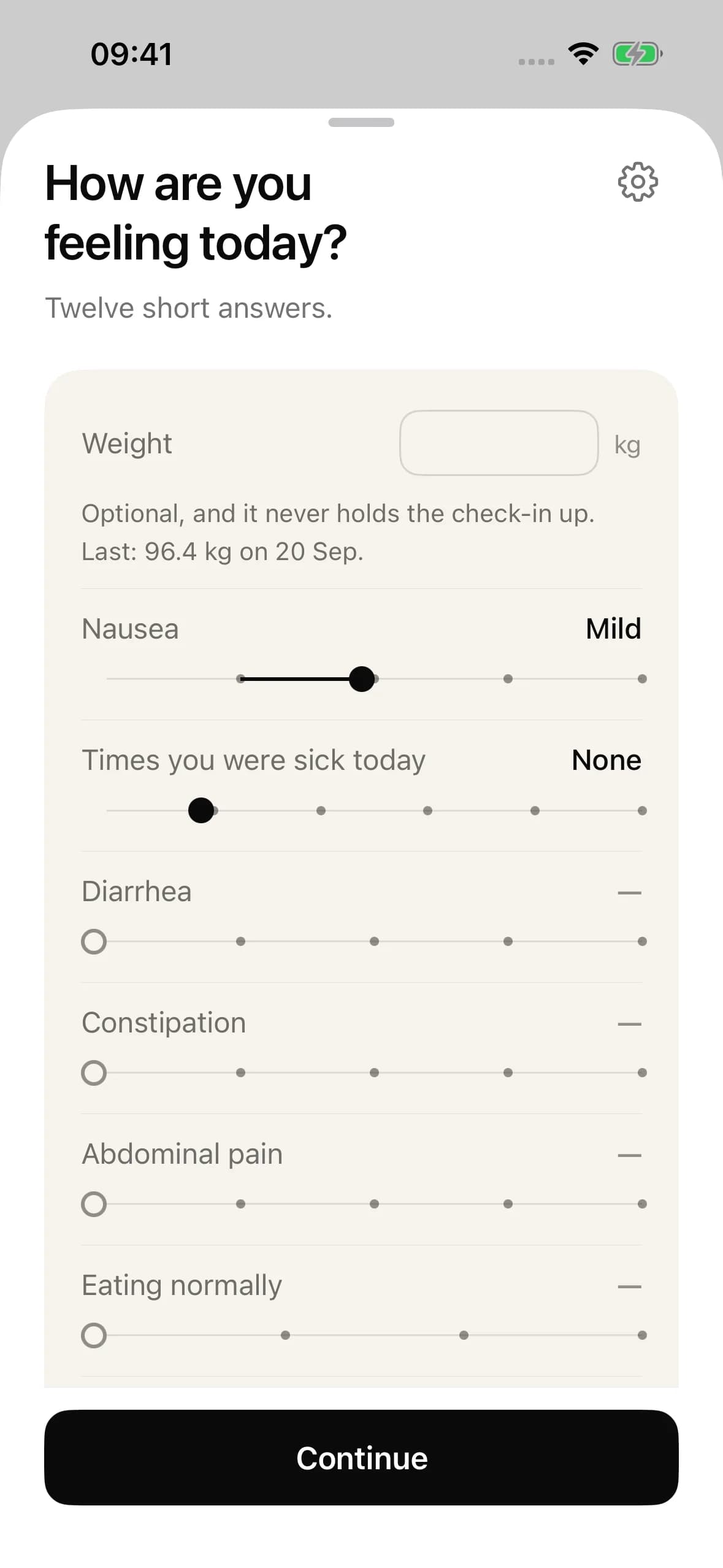
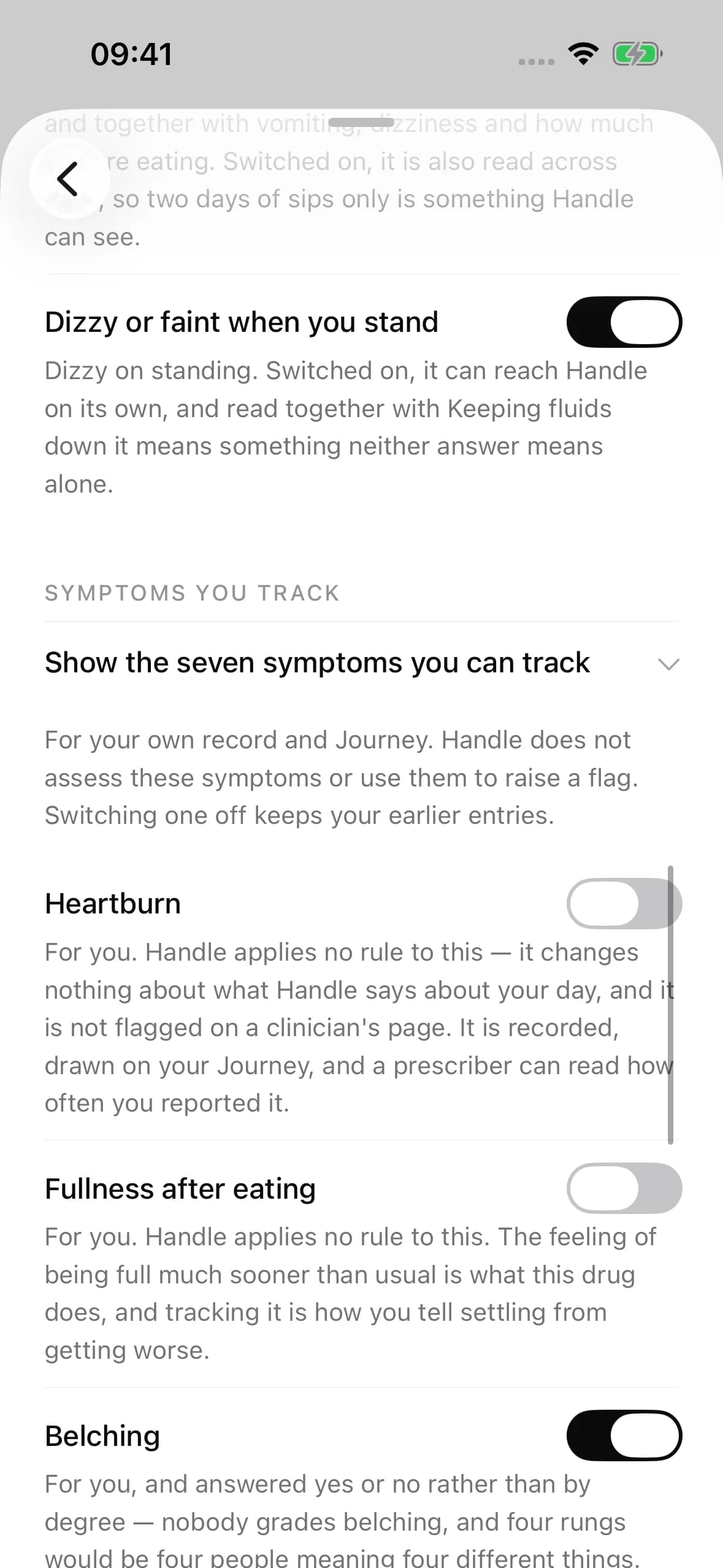
Handle's daily check-in asks about nausea every day, plus the symptoms you switch on, such as diarrhea, constipation, vomiting or stomach pain. You can add up to six tracked symptoms, like belching, heartburn, headache or fatigue, or one in your own words. It stays the same short card whatever you answer.
Handle never diagnoses, and it is not a monitoring or emergency service. If a symptom worries you, contact your care team directly.
- Nausea every day, plus the symptoms you choose
- Turn questions on or off at any time
- Missed a day? Add it later, up to 30 days back
Less talked-about Mounjaro side effects
These come up often in searches. Here is what the labels and trials say.
- Hair loss. In the weight-management trials, hair loss was reported by 4–5% of people on tirzepatide against 1% on placebo: 7.1% of women and 0.5% of men.2 The Zepbound label links it with weight reduction, and no one on tirzepatide in those trials stopped because of it. Mounjaro's own label lists it among reports since approval.1
- Burping and "sulfur burps". The label records burping (eructation): 2.5–3.3% against 0.4% in the diabetes trials, and 4–5% against 1% in the weight-management trials.1,2 It says nothing about smell; "sulfur burps" is not a label term.
- Tiredness. Fatigue was reported by 5–7% of people on tirzepatide against 3% on placebo in the weight-management trials,2 and by 10% of people on Mounjaro in a heart-outcomes trial with a median follow-up of about four years.1
- Headache. Headache isn't in either tirzepatide label's table of common side effects.1,2 The Medication Guide does list it among possible signs of low blood sugar, a risk mainly when Mounjaro is used with insulin or a sulfonylurea.1
- Injection-site reactions. Reactions where you inject were reported by 3.2% of people on Mounjaro against 0.4% on placebo in the diabetes trials, and by 6–8% against 2% in the weight-management trials.1,2 The label asks you to rotate injection sites with each dose; our guide to Mounjaro injection sites explains how.
- Dizziness and low blood pressure. In the weight-management trials, dizziness affected 4–5% of people on tirzepatide against 2% on placebo, and low blood pressure 1.6% against 0.1%.2
- Eyes. Mounjaro's label warns about complications in people with a history of diabetic retinopathy and asks you to report changes in vision.1 NAION, an eye condition that Europe's regulator lists as a very rare side effect of semaglutide, is not in the US tirzepatide labels,1,2 and the European review did not cover tirzepatide.7
- "Ozempic face". Not a label term: it isn't in Mounjaro's label. It's an informal name for loss of fullness in the face with rapid weight loss; Harvard Health notes it can follow any GLP-1 medicine or any other cause of rapid weight loss.5
- Muscle and lean mass. The Zepbound label says tirzepatide lowers weight with greater fat loss than lean-mass loss.2 In a SURMOUNT-1 body-scan substudy of 160 people, about 75% of the weight lost was fat and 25% lean mass, in both the tirzepatide and placebo groups.4 Lean mass, as a scan measures it, is not the same thing as muscle.
Serious side effects of Mounjaro
Serious side effects are less common, and most have warning signs worth learning. These are the label's main warnings.
| Warning | What the label reports |
|---|---|
| Pancreatitis | 0.23 people with confirmed pancreatitis per 100 years of use on Mounjaro, against 0.11 in comparison groups.1 The warning signs are in the red flags below. |
| Gallbladder problems | 0.6% against 0% in the diabetes trials; gallbladder inflammation in 0.7% against 0.2% in the weight-management trials.1,2 |
| Kidney problems from dehydration | Acute kidney injury in 0.5% against 0.2% in the weight-management trials.2 Nausea, vomiting and diarrhea can cause the fluid loss behind it.1 |
| Severe stomach problems | 0.4–1.3% against 0.9% in the diabetes trials, and 1.7–3.1% against 1% in the weight-management trials.1,2 |
| Low blood sugar | Mainly with insulin or a sulfonylurea: 14–19% had a reading below 54 mg/dL when Mounjaro was added to basal insulin, against 13% on placebo. Signs include dizziness, sweating, confusion, shakiness and a fast heartbeat.1 |
| Serious allergic reactions | Anaphylaxis and angioedema have been reported since approval.1 |
| Food in the lungs under anesthesia | Rare reports after approval in people taking GLP-1 medicines. Tell every healthcare provider you take Mounjaro before surgery or sedation.1 |
Pancreatitis figures count people whose pancreatitis was confirmed on expert review across Mounjaro's clinical studies.1
Who should not take Mounjaro
Mounjaro has a boxed warning: in rats, tirzepatide caused thyroid C-cell tumors, and it is not known whether it causes these tumors, including medullary thyroid carcinoma (MTC), in people.1 The label says not to use Mounjaro if you or anyone in your family has had MTC, if you have multiple endocrine neoplasia syndrome type 2 (MEN 2), or if you've had a serious allergic reaction to tirzepatide or any of its ingredients.1
Tell your healthcare provider about a lump or swelling in your neck, hoarseness, trouble swallowing or shortness of breath, which the Medication Guide lists as possible symptoms of thyroid cancer.1 The label also says Mounjaro is not recommended for people with severe gastroparesis (very slow stomach emptying), and asks you to mention pancreas problems, diabetic retinopathy and planned surgery before you start.1
Side effects in children 10 and older
In the US, Mounjaro is approved for type 2 diabetes in children aged 10 and older.1 In the children's trial, vomiting (16% and 12% on the two doses, against 3% on placebo), stomach pain (22% and 15%, against 9%) and low blood sugar were more common than in adults.1 The label says the KwikPen isn't recommended for children to use on themselves.1
Mounjaro side effects in women: contraception, pregnancy and hair loss
The only side effect the labels break down by sex is hair loss: 7.1% of women on tirzepatide against 0.5% of men in the weight-management trials, and 1.3% and 0% on placebo.2
Mounjaro can make birth control pills taken by mouth work less well. The label advises switching to a non-oral method, or adding a barrier method, for 4 weeks after starting and for 4 weeks after each dose increase.1 The UK's MHRA gives the same advice for Mounjaro, and says GLP-1 medicines should not be taken during pregnancy, while trying to get pregnant or while breastfeeding.11
If you're planning a pregnancy, plan this with your prescriber: the same MHRA guidance lists a gap of at least one month between stopping tirzepatide and trying to get pregnant.11 Our Mounjaro half-life guide sets out what the labels and the MHRA say about planning a pregnancy.
Long-term Mounjaro side effects, and stopping
The longest look comes from SURPASS-CVOT, a heart-outcomes trial that followed 13,299 adults with type 2 diabetes and established cardiovascular disease for a median of 210 weeks, about four years, with 6,647 of them on Mounjaro.1 The label says side effects were similar to the shorter trials, with exceptions it lists: decreased appetite (17%), constipation (13%), vomiting (12%), stomach pain (10%), fatigue (10%) and unusual skin sensations (0.7%).1
Stopping is a decision to make with your prescriber. In SURMOUNT-4, adults who had taken tirzepatide for 36 weeks were either kept on it or switched to placebo: over the next year, weight rose by an average of 14.0% on placebo, while those who continued lost a further 5.5%.2 Regain after stopping is a signal worth discussing, not a personal failure.
Mounjaro jab side effects in the UK
In the UK, Mounjaro is the brand for both type 2 diabetes and weight management; the MHRA authorised the weight-management use in November 2023.8 It is the same medicine, so if you use the jab for weight loss, the weight-management trial figures above are the closest guide.
On the NHS in England, NICE recommends tirzepatide for adults with a BMI of at least 35 (usually 2.5 lower for people from some ethnic backgrounds) and at least one weight-related condition. NHS England is rolling it out in phases, starting with people who have a BMI of 40 or more and at least four of five listed conditions, with more groups from around June 2026 and March 2027.9
In January 2026 the MHRA updated its warnings about a small risk of severe acute pancreatitis with all GLP-1 and dual GIP/GLP-1 medicines, including Mounjaro.10 If you think you've had a side effect, you can report it to the MHRA's Yellow Card scheme.10 Tracking a weekly jab? See our weight-loss injection tracker guide, or compare Mounjaro vs Wegovy.
Keeping a record your prescriber can use
A record beats memory at an appointment: the dose you took and when, how you felt each day, what you ate and drank, and anything that changed, such as a new strength or a new medicine. Handle keeps it for free, whichever tirzepatide brand you use; see the Mounjaro tracker and tirzepatide tracker guides, or the GLP-1 side effect tracker checklist.
Handle PremiumPremium
Show your prescriber the weeks, not a guess
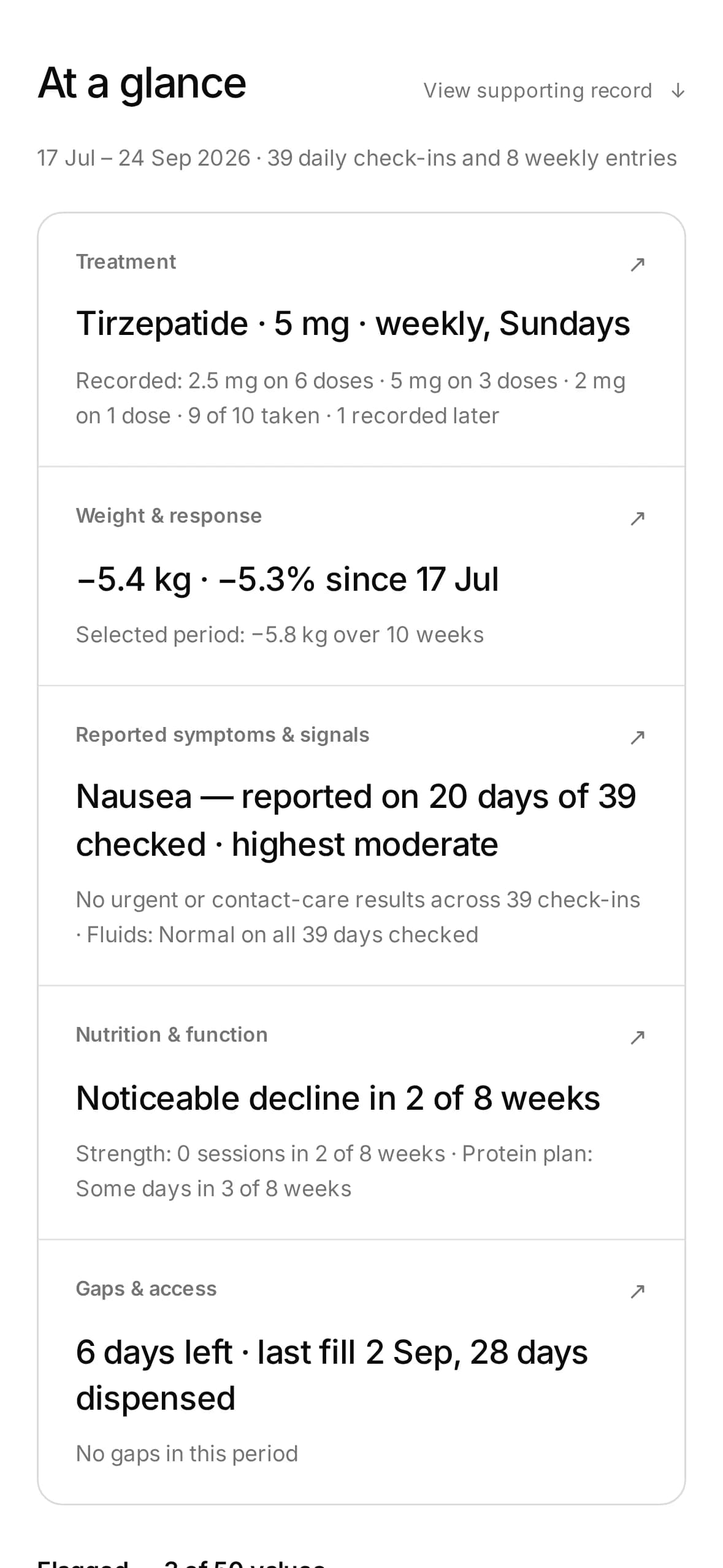
The consultation report, a Premium feature, brings together your Mounjaro record including any dose changes, symptom summaries, weight history, nutrition and activity, and an optional note about what you want to discuss. It helps your clinician see the pattern quickly. More on preparing for a GLP-1 doctor appointment.
- Shared as a secure link you can revoke at any time
- Your private daily notes are never included
- Your clinician needs no account to read it
Premium is an optional subscription in the iPhone app.
Questions to ask your prescriber about side effects
Side effects are easier to handle with a plan agreed in advance. These are good questions to bring.
- Which side effects should I call you about, and which can I manage at home?
- What should I do if I can't keep fluids down?
- Do my other medicines, such as insulin, a sulfonylurea or the contraceptive pill, need any changes while I'm on Mounjaro?
- What should I do if I miss a dose? Mounjaro's instructions have their own rule, so it's worth asking rather than guessing.
- I have a procedure coming up. Who needs to know that I take Mounjaro?
For how tirzepatide's side effects compare with semaglutide's, see semaglutide vs tirzepatide and Mounjaro vs Ozempic, or our overview of GLP-1 side effects.
Questions people ask
What are the most common side effects of Mounjaro?+
Nausea, diarrhea, decreased appetite, vomiting, constipation, indigestion and stomach pain. In the type 2 diabetes trials behind the label, nausea affected 12–18% of people on Mounjaro against 4% on placebo.1 In the weight-management trials of tirzepatide, stomach side effects were more frequent, with nausea at 25–29% against 8%.2
How long do Mounjaro side effects last?+
There is no fixed timeline. The label says most nausea, vomiting and diarrhea was reported while the dose was being stepped up, and decreased over time.1 If a side effect is severe or doesn't go away, tell your healthcare provider; for nausea, vomiting or diarrhea that won't settle, the Medication Guide says to do so right away.1
Does Mounjaro cause hair loss?+
It can. In tirzepatide's weight-management trials, hair loss was reported by 4–5% of people against 1% on placebo (7.1% of women and 0.5% of men), and the Zepbound label links it with weight reduction.2 No one on tirzepatide in those trials stopped because of it. Mounjaro's label also lists hair loss among reports received since approval.1
Does Mounjaro make you tired?+
Some people report it. Fatigue affected 5–7% of people on tirzepatide against 3% on placebo in the weight-management trials,2 and 10% of people on Mounjaro in a heart-outcomes trial that lasted about four years.1 If you also use insulin or a sulfonylurea, weakness or drowsiness can be signs of low blood sugar, so mention it to your care team.1
Is burping a side effect of Mounjaro?+
Yes. Burping (eructation) was reported by 2.5–3.3% of people on Mounjaro against 0.4% on placebo in the diabetes trials, and by 4–5% against 1% in the weight-management trials.1,2 The labels say nothing about smell: "sulfur burps" is not a label term. If it bothers you, ask your care team what may help.
Does Mounjaro cause cancer?+
In rats, tirzepatide caused thyroid C-cell tumors, which is why Mounjaro has a boxed warning; it is not known whether it causes these tumors, including medullary thyroid carcinoma, in people.1 The label says not to use it with a personal or family history of MTC or with MEN 2, and to report a neck lump, hoarseness, trouble swallowing or shortness of breath.1
Can Mounjaro cause depression?+
Regulators have not found a link. In January 2026 the FDA asked for the suicidal-thoughts warning to be removed from weight-management GLP-1 labels after 91 trials with 107,910 people showed no increased risk of suicidal thoughts or depression; Mounjaro's diabetes label doesn't carry that warning.6 The UK's MHRA reached a similar conclusion.11 Still tell your care team about low mood; in the US you can call or text 988.6
What happens when you stop taking Mounjaro?+
In the trial that tested it, weight went back up on average. In SURMOUNT-4, adults switched from tirzepatide to placebo after 36 weeks saw their weight rise by an average of 14.0% over the next year, while those who continued lost a further 5.5%.2 Stopping is a decision to make with your prescriber, and regain is a signal to discuss, not a failure.
Is Mounjaro safe?+
Mounjaro is approved by the FDA and, in the UK, the MHRA, after trials in thousands of people.1,8 Like any medicine it has risks: common stomach side effects, less common serious ones such as pancreatitis and gallbladder problems, and a boxed warning based on studies in rats.1 Whether it's right for you depends on your health history, which is a conversation for your prescriber.
Is there an app to track Mounjaro side effects?+
Yes. Handle's free daily check-in records nausea every day plus the symptoms you choose, alongside your Mounjaro doses, injection sites, weight and food. The consultation report, a Premium feature bought in the iPhone app, turns that into a summary your prescriber can read. Handle never diagnoses and never suggests a dose. Our GLP-1 side effect tracker guide explains what to record.
Sources
- Eli Lilly and Company, via DailyMed (U.S. National Library of Medicine). Mounjaro (tirzepatide) injection — Prescribing Information, effective August 27, 2026.
- Eli Lilly and Company, via DailyMed (U.S. National Library of Medicine). Zepbound (tirzepatide) injection — Prescribing Information, effective August 28, 2026.
- The New England Journal of Medicine (Aronne et al.), via PubMed. Tirzepatide as Compared with Semaglutide for the Treatment of Obesity, 2025.
- Diabetes, Obesity and Metabolism (Look et al.), via PubMed. Body composition changes during weight reduction with tirzepatide in the SURMOUNT-1 study of adults with obesity or overweight, 2025.
- Harvard Health Publishing. GLP-1 diabetes and weight-loss drug side effects: "Ozempic face" and more, February 5, 2024.
- U.S. Food and Drug Administration. FDA Requests Removal of Suicidal Behavior and Ideation Warning from Glucagon-Like Peptide-1 Receptor Agonist (GLP-1 RA) Medications, January 13, 2026.
- European Medicines Agency. PRAC concludes eye condition NAION is a very rare side effect of semaglutide medicines Ozempic, Rybelsus and Wegovy, June 6, 2025.
- Medicines and Healthcare products Regulatory Agency (UK). MHRA authorises diabetes drug Mounjaro (tirzepatide) for weight management and weight loss, November 8, 2023.
- National Institute for Health and Care Excellence. Tirzepatide for managing overweight and obesity (TA1026), updated September 1, 2025.
- Medicines and Healthcare products Regulatory Agency (UK). MHRA updates guidance for GLP-1 prescribers and patients, January 29, 2026.
- Medicines and Healthcare products Regulatory Agency (UK). GLP-1 medicines for weight loss and diabetes: what you need to know, updated February 5, 2026.
- NHS. Tirzepatide: a medicine to manage type 2 diabetes and treat obesity, last reviewed May 15, 2026.
Written by the Handle team from the sources above, last checked on September 23, 2026. How we write: our editorial policy. Spotted something out of date? Tell us at [email protected].
Handle supports recording and conversations with your care team. It does not diagnose, and it never tells you to start, change, skip or stop a dose. This page is general information, not medical advice. Always follow your prescriber and your medicine's instructions for use.