
Ozempic vs Wegovy
Ozempic vs Wegovy: one medicine, two different labels
Ozempic vs Wegovy is really one medicine compared with itself: both contain semaglutide, and both are made by Novo Nordisk. What differs is what each is approved to treat, the strengths each comes in and the trials behind it. Here is the comparison from the US labels and published trials, including each brand's tablet, and how to keep a clear record whichever one your prescriber chooses.
On this page
- Ozempic vs Wegovy at a glance
- Is Wegovy the same as Ozempic?
- Ozempic vs Wegovy for weight loss: what the trials show
- Beyond weight and blood sugar: heart, kidney and liver
- Ozempic vs Wegovy side effects
- How Ozempic and Wegovy are taken
- Oral Wegovy vs oral Ozempic: the tablets
- Cost, coverage and the UK
- Switching between Ozempic and Wegovy: what to record
- Questions to bring to your prescriber
- Questions people ask
- Sources
In short
- Ozempic and Wegovy are the same medicine, semaglutide, from the same maker, Novo Nordisk, sold under two names for two different jobs.1,2
- In the US, Ozempic is approved for adults with type 2 diabetes, to control blood sugar and lower heart and kidney risks; Wegovy is approved for long-term weight management, for lowering heart risk in people with heart disease and excess weight, and, under an accelerated approval, for the liver condition MASH.1,2
- Both are once-weekly injections. Ozempic is made in strengths from 0.25 mg to 2 mg per dose; Wegovy from 0.25 mg to 2.4 mg, plus a 7.2 mg pen sold as Wegovy HD.1,2
- In Wegovy's main weight trial, STEP 1, adults with overweight or obesity and without diabetes lost 14.9% of their body weight on average over 68 weeks on 2.4 mg, against 2.4% on placebo, counting everyone randomized; Ozempic's SUSTAIN trials measured blood sugar in type 2 diabetes, a different question.2,4,1
- Each brand also has a daily tablet in the US, the Wegovy pill and Ozempic tablets. Which product fits you is your prescriber's call, and Handle records whichever you take without ever suggesting a dose.2,3
Ozempic vs Wegovy at a glance
The facts from each US label, side by side. Strengths are what the pens are made in, not a dose to take; your prescriber sets that.
| Ozempic | Wegovy | |
|---|---|---|
| Made by | Novo Nordisk | Novo Nordisk |
| Medicine | Semaglutide, a GLP-1 receptor agonist1 | Semaglutide, a GLP-1 receptor agonist2 |
| First US approval | December 5, 20175 | June 4, 20216 |
| Approved in the US for | Adults with type 2 diabetes: blood-sugar control, and lowering the risk of major heart events (with heart disease) or of kidney decline, kidney failure and heart death (with chronic kidney disease)1 | Long-term weight management in adults with obesity, or overweight plus a weight-related condition, and children 12 and up with obesity; lowering the risk of major heart events in adults with heart disease and excess weight; MASH with moderate to advanced liver scarring (accelerated approval)2 |
| How it's taken | An injection under the skin of the abdomen, thigh or upper arm, once a week on the same day, any time of day, with or without meals1 | The same2 |
| Strengths per dose | 0.25, 0.5, 1 and 2 mg1 | 0.25, 0.5, 1, 1.7, 2.4 and 7.2 mg (the 7.2 mg pen is Wegovy HD)2 |
| Pens | Multi-dose pens holding several weekly doses, plus single-dose syringes of 0.25, 0.5 and 1 mg1 | Single-dose pens and syringes, and the Wegovy FlexTouch pen holding four 2.4 mg doses2 |
| Tablet version (US) | Ozempic tablets: 1.5, 4 and 9 mg, for type 2 diabetes3 | Wegovy pill: 1.5, 4, 9 and 25 mg, for weight management and heart-risk reduction2 |
| Main trials | SUSTAIN (type 2 diabetes), FLOW (kidney disease) | STEP (weight), SELECT (heart), ESSENCE (MASH) |
| Half-life | About 1 week1 | About 1 week2 |
| Storage | Pens: fridge before first use, then up to 56 days at 15–30 °C or in the fridge; syringes: fridge, or 8–30 °C for up to 28 days1 | Single-dose pens: fridge, or 8–30 °C for up to 28 days; FlexTouch: 56 days after first use2 |
| Boxed warning | Risk of thyroid C-cell tumors1 | Risk of thyroid C-cell tumors2 |
| Children | Not established1 | 12 and older, for weight management (not the 7.2 mg dose)2 |
From the US prescribing information: Ozempic effective June 1, 2026; Wegovy effective June 18, 2026.1,2
Is Wegovy the same as Ozempic?
In one sense, yes. Both contain semaglutide, a GLP-1 receptor agonist: it acts on the receptor for GLP-1, a gut hormone involved in appetite and blood-sugar control. Semaglutide has a half-life of about a week, which is why both are injected once a week, and Novo Nordisk makes both.1,2
In the ways that matter day to day, no. They carry different approvals, come in different strengths and pens, and were tested in different people. Ozempic was approved in 2017 for type 2 diabetes. Wegovy followed in 2021 for weight management, at higher strengths, and has since added heart-risk and liver indications.5,6,2
That also answers semaglutide vs Ozempic: semaglutide is the ingredient, and Ozempic is one brand of it. In the US, semaglutide is sold as Ozempic (injection and tablets), Wegovy (injection and pill) and Rybelsus (tablets); outside the US, the diabetes tablet keeps the Rybelsus name.1,2,3,8 No generic semaglutide can be sold in the US yet: the only one in Drugs@FDA, from Apotex, has only tentative approval, which does not allow marketing.12
Because they are the same medicine, the Wegovy label says it should not be used together with other semaglutide products or with any other GLP-1 medicine.2 Comparing more than these two? See every GLP-1 medicine side by side.
Ozempic vs Wegovy for weight loss: what the trials show
No trial has compared Ozempic and Wegovy head to head for weight loss. Ozempic was tested in adults with type 2 diabetes and judged mainly on blood sugar; Wegovy in adults with excess weight and judged on the share of body weight lost. Note the units: Ozempic's trials report kilograms, Wegovy's percent of body weight.
| Trial | Who took part | Medicine | Average weight change |
|---|---|---|---|
| SUSTAIN 1, 30 weeks | Type 2 diabetes, on diet and exercise only | Ozempic 0.5 mg or 1 mg vs placebo | −3.8 kg and −4.7 kg vs −1.2 kg1 |
| SUSTAIN FORTE, 40 weeks | Type 2 diabetes | Ozempic 2 mg vs 1 mg | −6.4 kg vs −5.6 kg, not a statistically significant difference1 |
| STEP 1, 68 weeks | Obesity, or overweight with a weight-related condition; no diabetes | Wegovy 2.4 mg vs placebo | −14.9% vs −2.4%2,4 |
| STEP 2, 68 weeks | Type 2 diabetes with a BMI of 27 or more | Wegovy 2.4 mg vs placebo | −9.6% vs −3.4%2 |
| STEP UP, 72 weeks | Obesity; no diabetes | Wegovy 7.2 mg or 2.4 mg vs placebo | −18.8% and −15.5% vs −3.9%2 |
Averages from each trial as printed in the US labels, counting everyone randomized whether or not they kept taking the medicine. They describe groups, not what any one person will lose, and results from different trials cannot be compared directly.
Wegovy is the semaglutide product approved for weight management, and its trials were built around that question; for Ozempic, weight was a secondary result. Who takes part shapes a result, too: in STEP 2, which enrolled people with type 2 diabetes, the average loss on Wegovy 2.4 mg was 9.6%, against 3.4% on placebo.2
If your real question is which will work better for you, that depends on your health, your other medicines and your goals, and it belongs with your prescriber. For the one head-to-head trial between two weight-management injections, see semaglutide vs tirzepatide.
Beyond weight and blood sugar: heart, kidney and liver
Both medicines also have outcome trials, again in different people. In SUSTAIN 6 (type 2 diabetes with heart disease or high risk), a major heart event (heart attack, stroke or heart death) happened to 6.6% on Ozempic, against 8.9% on placebo, over about two years. In FLOW (type 2 diabetes with chronic kidney disease), the main kidney outcome happened to 18.7% on Ozempic 1 mg, against 23.2% on placebo, over a median of 41 months.1
In SELECT (heart disease with overweight or obesity, no diabetes), a major heart event happened to 6.5% on Wegovy 2.4 mg, against 8.0% on placebo, over a median of 41.8 months. Wegovy's MASH approval, from the ESSENCE trial, is an accelerated approval based on liver biopsies, and keeping it may depend on a confirmatory trial.2
Ozempic vs Wegovy side effects
The side effects are the same kind, because the medicine is the same: mostly nausea, diarrhea, vomiting and constipation. The labels report them from different trials, in different people, at different strengths, so read each column on its own.
| Side effect | Ozempic 0.5 mg / 1 mg (placebo) | Wegovy 2.4 mg (placebo) |
|---|---|---|
| Nausea | 15.8% / 20.3% (6.1%) | 44% (16%) |
| Diarrhea | 8.5% / 8.8% (1.9%) | 30% (16%) |
| Vomiting | 5% / 9.2% (2.3%) | 24% (6%) |
| Constipation | 5% / 3.1% (1.5%) | 24% (11%) |
| Abdominal pain | 7.3% / 5.7% (4.6%) | 20% (10%) |
| Belching (eructation) | 2.7% / 1.1% (0%) | 7% (under 1%) |
| Hair loss | Reported after approval; no trial rate given | 3% (1%) |
| Stopped treatment because of stomach side effects | 3.1% / 3.8% (0.4%) | 4.3% (0.7%) |
Ozempic: two placebo-controlled trials in adults with type 2 diabetes, average exposure 32.9 weeks.1 Wegovy: STEP 1, 2 and 3, adults with obesity or overweight, up to 68 weeks.2 Each label warns that rates from different trials cannot be directly compared. More detail: Ozempic side effects and Wegovy side effects.
Both labels say most stomach side effects were reported while the dose was being stepped up, which is why both labels start at 0.25 mg and increase gradually; your prescriber sets the steps.1,2
Two label differences are worth knowing. The Wegovy label carries a warning about heart-rate increase, and at the 7.2 mg dose, 22% of people reported dysesthesia, an altered or painful skin sensation, against 6% on 2.4 mg and 0.3% on placebo.2
Otherwise the serious warnings match: pancreatitis, gallbladder problems, kidney injury from dehydration, serious allergic reactions, and breathing in stomach contents under general anesthesia or deep sedation, so both labels ask you to tell your care team before any planned procedure.1,2 European regulators also list NAION, an eye condition that can cause sudden vision loss, as a very rare side effect of semaglutide (up to 1 in 10,000 people); the US labels do not list it.11
In Handle
Keep the first weeks on record, not in your head
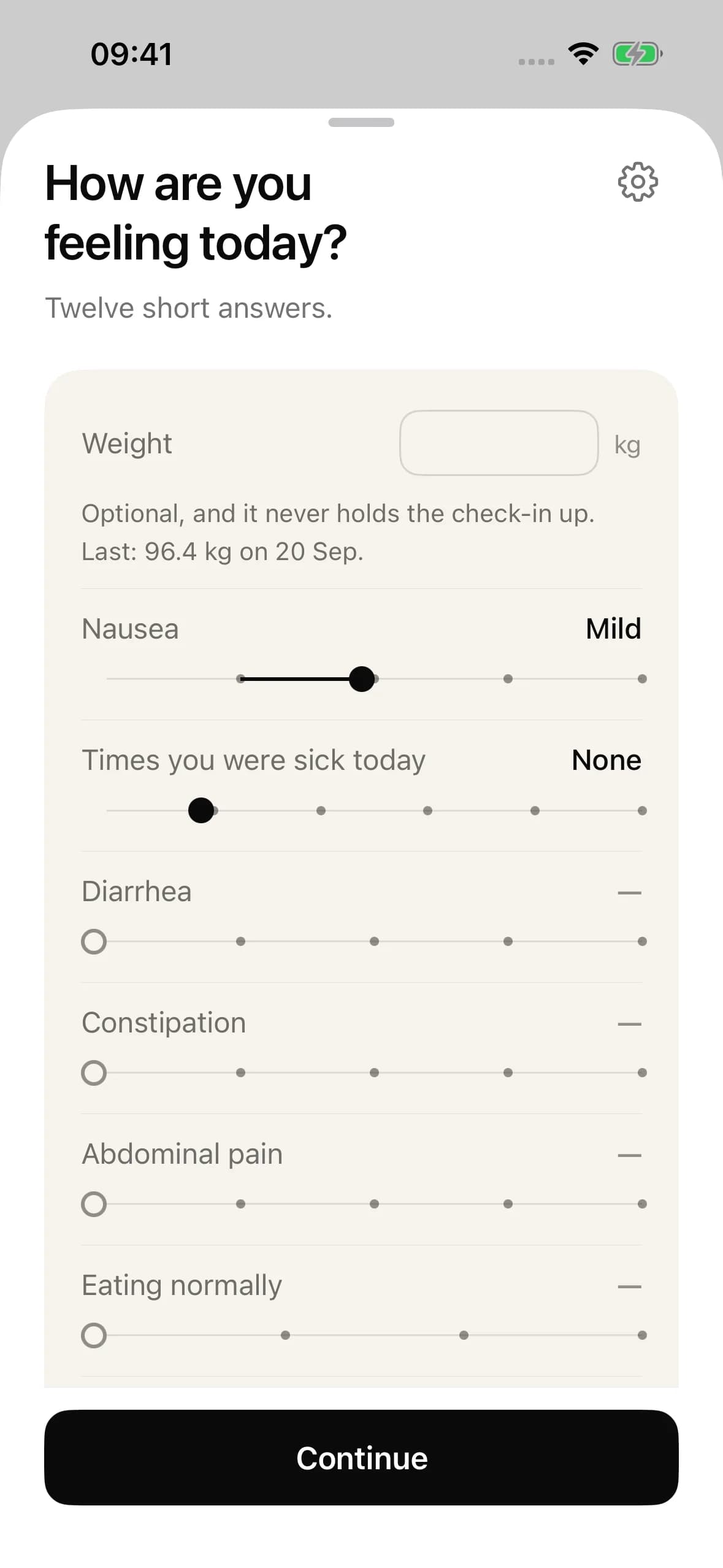
Whichever semaglutide you are prescribed, the weeks after each step up are the ones worth writing down. Log the weekly dose and the injection site, then answer a short daily check-in: nausea every day, plus the symptoms you choose.
Some answers, such as severe nausea, come with a clear next step, like contacting your care team. Handle never diagnoses and is not a monitoring or emergency service, so if you feel very unwell, contact your clinician or emergency services directly.
- Ozempic, Wegovy and Rybelsus are listed by name, on a weekly or daily schedule
- Diarrhea, constipation, vomiting and more if you switch them on
- Forgot to log? Add entries up to 30 days back
How Ozempic and Wegovy are taken
Both are injected under the skin once a week, on the same day each week, at any time of day, with or without meals, into the abdomen, thigh or upper arm.1,2 Both labels start low and step up gradually to lower the risk of stomach side effects; your prescriber sets each step. For where and how to rotate, see Ozempic injection sites.
The pens differ. Ozempic comes in multi-dose pens, each holding several weekly doses, and in single-dose prefilled syringes.1 Most Wegovy pens hold a single dose; the Wegovy FlexTouch pen holds four 2.4 mg doses, and the single-dose 7.2 mg pen is sold as Wegovy HD.2
Missed a week? Ozempic and Wegovy each have their own rule in their instructions, and the two rules are not the same. Ask your prescriber or pharmacist rather than guessing. Handle records what actually happened, including a missed week, and never tells you to catch up.
Oral Wegovy vs oral Ozempic: the tablets
Semaglutide also comes as a daily tablet, and in the US each brand now has one. They share three strengths but are different products with different approvals.2,3
Wegovy pill
Oral semaglutide for weight management
- FDA-approved December 22, 2025, for weight management and lowering heart risk in adults with heart disease and excess weight7,2
- Strengths: 1.5, 4, 9 and 25 mg2
- In OASIS 4 (64 weeks, adults with overweight or obesity and without diabetes), 25 mg lowered weight by 13.6% on average, against 2.4% on placebo, counting everyone randomized2
- UK: approved by the MHRA on June 11, 20269
Ozempic tablets
Oral semaglutide for type 2 diabetes
- The newer Rybelsus formulation, renamed in the US label on January 30, 2026, and on sale from May 4, 20263,8
- Strengths: 1.5, 4 and 9 mg. Rybelsus 3, 7 and 14 mg share the label, and the two are not interchangeable milligram for milligram3
- For blood-sugar control and lowering heart risk in adults with type 2 diabetes3
- Outside the US, the tablet is still called Rybelsus8
Both labels say to take the tablet on an empty stomach in the morning with up to 4 ounces of plain water, then wait at least 30 minutes before food, drink or other oral medicines.2,3 More in Wegovy pill vs injection and Foundayo vs Wegovy. Neither tablet is in Handle's medicine list yet (Rybelsus is): add yours under "Something else" with its name, amount and daily schedule.
Cost, coverage and the UK
Coverage and cost vary by insurance plan, pharmacy and country, and change often. Because Ozempic and Wegovy are approved for different conditions, check with your plan or pharmacist about the product you are actually prescribed.
In the UK, NICE recommends semaglutide (Wegovy) for weight management on the NHS only within a specialist weight management service, for a maximum of two years, for adults who meet its BMI and health criteria.10 The MHRA approved the Wegovy tablet on June 11, 2026, and it is not currently available on the NHS.9
Switching between Ozempic and Wegovy: what to record
Whether to move from one to the other, and how, is your prescriber's decision, and this page does not cover doses or timing. What you can do is keep a record that makes the change easy to review.
- The last dose of the old medicine. The date, the amount and where you injected it.
- The first dose of the new one. Its name, strength and pen type, exactly as prescribed.
- What your prescriber said. Your new plan in their words, and when they want to review it.
- How the next few weeks feel. Nausea, appetite, bowel changes and anything new, especially after each step.
- Your weight trend. Weekly averages across the change, rather than any single morning.
In Handle, both medicines stay on one record, so the switch sits in the same history as everything before it. For the details of each record, see the Ozempic tracker and Wegovy tracker guides.
Handle PremiumPremium
A summary your prescriber can read across a switch
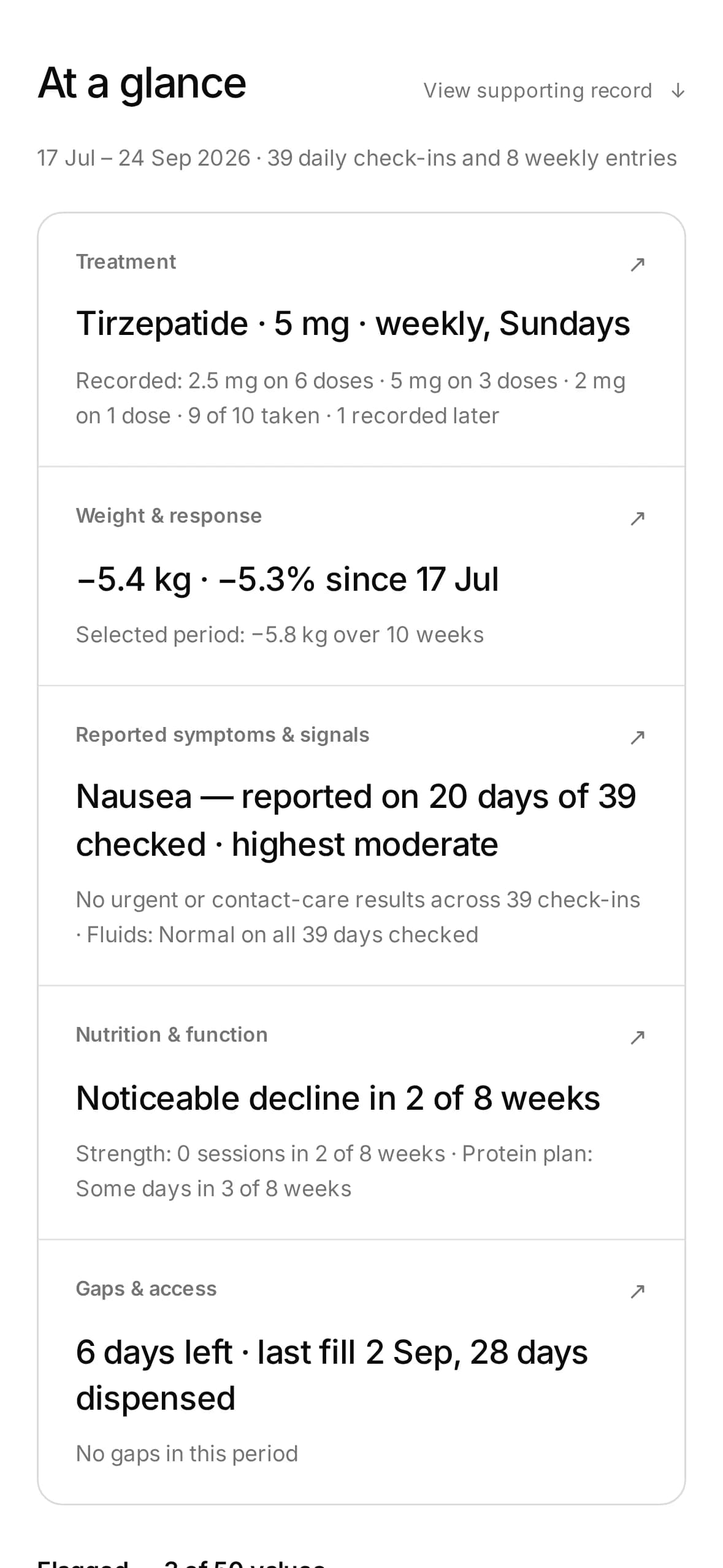
The consultation report lays out your medication record, including any switch between medicines, alongside your weight history, symptom summaries, nutrition and activity, and an optional note about what you want to discuss.
- Share a secure link, and revoke it whenever you like
- Your private daily notes are never included
- Your clinician needs no account to read it
Premium is an optional subscription in the iPhone app.
Questions to bring to your prescriber
A good appointment ends with a plan you understand. These help, whichever medicine you are discussing; there is more in preparing for a GLP-1 appointment.
- Which semaglutide product fits my situation, and why that one?
- Who decides when my strength changes, and how will we review it?
- What should I do if I miss a dose? (Ozempic and Wegovy have different rules.)
- Which side effects should I call you about, and which can I manage at home?
- Do any of my other medicines, such as insulin or a sulfonylurea, need to change?
- Would a tablet suit me better than an injection?
- I have a procedure coming up: who needs to know I take semaglutide?
Questions people ask
Is Wegovy the same as Ozempic?+
They contain the same medicine, semaglutide, from the same company, Novo Nordisk, but they are different products. Ozempic is approved for adults with type 2 diabetes; Wegovy is approved for long-term weight management and heart-risk reduction, comes in higher strengths and was tested in different trials.1,2 Neither is a stand-in for the other without your prescriber's say-so.
Is semaglutide the same as Ozempic?+
Semaglutide is the active ingredient, and Ozempic is one brand name for it. In the US, semaglutide is sold as Ozempic (injection and tablets), Wegovy (injection and pill) and Rybelsus tablets.1,2,3 No generic semaglutide can be sold in the US yet: the only one in Drugs@FDA has tentative approval, which does not allow marketing.12
Which is better for weight loss, Ozempic or Wegovy?+
No trial has compared them head to head for weight loss. Wegovy is the one approved for weight management: in STEP 1, adults with overweight or obesity and without diabetes lost 14.9% of their body weight on average over 68 weeks on 2.4 mg, against 2.4% on placebo.2,4 Ozempic's trials measured blood sugar in type 2 diabetes. Which medicine suits you is a decision to make with your prescriber.
Can you take Ozempic for weight loss?+
In the US, Ozempic's label covers adults with type 2 diabetes, for blood-sugar control and lowering heart and kidney risks. It is not approved for weight management; the semaglutide injection approved for that is Wegovy.1,2 Whether a medicine is right for you, and for what purpose, is your prescriber's decision.
Is Wegovy stronger than Ozempic?+
It is the same medicine made in a different range of strengths. Ozempic's pens go up to 2 mg per weekly dose; Wegovy's go up to 2.4 mg, with a 7.2 mg pen sold as Wegovy HD.1,2 The higher strengths match Wegovy's weight-management approval and trials. A higher number on a pen is nothing to measure yourself against: your prescriber sets the strength you use.
Do Ozempic and Wegovy have the same side effects?+
Yes, the same kind: mostly nausea, diarrhea, vomiting and constipation, reported mostly while the dose is being stepped up, plus the same boxed warning about thyroid C-cell tumors.1,2 The label percentages differ because the trials did, with different people on different strengths, so they cannot be compared directly.
Can you take Ozempic and Wegovy together?+
Not according to the Wegovy label, which says it should not be used with other semaglutide-containing products or with any other GLP-1 receptor agonist.2 Ozempic is semaglutide, so the two overlap completely. If you have been prescribed both, or are moving from one to the other, check the plan with your prescriber or pharmacist.
Is the Wegovy pill the same as Ozempic tablets?+
Both are oral semaglutide, taken once a day on an empty stomach with a little water, and they share the 1.5, 4 and 9 mg strengths. But they are different products: the Wegovy pill is approved for weight management and heart-risk reduction and goes up to 25 mg, while Ozempic tablets are for type 2 diabetes.2,3 See Wegovy pill vs injection for more.
How long do Ozempic and Wegovy stay in your system?+
Semaglutide has a half-life of about one week. The Ozempic label says it stays in the circulation for about 5 weeks after the last dose; the Wegovy label says about 5 to 7 weeks after the last 2.4 mg or 7.2 mg dose.1,2 Both labels also carry specific advice for anyone planning a pregnancy, so raise that with your prescriber early. Our Ozempic half-life guide sets out what each label says.
Sources
- Novo Nordisk, via DailyMed (U.S. National Library of Medicine). OZEMPIC (semaglutide) injection — Prescribing Information, effective June 1, 2026.
- Novo Nordisk, via DailyMed (U.S. National Library of Medicine). WEGOVY (semaglutide) injection and WEGOVY (semaglutide) tablets — Prescribing Information, effective June 18, 2026.
- Novo Nordisk, via DailyMed (U.S. National Library of Medicine). RYBELSUS and OZEMPIC (semaglutide) tablets — Prescribing Information, effective January 30, 2026.
- Wilding et al., New England Journal of Medicine 384:989–1002. Once-Weekly Semaglutide in Adults with Overweight or Obesity (STEP 1), 2021.
- U.S. Food and Drug Administration. Approval letter: NDA 209637, Ozempic (semaglutide) injection, December 5, 2017.
- U.S. Food and Drug Administration. Approval letter: NDA 215256, Wegovy (semaglutide) injection, June 4, 2021.
- Novo Nordisk (press release). FDA approves Novo Nordisk's Wegovy pill, the first and only oral GLP-1 for weight loss in adults, December 22, 2025.
- Novo Nordisk (press release). Novo Nordisk's Ozempic pill, the only FDA-approved oral peptide GLP-1 medication for adults with type 2 diabetes, soon to be available in the US, May 1, 2026.
- Medicines and Healthcare products Regulatory Agency (UK). First GLP-1 tablet for weight loss approved in the UK, June 11, 2026.
- National Institute for Health and Care Excellence. Semaglutide for managing overweight and obesity (TA875), updated September 4, 2023.
- European Medicines Agency. PRAC concludes eye condition NAION is a very rare side effect of semaglutide medicines Ozempic, Rybelsus and Wegovy, June 6, 2025.
- U.S. Food and Drug Administration. Drugs@FDA: ANDA 220314, semaglutide injection (Apotex), tentative approval, April 7, 2026.
Written by the Handle team from the sources above, last checked on September 23, 2026. How we write: our editorial policy. Spotted something out of date? Tell us at [email protected].
Handle supports recording and conversations with your care team. It does not diagnose, and it never tells you to start, change, skip or stop a dose. This page is general information, not medical advice. Always follow your prescriber and your medicine's instructions for use.