
GLP-1 doctor appointment
Questions to ask your doctor about GLP-1, and what to bring
Follow-up appointments are short, and the weeks between them are long. If you're already on treatment, knowing the questions to ask your doctor about GLP-1 medicine, and bringing a short record of how things have gone, makes that time count. Here are the questions worth asking, what to bring, what to say about side effects, and how to share your record.
On this page
- Questions to ask your doctor about GLP-1
- What to bring to a GLP-1 doctor appointment
- A GLP-1 appointment checklist
- How to talk to your doctor about GLP-1 medication
- What to tell your doctor about GLP-1 side effects
- What's in Handle's consultation report
- Sharing your GLP-1 log with your doctor
- Questions people ask
- Sources
In short
- Good questions to ask your doctor about GLP-1 treatment at a follow-up include which side effects to call about, what to do if you miss a dose, how you'll judge whether it's working, how dose decisions will be made, and whether it affects your other medicines.
- Bring a short record since your last visit: doses taken (including late, missed or switched ones), side effects by week, your weight trend, eating, fluids and activity, and every medicine you take.
- Lead with your main concern, then back it with specifics: dates, how many days a symptom lasted and how bad it was at worst.
- Labels ask you to tell your healthcare provider about any side effect that bothers you or doesn't go away, and right away about nausea, vomiting or diarrhea that doesn't go away.3
- Handle keeps that record for free; its consultation report, a Premium feature, shares it as a secure link.
Questions to ask your doctor about GLP-1
For people already on treatment, preparing for a review. Pick the ones that fit and write them down, most important first.
- Which side effects should I call you about, and which can I manage at home? Your prescriber can say what applies to you.
- What should I do if I miss a dose? Each product's instructions have their own rule, so ask rather than guess.
- How will we judge whether this is working for me? Weight is one measure; how you feel and manage day to day matters too.
- How will we decide whether to stay on this dose or change it? Labels start low and step up gradually, and your prescriber sets the steps. Knowing how they decide tells you what to record.
- Does it affect anything else I take? Such as insulin or a sulfonylurea, which can raise the risk of low blood sugar, or the contraceptive pill.3
- Is there a protein or fluid amount you'd like me to aim for? If so, note it along with who set it. Handle records clinician-set targets and never invents one.
- Should I be doing strength training? The Zepbound label notes that weight lost on tirzepatide is more fat than lean mass, but some lean mass goes too.3 It's worth asking what they suggest.
- I have a procedure coming up. What do I need to know? Labels ask you to tell every provider you take a GLP-1 before surgery or sedation.3
What to bring to a GLP-1 doctor appointment
You don't need every detail. These are the things a prescriber can act on, and the hardest to remember in the room.
| What to bring | What to note | Why it matters |
|---|---|---|
| Doses you took | Date and amount; late, missed or extra doses; injection site | Labels step up gradually and tell prescribers to weigh tolerability when choosing the ongoing dose.3 |
| Any switch | Medicine, strength and form (pen, vial or KwikPen), and the date | Names and strengths are easy to mix up months later. |
| Side effects | Which ones, how bad at worst, on how many days a week | In trials, most nausea, vomiting and diarrhea came during dose increases and eased over time.4 |
| Injection-site reactions | Where, when and what it looked like | Reported by 6–8% of people on Zepbound in its 72-week weight trials, against 2% on placebo.3 |
| Weight trend | First and latest weights, and weekly averages | Response is judged over months, not mornings. |
| Eating and fluids | What you manage, and any day you couldn't keep fluids down | Labels warn that losing fluids through vomiting or diarrhea can lead to kidney problems.3 |
| Protein and activity | Rough protein totals; strength and cardio sessions, counted separately | These medicines are meant to be used with a reduced-calorie diet and more physical activity.3 |
| Your medicines list | Everything you take, including over-the-counter medicines and supplements | The label asks you to keep a list to show your healthcare provider and pharmacist.3 |
Keeping these in one place is easier with a weight loss injection tracker and a GLP-1 food tracker.
A GLP-1 appointment checklist
- 1A week before: gather the dates
Each dose since your last visit, any that were late, missed or extra, and any switch of medicine, strength or pen.
- 2A few days before: sum up the weeks
For each symptom, how many days and how bad at worst. Your first and latest weights. A typical day's eating, and your strength and cardio sessions.
- 3The day before: medicines and questions
Update your medicines list, note any procedure coming up, and pick your top three questions.
- 4In the room: lead with what matters most
Say your main concern first, then walk through the record.
- 5Afterward: note what was decided
The plan your prescriber set, and when you'll next review it.
How to talk to your doctor about GLP-1 medication
Lead with your main concern, then back it with specifics. "Nausea on four days in the week after my dose went up, mild at worst" gives your prescriber something to work with; "it's been okay, mostly" doesn't.
Bring the weight trend, not one morning. In England, for weight management, NICE asks prescribers to decide whether to continue tirzepatide if less than 5% of starting weight has been lost after 6 months on the highest tolerated dose, and to consider stopping semaglutide if less than 5% has been lost after 6 months.1,2 That's a review point for a shared decision, not a pass mark.
If your weight has stalled or crept back, say so plainly. It's a signal worth discussing, not a failure.
What to tell your doctor about GLP-1 side effects
Bring every side effect to your review; some shouldn't wait for it. The Zepbound medication guide, for example, asks you to tell your healthcare provider about these.
- Any side effect that bothers you or doesn't go away. Your prescriber can only help with what they know about.3
- Severe or lasting stomach problems. Call right away about nausea, vomiting or diarrhea that doesn't go away, because losing fluids can lead to kidney problems.3
- Signs of gallbladder problems. Upper stomach pain, fever, yellowing of your skin or eyes, or clay-colored stools.3
- Vision changes, if you have type 2 diabetes. Any change during treatment is worth reporting.3
- Surgery or pregnancy. Tell every provider you take it before a planned procedure, and tell your prescriber if you become pregnant.3
- Changes in mood. The FDA had the suicidal-thoughts warning removed from GLP-1 labels in 2026 after finding no increased risk, but still asks you to report new or worsening depression, suicidal thoughts or unusual mood changes. In the US, call or text 988 any time.5
For what's common and what isn't, see our GLP-1 side effects guide, or the pages for Mounjaro, Ozempic, Wegovy and Zepbound.
Keeping a side effect diary for your doctor
A useful diary is boring on purpose: the same few symptoms, on the same scale, at about the same time each day, with your dose dates alongside. That consistency is what turns a vague memory into counts your prescriber can read at a glance. Our GLP-1 side effect tracker guide covers the how-to.
Free in Handle
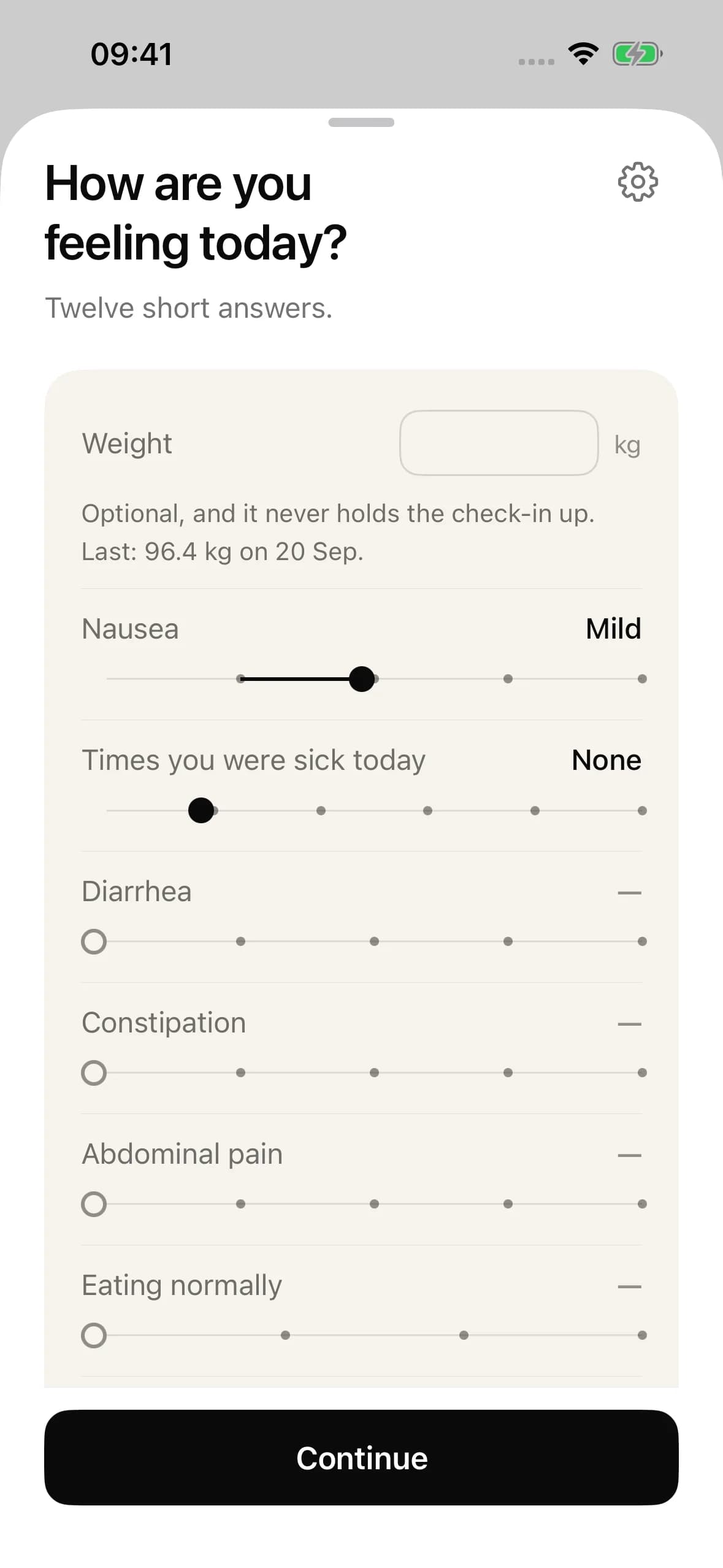
A daily check-in that takes seconds
Handle asks about nausea every day, on the same four-step scale from none to severe, plus the symptoms you choose. Track up to six more, such as heartburn or fatigue, or add one in your own words.
- The card never grows: no follow-up questions
- A day you skip stays blank, never "fine"
- A private daily note that never goes on a report
Handle PremiumPremium
Your record, ready as a consultation report
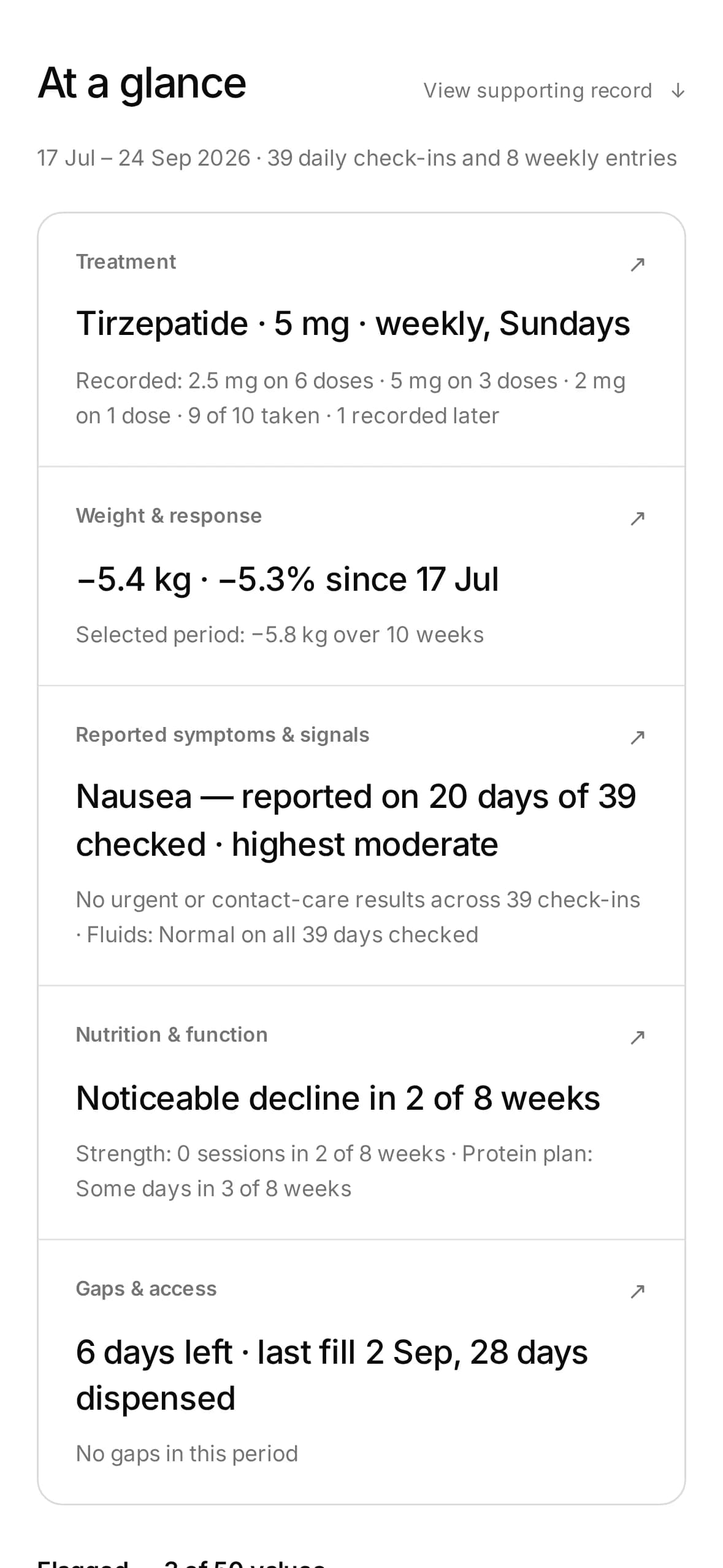
If you log in Handle, the report is already written: your medication record including any switches, your weight history, a summary for each symptom, and your nutrition and activity. Add a note about what you want to discuss, then share it as a secure link your clinician opens without an account.
- Your clinician can choose the period, from the last week to your whole history
- Your private daily notes are never included
- Revoke the link whenever you like
Premium is an optional subscription in the iPhone app.
What's in Handle's consultation report
It is built only from what you recorded. Nothing is scored, and nothing claims one thing caused another.
What your clinician sees
- Your note, word for word, if you add one
- Your medication record, including switches
- Your weight history, from before you started
- For each symptom: days reported, days answered and the highest severity you recorded
- Protein and fluid totals, strength and cardio sessions, and any targets your clinician set
What's never included
- Your private daily notes
- A day-by-day copy of your check-ins
- Scores, diagnoses or dose advice
- Guesses: a day you didn't answer shows as not recorded
Anyone you forward the link to can open it until you revoke it, and a copy someone has already saved or printed can't be recalled.
Sharing your GLP-1 log with your doctor
Bring it on paper, show it on your phone, or send it ahead, and ask the clinic which they prefer. If you keep your log on paper, our free printable GLP-1 tracker is ready to print.
In Handle, the consultation report is the Premium way to share: add an optional note, generate the link and send it however you usually contact your clinic. Everything it draws on is recorded for free, so on the free plan you can open Journey at the appointment and walk through the weeks together. See what the free GLP-1 tracker covers.
Free in Handle
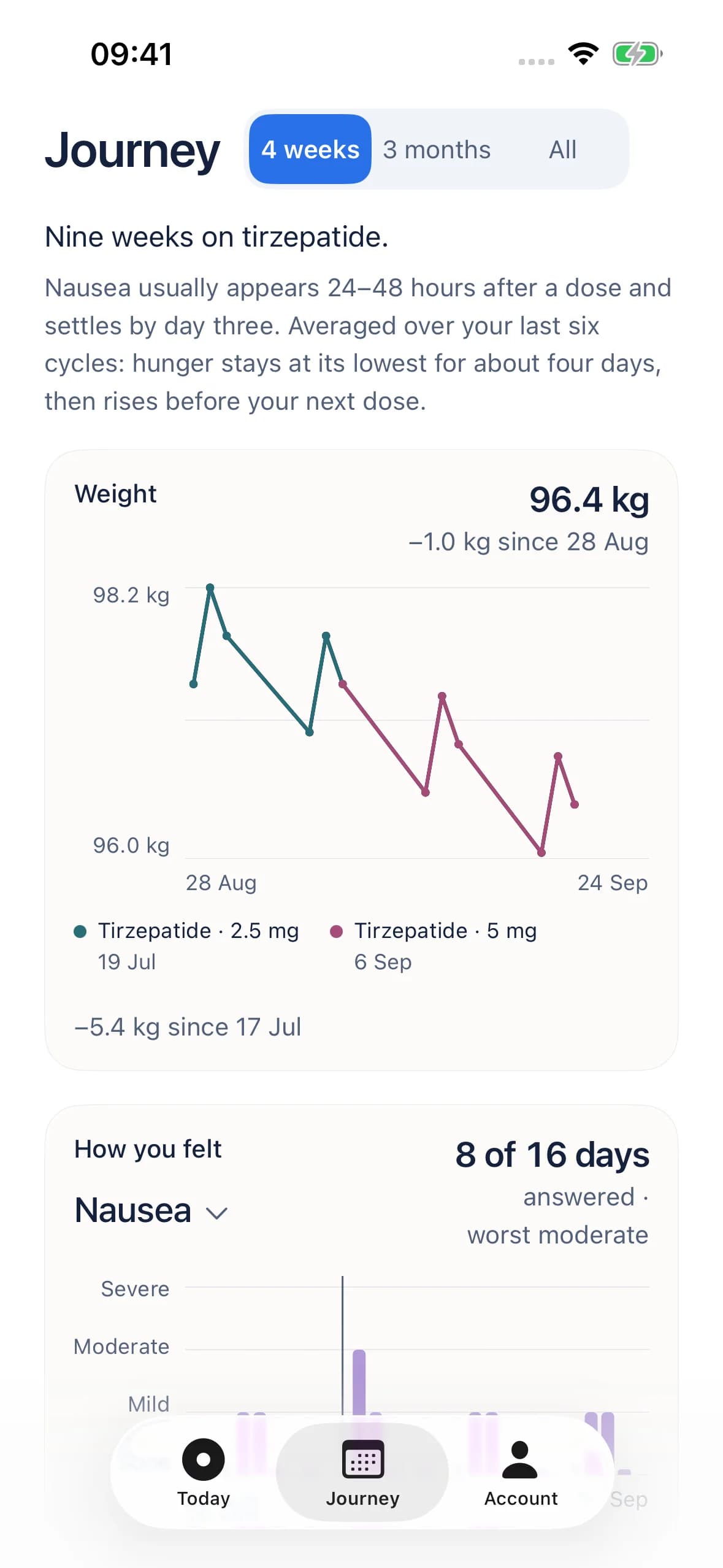
Show the weeks, not just the last weigh-in
Journey charts your weight as weekly averages with your dose as a step line beneath it, next to how you felt, your intake and your training. It shows them side by side and leaves the interpretation to you and your prescriber.
- Choose the period you want to show
- Add a forgotten entry up to 30 days back, with its real date
Questions people ask
What questions should I ask my doctor about GLP-1?+
At a follow-up, ask which side effects to call about, what to do if you miss a dose, how you'll judge whether it's working, how dose decisions will be made, and whether it affects your other medicines. Add anything specific to you, such as an upcoming procedure, and put the most important question first.
What should I bring to a GLP-1 follow-up appointment?+
A short record since your last visit: the doses you took, including late, missed or switched ones; side effects by week; your weight trend; a rough picture of eating, fluids and activity; your full medicines list; and your top three questions. The checklist above walks through each one.
How do I talk to my doctor about my GLP-1 medication?+
Lead with your main concern, then give specifics: dates, how many days a symptom lasted, and how bad it was at worst. Say what matters to you day to day, not just your weight. If something isn't working, say so plainly. Deciding what to change is a shared conversation with your prescriber.
What should I tell my doctor about GLP-1 side effects?+
Which side effects you've had, how bad they were at worst, on how many days, and whether they started after a dose change. Labels also ask you to report any side effect that bothers you or won't go away, and to call right away about nausea, vomiting or diarrhea that doesn't go away.3
Should I keep a side effect diary for my doctor?+
It helps, especially in the weeks after a dose increase, when stomach side effects are most common.4 Keep it short and consistent: the same symptoms, on the same scale, each day. A weekly summary is far easier for a clinician to read than pages of entries.
How do I share my GLP-1 log with my doctor?+
Bring it on paper, show it on your phone, or send it ahead. Handle's consultation report, a Premium feature, is shared as a secure link your clinician opens in a browser without an account, and you can revoke it whenever you like. On the free plan, you can show your Journey charts at the appointment.
Can Handle tell my doctor what dose I should be on?+
No. Handle records the plan your prescriber set and the doses you actually took, and it never suggests a dose, a change or a catch-up. Whether to stay on a dose or change it is your prescriber's decision. The record is there to help them see the pattern.
Sources
- National Institute for Health and Care Excellence (NICE). Tirzepatide for managing overweight and obesity (TA1026), published December 23, 2024; updated September 1, 2025.
- National Institute for Health and Care Excellence (NICE). Semaglutide for managing overweight and obesity (TA875), published March 8, 2023; updated September 4, 2023.
- Eli Lilly and Company, via DailyMed (U.S. National Library of Medicine). Zepbound (tirzepatide) injection — Prescribing Information and Medication Guide, effective August 28, 2026.
- Eli Lilly and Company, via DailyMed (U.S. National Library of Medicine). Mounjaro (tirzepatide) injection — Prescribing Information, effective August 27, 2026.
- U.S. Food and Drug Administration. FDA Requests Removal of Suicidal Behavior and Ideation Warning from Glucagon-Like Peptide-1 Receptor Agonist (GLP-1 RA) Medications, January 13, 2026.
Written by the Handle team from the sources above, last checked on September 23, 2026. How we write: our editorial policy. Spotted something out of date? Tell us at [email protected].
Handle supports recording and conversations with your care team. It does not diagnose, and it never tells you to start, change, skip or stop a dose. This page is general information, not medical advice. Always follow your prescriber and your medicine's instructions for use.