
Tirzepatide tracker
A tirzepatide tracker for one medicine with two names
Tirzepatide is sold as Mounjaro and as Zepbound, and some prescriptions simply say tirzepatide. Handle records whichever you take, by brand or under its own name: each weekly dose and site, a short daily check-in, your weight, food and fluids. Here is what to write down, and what the label says about how tirzepatide works.
On this page
- What tirzepatide is, in the label's words
- Mounjaro and Zepbound: one tirzepatide, two labels
- What to record in a tirzepatide tracker
- Half-life and steady state, in plain words
- What tirzepatide did in the trials
- If your tirzepatide isn't Mounjaro or Zepbound
- Setting up a tirzepatide tracker in Handle
- Side effects in the two sets of tirzepatide trials
- Questions people ask
- Sources
In short
- A tirzepatide tracker records each weekly dose as you took it (the amount, the day and the injection site) alongside your symptoms, weight and food, so you and your prescriber can see how the weeks are going.
- Tirzepatide is one medicine with two US brand names from Eli Lilly: Mounjaro, approved for type 2 diabetes,1 and Zepbound, approved for weight management and obstructive sleep apnea.2 In the UK and EU, Mounjaro is licensed for both diabetes and weight management.3,4
- It activates two gut-hormone receptors, GIP and GLP-1, has a half-life of about five days, and reaches a steady level after about four weeks of once-weekly doses.1,2
- Handle records the tirzepatide you're prescribed for free, by brand or under its own name, and never tells you what dose to take or when to change it.
What tirzepatide is, in the label's words
Tirzepatide is one molecule that switches on two receptors for hormones the gut releases, GIP and GLP-1. In Zepbound's label, it "selectively binds to and activates both the GIP and GLP-1 receptors".2
The labels describe three main effects. It reduces appetite and food intake: GLP-1 is a natural regulator of appetite, and laboratory and animal studies suggest GIP may add to that.2 It prompts insulin release only when blood sugar is raised, and lowers glucagon.1,2 And it slows how quickly the stomach empties, most after the first dose, with the effect lessening over time.2
One more detail explains the weekly schedule: a fatty-acid chain on the molecule lets it bind to albumin, a protein in the blood, which prolongs its half-life.1,2 For every GLP-1 medicine side by side, see our GLP-1 medications guide.
Mounjaro and Zepbound: one tirzepatide, two labels
Both are made by Eli Lilly, come in the same strengths and forms, and are injected once a week at any time of day. What differs is what each is approved for, and where.
| Mounjaro | Zepbound | |
|---|---|---|
| First US approval | 20221 | November 8, 20235 |
| Approved in the US for | Type 2 diabetes in adults and children 10 and older; lowering the risk of major heart events in adults with type 2 diabetes at high risk1 | Long-term weight management in adults with obesity, or overweight with a weight-related condition; moderate to severe sleep apnea in adults with obesity2 |
| UK and EU | Licensed for type 2 diabetes and for weight management3,4 | Not sold under this name |
| Strengths | 2.5, 5, 7.5, 10, 12.5 and 15 mg1 | The same six2 |
| Forms | Single-dose pen or vial; four-dose multi-dose vial or KwikPen1 | The same four2 |
| Half-life | About 5 days1 | About 5 to 6 days in people with overweight or obesity2 |
| Track it | Mounjaro tracker | Zepbound tracker |
Zepbound's label says using it with other tirzepatide-containing products, or with any GLP-1 receptor agonist, is not recommended.2 For a fuller comparison, see Mounjaro vs Zepbound, or find out whether there is a tirzepatide pill.
What to record in a tirzepatide tracker
Whether your prescription says Mounjaro, Zepbound or simply tirzepatide, the useful record is the same.
- What you were prescribed. The name on the prescription, the amount and your dose day. If anything changes (a new strength, pens to vials, one brand to another), note the date.
- Each dose, as taken. The amount, the day and the time, including a late or missed week. A record of what happened is more useful than a record of what was planned.
- The injection site. Both labels list the abdomen and thigh, or the back of the upper arm if someone else injects, and say to rotate sites with each dose.1,2 Exposure is similar from all three areas.1
- Symptoms, most of all after a change. In the diabetes trials, most reports of nausea, vomiting and diarrhea came while the dose was being stepped up, and they decreased over time.1
- Weight, food and fluids. A weekly weight average says more than one weigh-in. Fluids matter if you're vomiting or have diarrhea: both labels warn that fluid loss can lead to kidney injury.1,2 Our guide to what to eat on tirzepatide covers food, protein and fluids.
- Your other medicines. The labels explain that tirzepatide makes low blood sugar more likely alongside insulin or a sulfonylurea, and can lower how much of a contraceptive pill is absorbed.1,2 Keep your prescriber's list of your medicines up to date.
In Handle
Record the tirzepatide you're prescribed
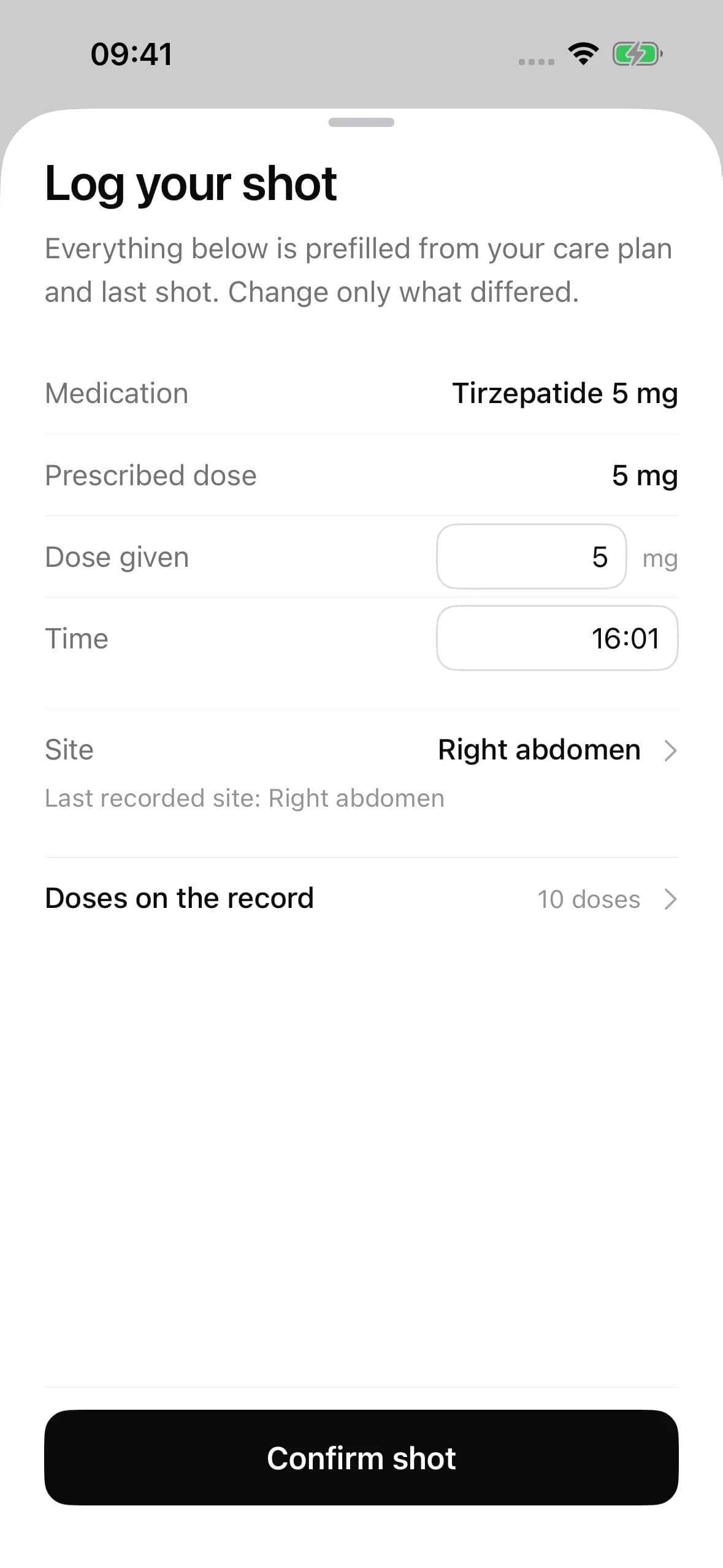
Choose Mounjaro or Zepbound from Handle's list, or pick "Something else", select tirzepatide, and enter the name, amount and weekly schedule from your prescription. After that, each dose is a quick entry: the time and the injection site.
- Amount, time and site in one entry
- A switch of brand stays on one continuous record
- Forgot to log a dose? Add it later, up to 30 days back
- Dose-day reminders in the iPhone app
Half-life and steady state, in plain words
Half-life is how long it takes for the amount of a medicine in your body to fall by half. Tirzepatide's is about five days, or five to six days in people with overweight or obesity.1,2 After an injection, levels peak within 8 to 72 hours, typically about a day after the dose, then fall slowly through the week.2
Because each weekly dose arrives before the last one has worn off, the level builds over the first weeks. The labels say it reaches a steady state after about four weeks of once-weekly doses.1,2 It is one reason a few weeks of steady notes tell you and your prescriber more than any single day. Our tirzepatide half-life guide puts the label figures in one place.
Handle PremiumPremium
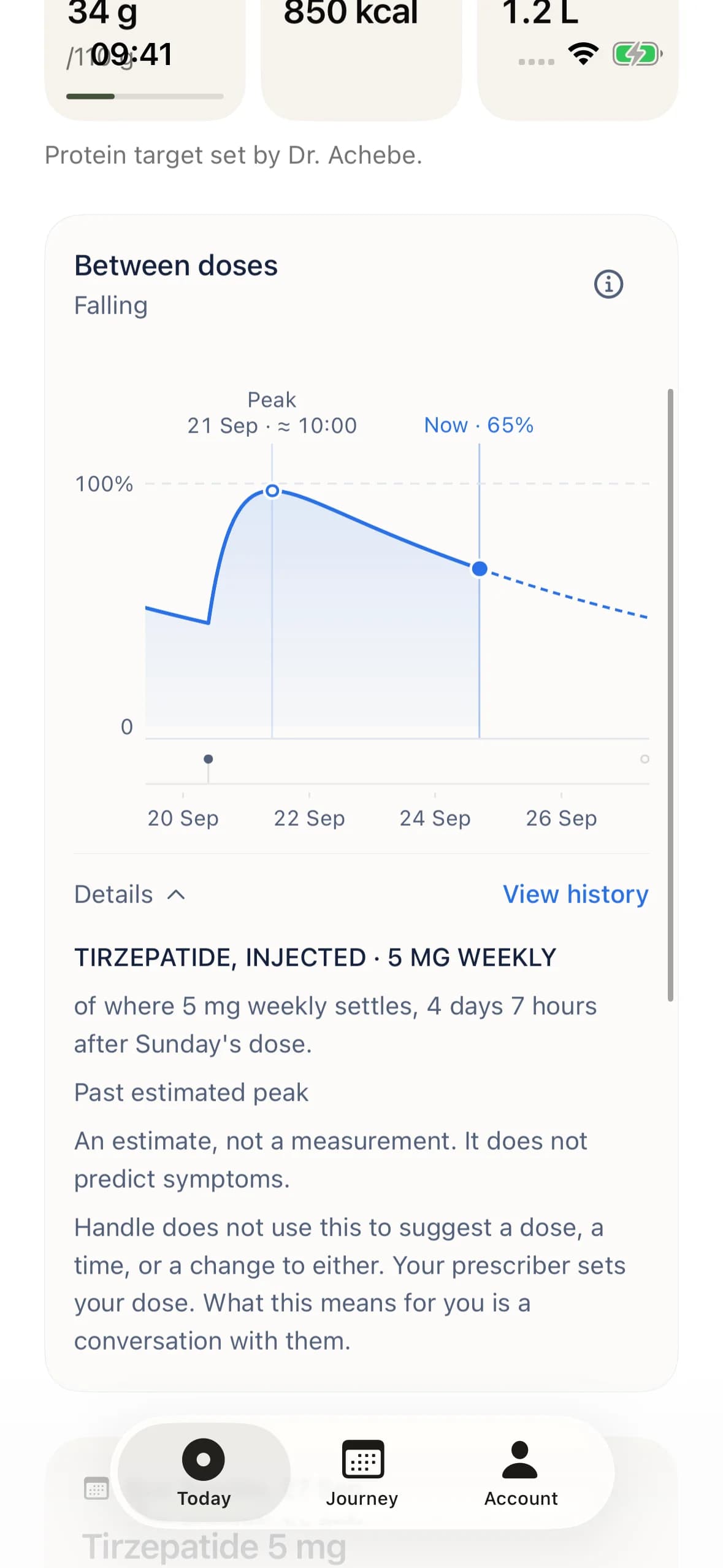
Between doses: your tirzepatide week, estimated
Between doses draws an estimated level curve from the doses you have recorded, using tirzepatide's published half-life and absorption figures.
It is a model, not a blood test. It only draws doses you have already taken, never a future one, and it is not dose advice.
Premium is an optional subscription in the iPhone app.
What tirzepatide did in the trials
In SURMOUNT-1, 2,539 adults with obesity or overweight and no diabetes lost an average of 15.0% to 20.9% of their body weight over 72 weeks, depending on the dose, against 3.1% on placebo. Those figures count everyone who started, whether or not they kept taking it (the treatment-regimen estimand).8
SURMOUNT-5 is the one head-to-head weight-management trial against semaglutide: 751 adults without type 2 diabetes, 72 weeks, open-label, each on the highest dose they tolerated, up to 15 mg of tirzepatide or 2.4 mg of semaglutide. Average weight change was −20.2% on tirzepatide and −13.7% on semaglutide (treatment-regimen estimand).9 Averages aren't a prediction for you; more in semaglutide vs tirzepatide.
If your tirzepatide isn't Mounjaro or Zepbound
Some people are prescribed tirzepatide made by a compounding pharmacy. Two facts from the FDA are worth knowing. On December 19, 2024, the FDA determined that the shortage of tirzepatide injection was resolved.6 And the FDA says compounded drugs are not FDA-approved, and should only be used by patients whose medical needs can't be met by an approved drug.7
Handle doesn't compare products or comment on where a medicine comes from. It records the medicine, amount and schedule your prescriber set, under "Something else", and treats that record like any other. Questions about the prescription itself are for your prescriber and pharmacist.
Setting up a tirzepatide tracker in Handle
The same four steps work for any GLP-1; our GLP-1 tracker guide covers the wider choice of apps.
- 1Add your plan
Pick Mounjaro, Zepbound or "Something else", then the amount your prescriber set and your weekly dose day.
- 2Log this week's dose
Record the time and the site. Earlier doses can go in too, up to 30 days back, and Handle keeps the day each happened separate from the day you logged it.
- 3Choose what to track
Nausea is asked every day. Switch on the symptoms that matter to you, and add up to six more.
- 4Let the weeks build
Weigh when you like and log food when it's easy. Before an appointment, open Journey to see your weight, dose, symptoms and intake side by side.
In Handle
Track the symptoms that matter to you
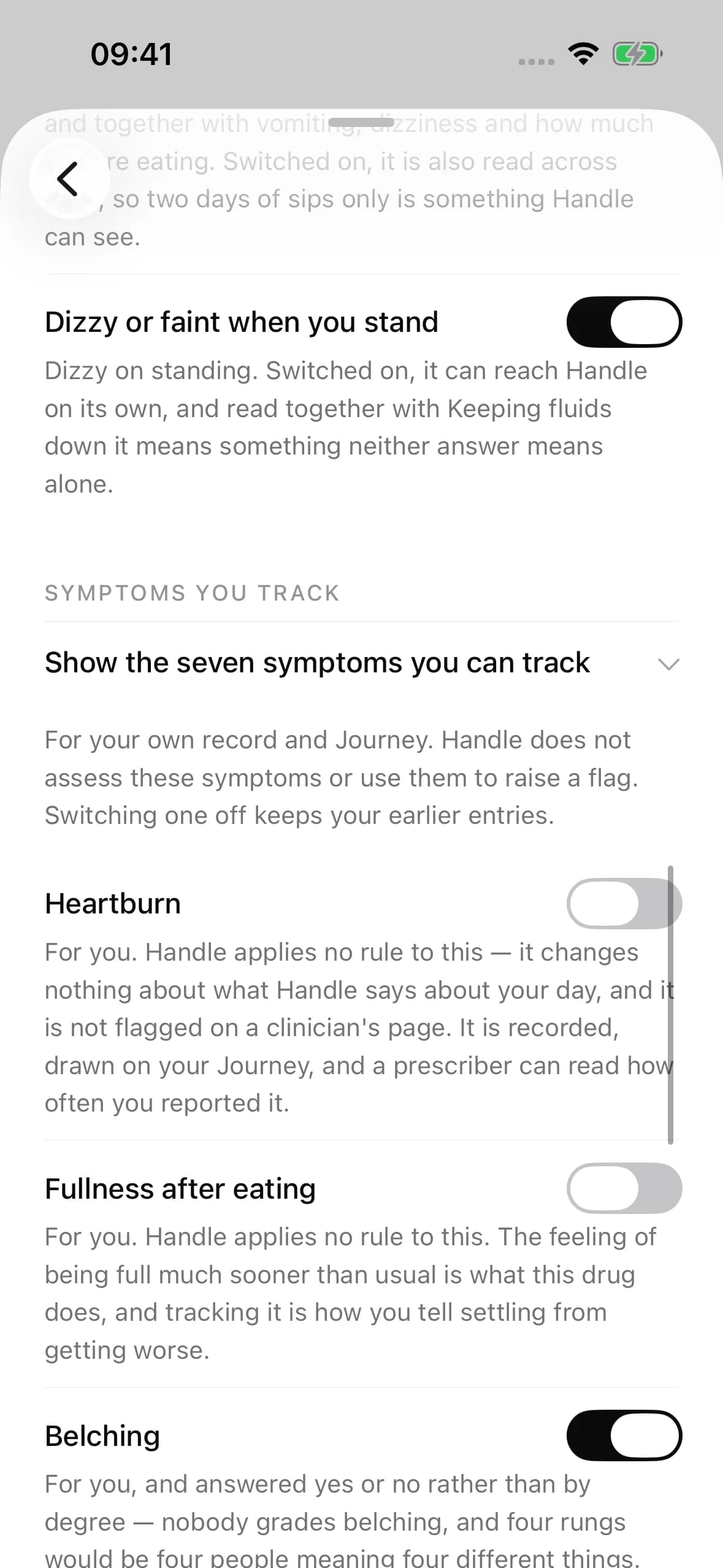
Choose what your daily check-in asks. Beyond nausea, you can switch on diarrhea, constipation or heartburn, and add up to six tracked symptoms such as belching or fatigue, or one in your own words. The card stays short, whatever you answer.
Some answers, such as severe nausea, come with a clear next step, like contacting your care team. Handle never diagnoses and is not a monitoring or emergency service; if you feel very unwell, contact your clinician or emergency services directly.
Side effects in the two sets of tirzepatide trials
Each label reports side effects from different trials: adults with type 2 diabetes for Mounjaro, and adults with obesity or overweight for Zepbound. Read each column against its own placebo figure.
| Side effect | Diabetes trials (Mounjaro label) | Weight trials (Zepbound label) |
|---|---|---|
| Nausea | 12–18% vs 4% on placebo | 25–29% vs 8% on placebo |
| Diarrhea | 12–17% vs 9% | 19–23% vs 8% |
| Vomiting | 5–9% vs 2% | 8–13% vs 2% |
| Constipation | 6–7% vs 1% | 11–17% vs 5% |
| Indigestion | 5–8% vs 3% | 9–10% vs 4% |
| Stomach pain | 5–6% vs 4% | 9–10% vs 5% |
Ranges cover the 5, 10 and 15 mg doses. Mounjaro: two 40-week trials, SURPASS-1 and SURPASS-5.1 Zepbound: SURMOUNT-1 and SURMOUNT-2, up to 72 weeks.2 The trials differ in who took part and for how long, so they are not a head-to-head comparison. More in Mounjaro side effects and Zepbound side effects.
Handle PremiumPremium
Take your tirzepatide record to the appointment
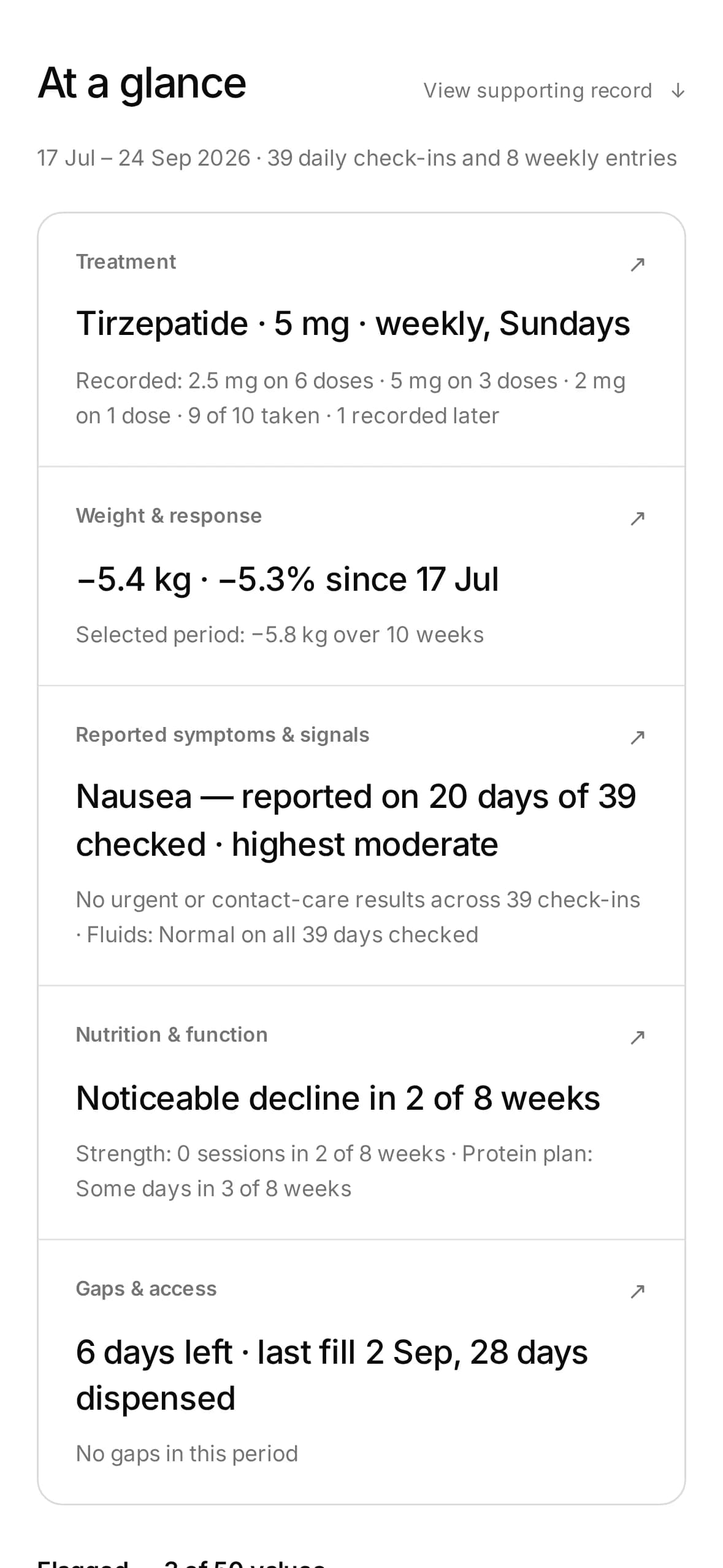
The consultation report gathers your medication record, including any switch between brands, your weight history, symptom summaries, nutrition and activity, and an optional note about what you want to discuss. See our guide to preparing for a GLP-1 doctor appointment.
- Shared as a secure link that can be revoked at any time
- Your private daily notes are never included
- Your clinician needs no account to read it
Premium is an optional subscription in the iPhone app.
Questions people ask
Is there a tirzepatide tracker app?+
Yes. Handle records tirzepatide whether it's Mounjaro, Zepbound or prescribed under its own name: weekly doses and injection sites, a short daily check-in, weight, food and fluids. Core recording in the iPhone app is free and never comes with dose advice. See our guide to GLP-1 trackers for how the options compare.
What is the best app to track tirzepatide?+
The best one is the one you'll keep using. Check that the free tier records doses, injection sites, symptoms and weight without a paywall, handles weekly dosing and a switch between brands, and gives your prescriber something readable. Handle's free plan does all of that, with Journey's charts to show at an appointment, and it leaves every dose decision with your prescriber.
Is tirzepatide the same as Mounjaro?+
Mounjaro is a brand of tirzepatide, and so is Zepbound: both are made by Eli Lilly and contain the same medicine in the same six strengths.1,2 In the US, Mounjaro is approved for type 2 diabetes and Zepbound for weight management and sleep apnea; in the UK and EU, Mounjaro covers diabetes and weight management.3,4
How long does tirzepatide stay in your system?+
Tirzepatide's half-life is about five days, or five to six in people with overweight or obesity, and a steady level builds after about four weeks of weekly doses.1,2 Handle's Between doses view, a Premium feature, estimates your level from the doses you recorded. It is a model, not a blood test.
Why is tirzepatide only taken once a week?+
Because the body clears it slowly. Tirzepatide carries a fatty-acid chain that binds it to albumin, a protein in the blood, which prolongs its half-life to about five days.1,2 That is why both labels describe a once-weekly injection, at any time of day, with or without meals.1,2
Can I track tirzepatide that isn't Mounjaro or Zepbound?+
Yes. When you add your plan, choose "Something else", select tirzepatide, and enter the name, amount and weekly schedule your prescriber set. Handle records it like any other medicine, with doses, sites, check-ins and weight, and doesn't comment on where it comes from. Questions about the prescription itself are best taken to your prescriber or pharmacist.
Is Handle's tirzepatide tracker free?+
Yes. Doses, injection sites, the daily check-in, weight, food, drinks and activity, and the Journey charts are all free, with no advertising. The Between doses estimate, the consultation report with share links, food photo scanning and iOS widgets are Premium features. See what's free in Handle.
Does Handle give advice about my tirzepatide dose?+
No. The labels start low and step up gradually, and your prescriber sets the steps. Handle records the plan they set and the doses you actually took, and never suggests a change, a skipped dose or a catch-up. If you're unsure what comes next, that's a question for your prescriber.
Sources
- Eli Lilly and Company, via DailyMed (U.S. National Library of Medicine). Mounjaro (tirzepatide) injection — Prescribing Information, effective August 27, 2026.
- Eli Lilly and Company, via DailyMed (U.S. National Library of Medicine). Zepbound (tirzepatide) injection — Prescribing Information, effective August 28, 2026.
- Medicines and Healthcare products Regulatory Agency (UK). MHRA authorises diabetes drug Mounjaro (tirzepatide) for weight management and weight loss, November 8, 2023.
- European Medicines Agency. Mounjaro — European public assessment report.
- U.S. Food and Drug Administration. FDA Approves New Medication for Chronic Weight Management, November 8, 2023.
- U.S. Food and Drug Administration. FDA clarifies policies for compounders as national GLP-1 supply begins to stabilize, updated through April 28, 2025.
- U.S. Food and Drug Administration. FDA's Concerns with Unapproved GLP-1 Drugs Used for Weight Loss, content current as of February 4, 2026.
- Jastreboff AM et al., New England Journal of Medicine 2022;387:205-216. Tirzepatide Once Weekly for the Treatment of Obesity (SURMOUNT-1), 2022.
- Aronne LJ et al., New England Journal of Medicine 2025;393:26-36. Tirzepatide as Compared with Semaglutide for the Treatment of Obesity (SURMOUNT-5), 2025.
Written by the Handle team from the sources above, last checked on September 24, 2026. How we write: our editorial policy. Spotted something out of date? Tell us at [email protected].
Handle supports recording and conversations with your care team. It does not diagnose, and it never tells you to start, change, skip or stop a dose. This page is general information, not medical advice. Always follow your prescriber and your medicine's instructions for use.