
Sulfur burps
Sulfur burps on a GLP-1: what's known, and what isn't
Sulfur burps are burps that smell of rotten eggs, and if you take Mounjaro, Zepbound, Ozempic or Wegovy you may have wondered whether your medicine is behind them. Here is what the labels actually report, what is and isn't known about the smell, what reputable sources suggest, the signs that need a call, and how to keep a simple record for your prescriber.
On this page
- What sulfur burps are
- What the labels report: burping on GLP-1 medicines
- Do GLP-1s cause sulfur burps? What's known, and what's a guess
- Easing sulfur burps: what reputable sources suggest
- Red flags: when burping needs a call
- Tracking sulfur burps for your prescriber
- Questions to ask your prescriber
- Questions people ask
- Sources
In short
- "Sulfur burps" (sulphur burps in UK spelling) are burps that smell of rotten eggs; a 2025 expert commentary describes them as burping "with hydrogen sulfide odor", but GLP-1 labels record only eructation, the medical word for burping, and never mention smell.8,1
- Burping is a listed side effect: in the weight-management trials behind the labels, 4–5% of people on Zepbound reported it against 1% on placebo, and 7% of people on Wegovy 2.4 mg against under 1%.2,4
- Nobody has shown why some people notice a sulfur smell: slower stomach emptying, bacterial overgrowth in the small intestine and sulfur in food are hypotheses, and the 2025 commentary says "direct evidence is lacking".8
- Mayo Clinic's general advice for burping is to eat and drink slowly and to skip fizzy drinks, gum and hard candy;10 none of it has been tested for sulfur burps in people taking a GLP-1 medicine.
- When burping is the only symptom it rarely points to anything serious, Mayo Clinic says, but the Medication Guides ask you to call your healthcare provider right away about severe stomach pain that will not go away, or nausea, vomiting or diarrhea that does not go away.10,1
What sulfur burps are
"Sulfur burps" isn't a medical term. It's the everyday name, spelled sulphur burps in the UK, for burps that smell of rotten eggs. A 2025 expert commentary on GLP-1 treatment in the journal Obesity Pillars describes them as eructation, the medical word for burping, "with hydrogen sulfide odor".8
Burping itself is ordinary. Mayo Clinic describes it as your body's way of pushing out excess air from your upper digestive tract, and says most belching is caused by swallowing excess air, which often never even reaches the stomach.10
The smell is the less understood part. Hydrogen sulfide, the gas with the familiar rotten-egg smell, is the usual suspect, but the only measurement study we found looked at gas from the other end: in 1998, researchers collected flatus from 16 healthy people and found hydrogen sulfide was the main sulfur gas: the more of it there was, the worse the smell.9 We found no study that has measured hydrogen sulfide in burps, and none that has measured burp smell in people taking GLP-1 medicines.
What the labels report: burping on GLP-1 medicines
No label records smell, so there is no "sulfur burps" rate for any medicine. What the labels do record is burping of any kind, listed as eructation, and it was more common than on placebo with each of these medicines. Every row comes from different trials in different people, so read each one on its own.
| Medicine | Trials behind the figure | Placebo | On the medicine |
|---|---|---|---|
| Zepbound (tirzepatide injection) | SURMOUNT-1 and SURMOUNT-2: 2,519 adults with obesity or overweight, with or without type 2 diabetes, for up to 72 weeks2 | 1% | 4% on 5 mg; 5% on 10 mg and 15 mg |
| Mounjaro (tirzepatide injection) | SURPASS-1 and SURPASS-5, in adults with type 2 diabetes: 718 people on Mounjaro, for 36.6 weeks on average1 | 0.4% | 3.0% on 5 mg; 2.5% on 10 mg; 3.3% on 15 mg |
| Wegovy injection 2.4 mg (semaglutide) | STEP 1, 2 and 3: 2,116 adults with obesity or overweight on Wegovy, for up to 68 weeks4 | Under 1% | 7% |
| Wegovy injection 2.4 mg, ages 12 and up | STEP TEENS: 133 young people with obesity on Wegovy and 67 on placebo, for 68 weeks4 | 0% | 4% |
| Ozempic (semaglutide injection) | Two trials in adults with type 2 diabetes: 521 people on Ozempic, for 32.9 weeks on average3 | 0% | 2.7% on 0.5 mg; 1.1% on 1 mg |
| Rybelsus (semaglutide tablets) | Two trials in adults with type 2 diabetes: 1,071 people on Rybelsus 3 mg, 7 mg or 14 mg tablets, for 41.8 weeks on average5 | 0% | 0.6% on 7 mg; 2% on 14 mg |
| Foundayo (orforglipron tablets) | ATTAIN-1 and ATTAIN-2: 3,155 adults with obesity or overweight, with or without type 2 diabetes, for up to 72 weeks6 | 1% | 6% on 5.5 mg; 8% on 9 mg and 17.2 mg |
| Wegovy pill 25 mg (semaglutide tablets) | Trial registry, not the label: OASIS 4, adults without diabetes, weeks 0 to 71. These are adverse events, not the label's adverse reactions7 | 2.0% (2 of 102) | 10.3% (21 of 204) |
Figures from each medicine's US prescribing information, section 6.1, apart from the Wegovy pill: its label gives no separate figure and says common reactions with the tablets were similar to those in the injection trials.4 The labels say side-effect rates from different medicines' trials can't be compared directly, and the doses shown are trial groups; your prescriber sets yours.2 The trials that compared tirzepatide with semaglutide directly are covered in semaglutide vs tirzepatide.
Do sulfur burps go away on a GLP-1?
The labels say little about timing. Wegovy's is the only one that ties burping to a stage of treatment: it lists burping among stomach reactions that "were most frequently reported during dosage escalation".4 The Mounjaro and Zepbound labels describe that pattern for nausea, vomiting and diarrhea, not for burping, and no label says how long burping lasts.1,2
So nobody can promise yours will pass, or say when. What helps is noting when it started and whether it's changing, which is useful to your prescriber either way. Our pages on Mounjaro side effects and Zepbound side effects put burping alongside the rest of each label.
Do GLP-1s cause sulfur burps? What's known, and what's a guess
You'll read one explanation almost everywhere: the medicine slows your stomach, food sits and ferments, and hydrogen sulfide builds up. Some links in that chain are established. The chain as a whole has never been shown.
Established
From the labels and published studies
- Burping was more common than on placebo with each medicine in the table above.
- These medicines slow how quickly the stomach empties; Wegovy's label says semaglutide delays gastric emptying.4
- That slowing lessens: the Mounjaro, Zepbound and Foundayo labels say the delay is largest after the first dose and diminishes over time.1,2,6
- In flatus, the gas from the other end, hydrogen sulfide is the main sulfur gas, and the more of it there is, the worse the smell.9
Not established
Plausible, but untested
- That slower emptying lets food ferment in the stomach and make hydrogen sulfide. It's the explanation you'll read most, but direct evidence for it is lacking.8
- That an overgrowth of bacteria in the small intestine (SIBO) is responsible.8
- That sulfur in food is the cause.8
- What gas these burps actually contain: we found no study that has measured it.
- Whether sulfur burps say anything about how well your medicine is working: we found no study that has looked.
The 2025 commentary in Obesity Pillars lists sulfur burps among "poorly understood adverse effects" that "warrant mechanistic investigation". Its verdict on the three explanations on the right: "direct evidence is lacking".8
Easing sulfur burps: what reputable sources suggest
These are Mayo Clinic's tips for reducing burping, and most are about swallowing less air. None has been tested for sulfur burps in people taking a GLP-1 medicine, so treat them as general advice and ask your care team whether they suit you.10
- Eat and drink slowly. Taking your time can help you swallow less air; Mayo Clinic suggests making meals relaxed occasions rather than eating on the run.10
- Skip fizzy drinks and beer. Carbonated drinks and beer release carbon dioxide gas.10
- Skip gum and hard candy. You swallow more often than normal, and part of what you swallow is air.10
- Don't smoke. When you inhale smoke, you also swallow air.10
- Check your dentures. Poorly fitting dentures can make you swallow excess air as you eat and drink.10
- Take a short walk after eating. Mayo Clinic says getting moving may help.10
If heartburn or reflux comes with the burping, mention that too: Mayo Clinic notes that acid reflux can sometimes cause excessive belching.10
Food, protein and over-the-counter remedies
Lists of sulfur-rich foods to avoid, such as eggs, meat, broccoli and cabbage, are common online. No study has tested whether cutting them out helps sulfur burps in people taking a GLP-1 medicine, and some of them, such as eggs and meat, are important sources of protein. If one food seems to set things off, note it, and talk to your care team or a dietitian before cutting out whole groups of food. Our GLP-1 food tracker guide covers keeping a simple food and protein record.
You'll also see over-the-counter remedies recommended. Handle doesn't recommend medicines: ask a pharmacist or your prescriber, who knows what else you take, before trying one. And any change to your GLP-1 medicine itself is a decision for you and your prescriber.
Red flags: when burping needs a call
Mayo Clinic says burping, gas and bloating often resolve on their own or with simple changes, and that when they're the only symptoms, they rarely represent any serious underlying condition.10 What matters is what comes with them. The urgent list below quotes the Medication Guides and the NHS directly.
Sulphur burps with diarrhoea: what the NHS says
Egg-smelling burps aren't always about your medicine. The NHS lists "smelly burps – they may smell like eggs" among the main symptoms of giardiasis, an infection, alongside smelly diarrhoea, tummy pain or cramps, farting, bloating and weight loss.11
It says to ask for an urgent GP appointment or get help from NHS 111 if "you have had diarrhoea for more than 7 days, or your diarrhoea gets worse quickly", or if "you have bloody diarrhoea or bleeding from your bottom".11 Outside the UK, call your doctor or care team.
When to see your doctor about burping
Mayo Clinic advises seeing a healthcare professional if symptoms don't improve with simple changes, particularly if you also notice diarrhea, persistent or severe belly pain, bloody stools, changes in the color or frequency of stools, losing weight without trying, chest discomfort, or loss of appetite or feeling full quickly.10
Some of those, such as eating less or feeling full sooner, are also what GLP-1 medicines are prescribed to do. Handle can't tell which is which, and neither can a web page, so tell your prescriber about anything new, getting worse or not going away.
Tracking sulfur burps for your prescriber
By the time of an appointment, burping is easy to forget, or to sum up as "a lot", which is hard for anyone to act on. A daily yes or no, kept on the same record as your doses, turns that into something concrete: how often, since when, and whether it's changing.
Note what else was going on, such as meals, fizzy drinks or other symptoms, without trying to work out the cause yourself. Our GLP-1 side effect tracker guide covers what to record, and our guide to preparing for a GLP-1 doctor appointment covers what to bring.
Free in Handle
Track belching in one tap a day
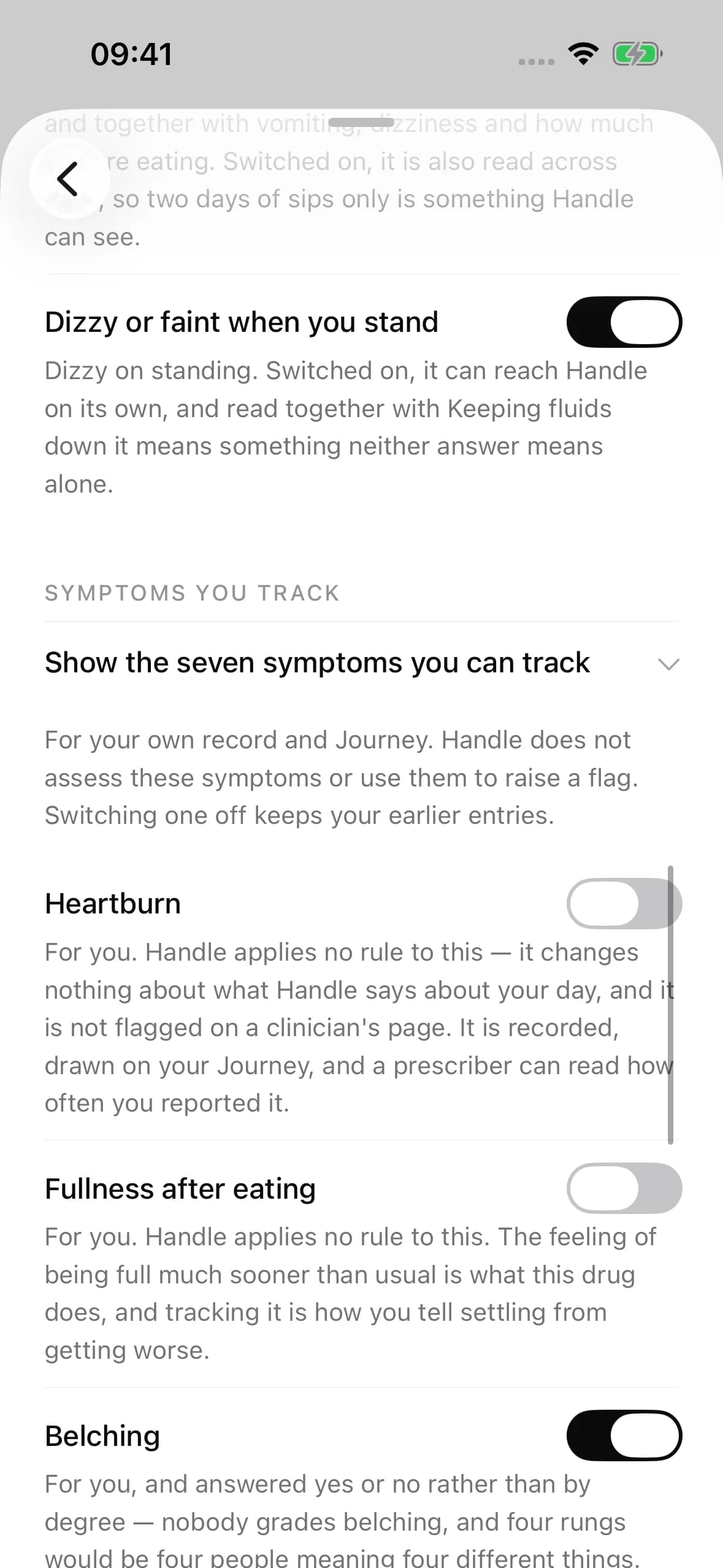
Add belching to Handle's daily check-in as one of up to six tracked symptoms. It's a simple yes or no, because nobody grades a burp. If "eggy burps" says it better, add a symptom in your own words instead.
Tracked symptoms are recorded and drawn on your Journey. Handle applies no rule to them, doesn't diagnose, and isn't a monitoring or emergency service, so contact your care team directly about anything that worries you.
- Belching, heartburn, fullness, metallic taste, headache or fatigue
- Or one symptom in your own words
- Missed a day? Add it later, up to 30 days back
Handle PremiumPremium
Show your prescriber how often, not just that it happens
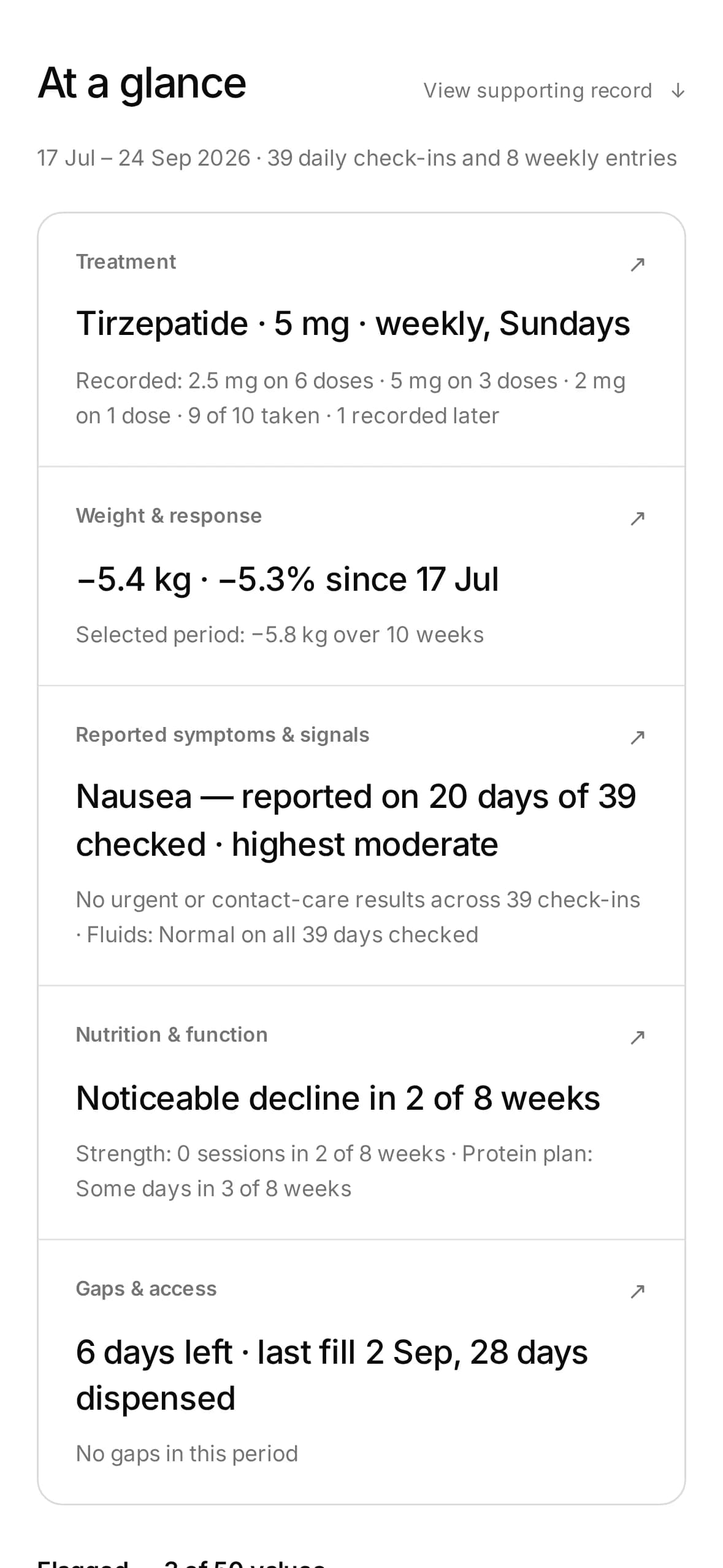
The consultation report, a Premium feature, lists each symptom you track with the number of days you reported it out of the days you answered, beside your medication record, weight history and an optional note about what you want to discuss.
It's a count, not an assessment: Handle puts no flag on a tracked symptom, and a symptom in your own words appears in quotation marks, as yours.
- Shared as a secure link you can revoke at any time
- Your private daily notes are never included
- Your clinician needs no account to read it
Premium is an optional subscription in the iPhone app.
Questions to ask your prescriber
- Could the burping I'm noticing be from my medicine, or is it worth checking for something else?
- Which symptoms alongside it should I call you about, and which can wait until my next appointment?
- Could a dietitian help with my meals without me cutting back on protein?
- Could any of my other medicines or supplements be making burping or reflux worse?
- If I want to try an over-the-counter remedy, which is safe with the other medicines I take?
For each medicine's full label picture, see Ozempic side effects, Wegovy side effects, Foundayo side effects and our overview of GLP-1 side effects.
Questions people ask
What causes sulfur burps on Mounjaro or Ozempic?+
Nobody knows for sure. Burping (eructation) is a listed side effect of both, but neither label mentions smell, and we found no study that has measured burp odor in people taking them.1,3 Slower stomach emptying, bacterial overgrowth in the small intestine and sulfur in food are the usual explanations; a 2025 expert commentary calls them hypotheses and says "direct evidence is lacking".8 If sulfur burps bother you, tell your care team.
Are sulphur burps a side effect of Mounjaro?+
Burping is. Mounjaro's US label records it in 2.5–3.3% of people in its type 2 diabetes trials, against 0.4% on placebo, and in the weight-management trials of the same medicine, sold in the US as Zepbound, 4–5% against 1%.1,2 Neither label mentions smell, so "sulphur burps" isn't a label term. If they bother you, ask your GP, prescriber or pharmacist what may help.
How do I stop sulfur burps?+
There's no proven way to stop sulfur burps on a GLP-1 medicine. Mayo Clinic's general advice for burping is to eat and drink slowly, skip fizzy drinks, beer, gum and hard candy, avoid smoking and take a short walk after eating,10 but none of it has been tested for sulfur burps. Check with a pharmacist or your prescriber before trying an over-the-counter remedy.
Do sulfur burps go away?+
The labels don't say how long burping lasts. Wegovy's lists burping among stomach reactions most often reported while the dose was being stepped up,4 and the Mounjaro and Zepbound labels give no timing for burping at all.1,2 A daily yes-or-no record shows you and your prescriber whether yours is settling, rather than relying on memory.
Are sulfur burps a sign the medicine is working?+
There's no evidence either way. We found no study linking burping, or its smell, to how well a GLP-1 medicine works for weight or blood sugar, and the labels don't connect them. Whether your treatment is working is a conversation to have with your prescriber, based on your whole record rather than one side effect.
Can the Wegovy pill cause sulfur burps?+
Burping was reported with it. In the OASIS 4 trial's registry results, from adults with overweight or obesity and without diabetes, belching was recorded as an adverse event in 10.3% of people taking the Wegovy pill 25 mg, against 2.0% on placebo.7 The label gives no separate figure and says common reactions were similar to the injection's.4 Neither mentions smell. More in Wegovy pill vs injection.
When should I worry about sulfur burps?+
When something else comes with them. The Medication Guides name severe pain in your stomach area that will not go away, symptoms of gallbladder problems, and nausea, vomiting or diarrhea that does not go away as reasons to call your healthcare provider right away.1 The NHS says to call 999 or go to A&E if you have chest pain or you're vomiting blood,12 and lists egg-smelling burps among the symptoms of giardiasis, an infection.11
What is eructation?+
Eructation is the medical word for burping. It's the term US prescribing information uses, and the labels don't describe smell, so "sulfur burps" doesn't appear in them.1 Mayo Clinic describes a burp as your body pushing out excess air from the upper digestive tract, and says most belching comes from swallowing excess air.10
Should I stop eating eggs or protein to prevent sulfur burps?+
Not without advice. No study has tested cutting out sulfur-rich foods such as eggs or meat for sulfur burps in people taking a GLP-1 medicine, and they're important protein foods. If one food seems to set it off, note it, and ask your care team or a dietitian before cutting anything out.
Sources
- Eli Lilly and Company, via DailyMed (U.S. National Library of Medicine). Mounjaro (tirzepatide) injection — Prescribing Information and Medication Guide, effective August 27, 2026.
- Eli Lilly and Company, via DailyMed (U.S. National Library of Medicine). Zepbound (tirzepatide) injection — Prescribing Information and Medication Guide, effective August 28, 2026.
- Novo Nordisk, via DailyMed (U.S. National Library of Medicine). Ozempic (semaglutide) injection — Prescribing Information, effective June 1, 2026.
- Novo Nordisk, via DailyMed (U.S. National Library of Medicine). Wegovy (semaglutide) injection and Wegovy (semaglutide) tablets — Prescribing Information and Medication Guide, effective June 18, 2026.
- Novo Nordisk, via DailyMed (U.S. National Library of Medicine). Rybelsus (semaglutide) tablets and Ozempic (semaglutide) tablets — Prescribing Information, effective January 30, 2026.
- Eli Lilly and Company, via DailyMed (U.S. National Library of Medicine). Foundayo (orforglipron) tablets — Prescribing Information, effective July 29, 2026.
- ClinicalTrials.gov (U.S. National Library of Medicine). Efficacy and Safety of Oral Semaglutide 25 mg Once Daily in Adults With Overweight or Obesity (OASIS 4, NCT05564117): results.
- Obesity Pillars (Noronha et al.), via PubMed Central. Optimizing GLP-1 therapies for obesity and diabetes management, December 2025.
- Gut (Suarez, Springfield and Levitt), via PubMed Central. Identification of gases responsible for the odour of human flatus and evaluation of a device purported to reduce this odour, 1998.
- Mayo Clinic. Belching, gas and bloating: Tips for reducing them, January 30, 2024.
- NHS. Giardiasis, last reviewed August 28, 2026.
- NHS. Stomach ache, last reviewed May 26, 2023.
Written by the Handle team from the sources above, last checked on September 24, 2026. How we write: our editorial policy. Spotted something out of date? Tell us at [email protected].
Handle supports recording and conversations with your care team. It does not diagnose, and it never tells you to start, change, skip or stop a dose. This page is general information, not medical advice. Always follow your prescriber and your medicine's instructions for use.