
GLP-1 side effect tracker
A GLP-1 side effect tracker that stays short
Side effects are easier to handle when you and your prescriber can see them clearly. A GLP-1 side effect tracker helps by asking the same few questions every day, on the same scale, with your dose dates alongside. Here's what to track, how to keep it consistent, and how Handle's free check-in does it in seconds.
On this page
- What a GLP-1 side effect tracker should record
- The side effects worth tracking, from the label
- Why the weeks after a dose change matter most
- How to use a GLP-1 symptom tracker well
- A GLP-1 side effect tracker vs a notes app
- Tracking Mounjaro, Ozempic or Wegovy side effects
- What a side effect tracker can't do
- Questions people ask
- Sources
In short
- A GLP-1 side effect tracker is a short, consistent symptom log: the same few symptoms, on the same scale, most days, with your dose dates recorded alongside.
- Stomach side effects are the most common. In Zepbound's 72-week weight-management trials, nausea was reported by 25–29% of people on the medicine versus 8% on placebo, and diarrhea by 19–23% versus 8%.1
- Labels say most nausea, vomiting and diarrhea happens while the dose is being stepped up and decreases over time, so the weeks after each step up are the ones most worth recording.1,2
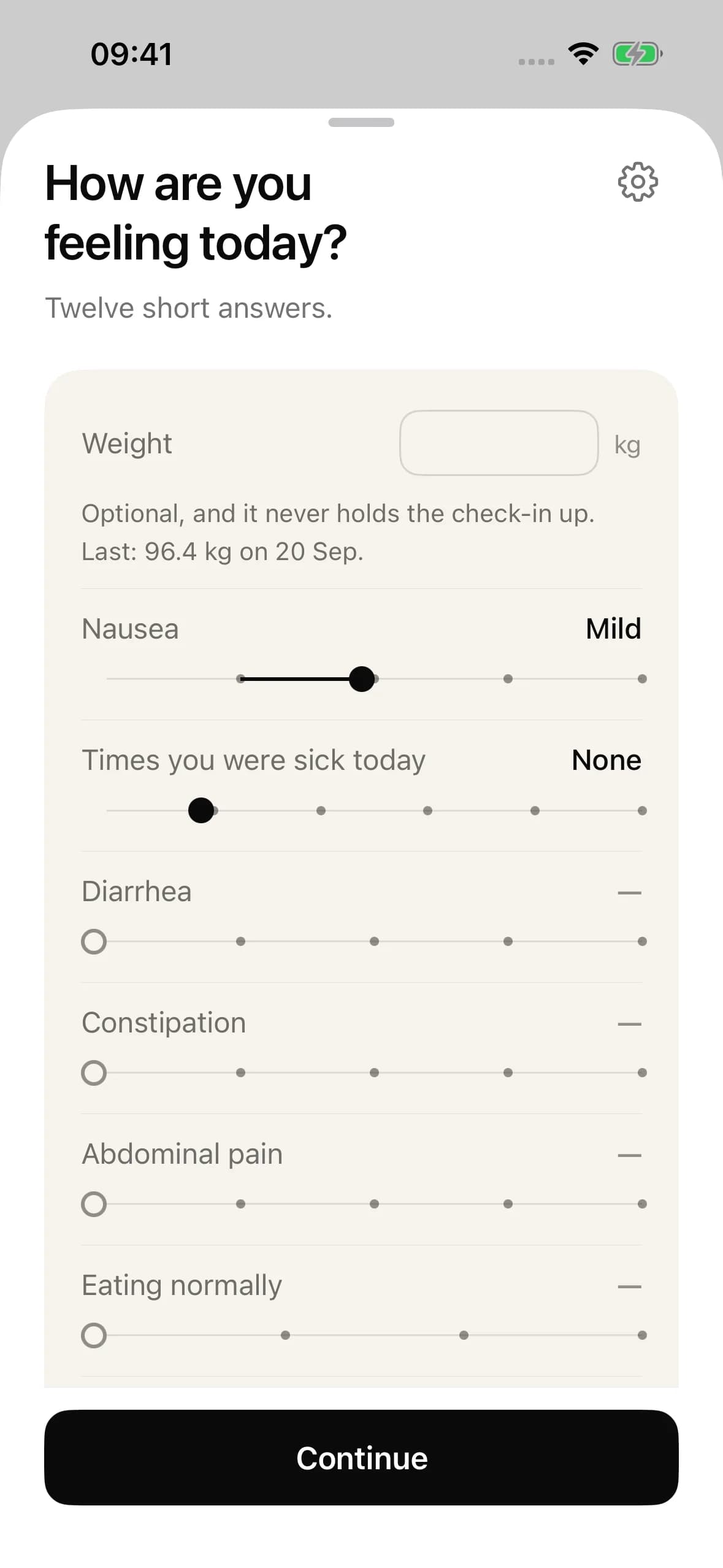
- Handle's free check-in asks about nausea every day plus the symptoms you choose, and tracks up to six more, such as heartburn or fatigue, or one in your own words. The consultation report, a Premium feature, shows your clinician how often you reported each one.
What a GLP-1 side effect tracker should record
A tracker earns its place when one week can be compared with the next. That takes less than you might think.
- The same symptoms, most days. A short list you answer daily beats a long one you abandon by week three.
- The same scale every time. None, mild, moderate or severe should mean the same thing in March as in June.
- Your doses, as taken. Dates and amounts, including any late or missed week and every dose change, so the timeline makes sense later.
- Anything in your own words. Some symptoms don't fit a list. A short label you choose, used the same way each time, still counts.
- Blanks as blanks. A day you didn't answer is unknown, not a good day. An honest gap is more useful than a guess.
- Fluids on rough days. Labels warn that losing fluids through vomiting or diarrhea can lead to kidney problems, so note any day you couldn't keep them down.1
The side effects worth tracking, from the label
Figures from the Zepbound label's pool of two 72-week weight-management trials. Other medicines' labels report different numbers from different trials, which can't be compared directly.
| Side effect | On Zepbound (5–15 mg) | On placebo | How to track it in Handle |
|---|---|---|---|
| Nausea | 25–29% | 8% | Asked every day |
| Diarrhea | 19–23% | 8% | A check-in question you choose |
| Constipation | 11–17% | 5% | A check-in question you choose |
| Vomiting | 8–13% | 2% | A check-in question you choose |
| Abdominal pain | 9–10% | 5% | A check-in question you choose |
| Indigestion (dyspepsia) | 9–10% | 4% | Heartburn or fullness, or your own words |
| Fatigue | 5–7% | 3% | A tracked symptom |
| Belching (eructation) | 4–5% | 1% | A tracked symptom |
| Reflux (GERD) | 4–5% | 2% | Track heartburn |
| Dizziness | 4–5% | 2% | A check-in question you choose |
| Hair loss | 4–5% | 1% | Your own words |
Source: Zepbound prescribing information, Table 1 (SURMOUNT-1 and SURMOUNT-2 pooled).1 For each medicine's own figures, see Zepbound side effects, Wegovy side effects and our GLP-1 side effects guide. For burps that smell of rotten eggs, see our guide to sulfur burps.
Why the weeks after a dose change matter most
The labels tell a consistent story about stomach side effects. For Zepbound, most nausea, vomiting and diarrhea happened during dose escalation and decreased over time; Wegovy's label says these reactions were most often reported while the dose was being increased.1,2 Labels start low and step up gradually partly to reduce that risk, and your prescriber sets the steps.3
So the weeks after each change are the most useful to record. Keep your dose dates on the same record as your symptoms, so the timeline is clear when you look back with your prescriber.
Tiredness, dizziness and a changed sense of taste can come early too. Saxenda's label says these were mainly reported in the first 12 weeks, often alongside stomach symptoms.4
Free in Handle
Nausea every day, and only what you choose
Handle's daily check-in starts with nausea and adds the symptoms you pick, each on a fixed scale: none, mild, moderate or severe, or a simple yes or no for things like belching. It's the same short card every day, whatever you answer.
A few answers, such as severe nausea, come with a suggested next step like contacting your care team. Handle never diagnoses and is not a monitoring or emergency service, so don't wait for it: if you feel very unwell, contact your clinician or emergency services directly.
- Diarrhea, hunger, food noise or heartburn, if you want them
- Constipation, vomiting, abdominal pain or dizziness, switched on when you need them
- A day you skip stays blank, never "fine"
Free in Handle
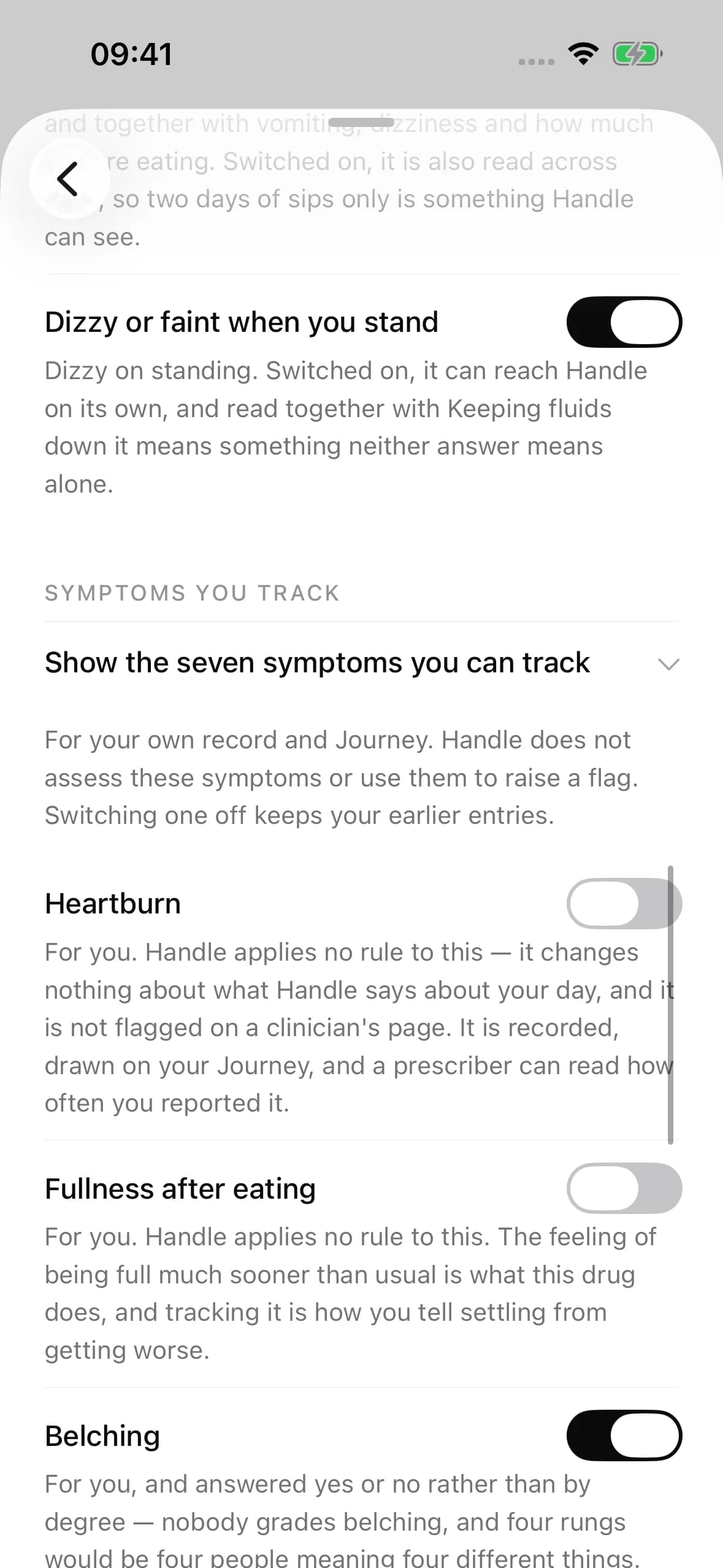
Track up to six more, or name your own
Choose from heartburn, fullness after eating, belching, metallic taste, headache and fatigue, or add one in your own words, like "bloating" or "hair shedding". Tracked symptoms are recorded and drawn on your Journey, and Handle applies no rules to them.
- Switch symptoms on or off at any time
- Up to six at once, so the card stays short
How to use a GLP-1 symptom tracker well
- 1Pick a moment
Check in at about the same time each day, such as before bed, so each answer covers a similar stretch.
- 2Answer for today
Rate the day as a whole, the same way each time, rather than how you feel this minute.
- 3Log doses as you take them
Include a late or missed dose. Forgot to log? Add it later, up to 30 days back, with the real date.
- 4Keep your own words consistent
One custom symptom, named the same way each time, is easier to read later than a dozen different notes.
- 5Look back weekly
Once a week is enough to see how things are going and what to raise.
- 6Bring the summary
Take the weekly picture to your appointment, or share it as a report. Here are the questions to ask your doctor about GLP-1.
A GLP-1 side effect tracker vs a notes app
| Handle | Paper diary or notes app | |
|---|---|---|
| Same scale every day | Built in | Up to you |
| Dose dates on the same record | Logged with each dose | A separate list, if you keep one |
| Symptoms in your own words | Yes, alongside the list | Yes |
| Adding a day you missed | Up to 30 days back, with the real date | Easy to blur dates |
| A weekly picture | Journey charts | Count it up yourself |
| Summary for your clinician | Consultation report (Premium) | Copy it out by hand |
| Tells you what a symptom means | No, that's for your clinician | No |
If you'd rather keep a paper diary, our printable GLP-1 dose and symptom log puts how you felt on the same line as each dose.
Handle PremiumPremium
A summary your clinician can read
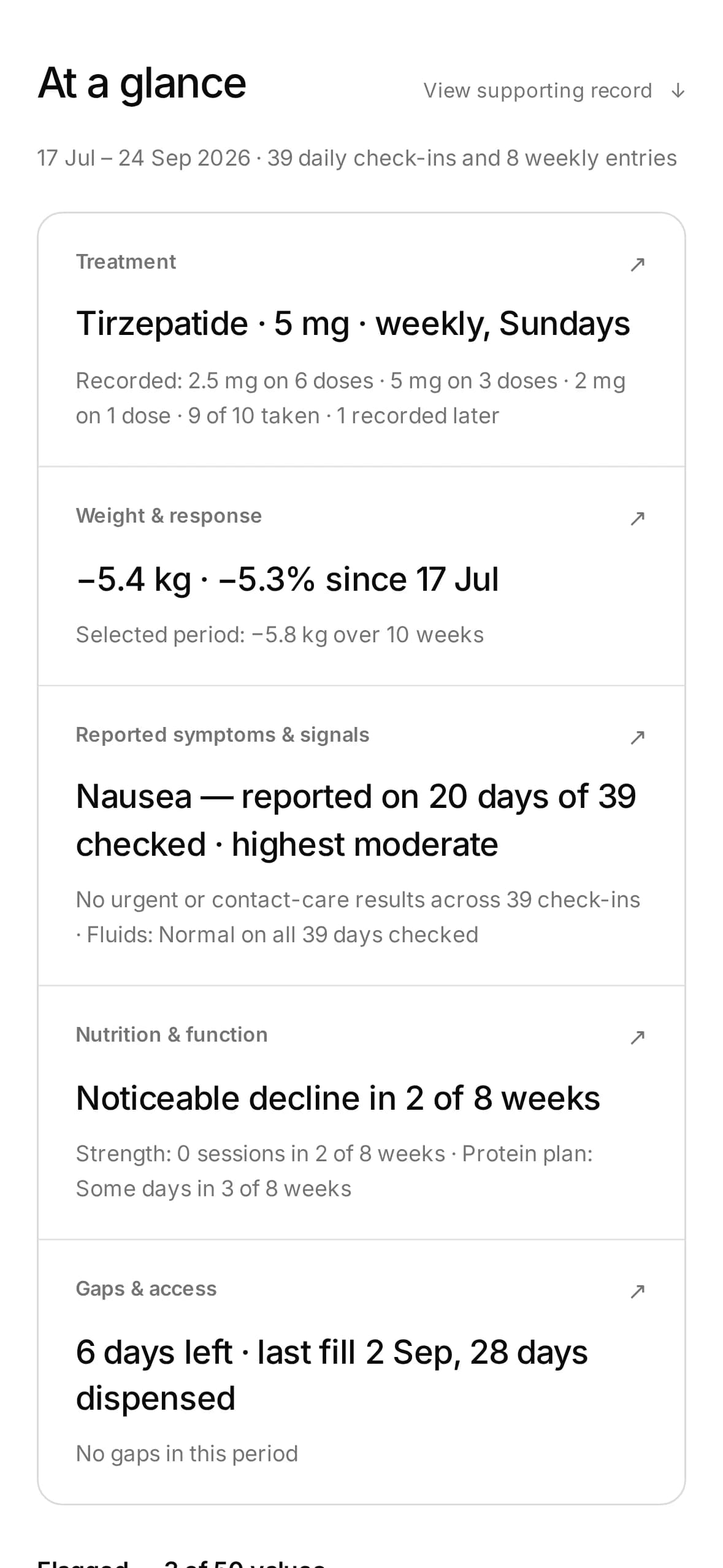
The consultation report, a Premium feature, turns your check-ins into a summary. For each symptom it shows the days you reported it, the days you answered and the highest severity you recorded, with a week-by-week breakdown.
It's a summary, not a diary: no day-by-day entries, and never your private notes. A day you didn't answer shows as not recorded, not as symptom-free.
- Share a secure link and revoke it any time
- Your clinician needs no account
- Add a note about what you want to discuss
Premium is an optional subscription in the iPhone app.
Tracking Mounjaro, Ozempic or Wegovy side effects
The check-in works the same whichever GLP-1 you take. Handle lists Mounjaro, Zepbound, Ozempic, Wegovy, Rybelsus, Saxenda, Victoza and Trulicity by name, and any other medicine, including newer pills such as Foundayo or the Wegovy pill, can be added under its own name and schedule.
The labels differ in detail. Wegovy's lists headache (14% versus 10% on placebo) and fatigue (11% versus 5%) in its 68-week weight trials, and Ozempic's names fatigue, a change in taste and dizziness among less common ones.2,3 Our pages on Mounjaro side effects, Ozempic side effects and Wegovy side effects go label by label, and the Mounjaro tracker and Ozempic tracker pages cover dose logging.
What a side effect tracker can't do
A tracker is a record, not a clinician. Handle doesn't diagnose, doesn't tell you what a symptom means, and doesn't decide whether your medicine caused it. Journey puts symptoms and doses on one timeline and says nothing about how they relate; that's a conversation for you and your prescriber.
Nor does it replace a phone call. The Zepbound medication guide asks you to tell your healthcare provider about any side effect that bothers you or doesn't go away.1 If something worries you, call rather than waiting for a pattern to form. And whatever you log, Handle never suggests a change to your dose.
Questions people ask
What is the best app to track GLP-1 side effects?+
The best one is the one you'll keep using. Look for a short daily check-in on a fixed scale, room for symptoms in your own words, your dose dates on the same record, and a way to share a summary with your clinician. Handle's check-in is free, and its shareable report is part of Premium.
Is there a free GLP-1 symptom tracker?+
Yes. Handle's daily check-in, up to six tracked symptoms, dose logging and Journey charts are free, with no ads. The consultation report you can share with your clinician is a Premium feature. Our free GLP-1 tracker guide lists exactly what's included.
How do I track side effects on Mounjaro, Ozempic or Wegovy?+
The same way for each: answer a short check-in every day on a fixed scale, log each dose as you take it, and note every dose change. Handle lists these medicines by name, so your doses and symptoms sit on one record. For label details, see Mounjaro side effects.
How long do GLP-1 side effects last?+
It varies from person to person. Labels say most nausea, vomiting and diarrhea happened while the dose was being increased, and decreased over time.1 A tracker is the easiest way to see how your own weeks are going, and to show your prescriber if something isn't settling.
Should I keep a side effects journal on tirzepatide or semaglutide?+
It helps, especially in the first months and after each dose change. Keep it short: the same symptoms, on the same scale, each day, with your doses alongside. Consistency matters more than detail, and a week-by-week picture is far easier for your prescriber to read than pages of notes.
Will Handle tell me if a side effect is serious?+
Don't rely on it for that. Handle records what you report, doesn't diagnose, and is not a monitoring or emergency service. If a symptom worries you, contact your clinician, and for severe symptoms get medical help straight away. The label lists the ones that need urgent attention.1
Can I track a symptom that isn't on the list?+
Yes. Add one in your own words, such as "bloating" or "hair shedding", alongside Handle's list: heartburn, fullness after eating, belching, metallic taste, headache and fatigue. You can track up to six at once, and switch them on or off whenever you like.
Does my doctor see every check-in?+
No. The consultation report, a Premium feature, summarizes each symptom: the days you reported it, the days you answered and the highest severity recorded, with a weekly breakdown. It never includes a day-by-day diary or your private notes, and you decide when to share it.
Sources
- Eli Lilly and Company, via DailyMed (U.S. National Library of Medicine). Zepbound (tirzepatide) injection — Prescribing Information and Medication Guide, effective August 28, 2026.
- Novo Nordisk, via DailyMed (U.S. National Library of Medicine). Wegovy (semaglutide) injection and tablets — Prescribing Information, effective June 18, 2026.
- Novo Nordisk, via DailyMed (U.S. National Library of Medicine). Ozempic (semaglutide) injection — Prescribing Information, effective June 1, 2026.
- Novo Nordisk, via DailyMed (U.S. National Library of Medicine). Saxenda (liraglutide) injection — Prescribing Information, effective February 25, 2026.
Written by the Handle team from the sources above, last checked on September 23, 2026. How we write: our editorial policy. Spotted something out of date? Tell us at [email protected].
Handle supports recording and conversations with your care team. It does not diagnose, and it never tells you to start, change, skip or stop a dose. This page is general information, not medical advice. Always follow your prescriber and your medicine's instructions for use.