
What to eat on Ozempic
What to eat on Ozempic, with diabetes in mind
Ozempic is a type 2 diabetes medicine, so what to eat on Ozempic is partly a nausea question and partly a blood sugar one. Here's what the label, Novo Nordisk, the American Diabetes Association, the NHS and Diabetes UK say about food, drinks, skipped meals and alcohol, where the protein figures come from, and the questions worth taking to your care team.
On this page
- What to eat on Ozempic starts with your diabetes plan
- Foods to avoid on Ozempic: what each source says
- What to eat on Ozempic to avoid nausea
- Low blood sugar: when eating less matters
- Protein on Ozempic: the figures, and the disagreement
- Fluids on Ozempic: the label gives no number
- Constipation and diarrhea on Ozempic
- Ozempic in the UK
- Questions to bring to your next diabetes appointment
- Questions people ask
- Sources
In short
- Ozempic is approved "as an adjunct to diet and exercise" for adults with type 2 diabetes, and its Medication Guide says it may be taken with or without food.1
- For nausea, Novo Nordisk's Ozempic site (August 2026) suggests bland, low-fat foods like crackers, toast and rice for no more than a couple of days, foods that contain water like soups, eating more slowly, and avoiding fried, greasy or sweet foods.2
- Low blood sugar is less likely on Ozempic alone than with a sulfonylurea (documented symptomatic lows in 17.3–24.4% of patients, according to the label), and the American Diabetes Association says smaller portions, skipped or delayed meals and alcohol on an empty stomach can lead to a low for people on such medicines.1,6
- Alcohol may worsen nausea and reflux on GLP-1 medicines, according to a 2025 advisory for clinicians, and the NHS tells people at risk of lows not to drink alcohol without eating.10,7
- Protein advice varies: the ADA's 2026 Standards say protein goals "should be individualized" and the 2025 advisory says there is "still no consensus on the optimal approach", so ask your clinician or dietitian what's right for you.4,10
What to eat on Ozempic starts with your diabetes plan
Ozempic is approved for adults with type 2 diabetes "as an adjunct to diet and exercise", and, for some people with type 2 diabetes, to lower the risk of certain heart and kidney problems.1 It isn't approved for weight management; semaglutide for weight loss is sold as Wegovy (see Ozempic vs Wegovy). So the starting point is the eating plan you already have for diabetes, not a new diet.
The label describes a minor delay in stomach emptying just after meals, and says Ozempic may be taken with or without food, at any time of day.1 Diabetes UK puts it plainly: GLP-1 medicines "slow down how quickly food is digested, make you full for longer and can reduce your appetite, so you eat less."8 Much GLP-1 diet advice is written for weight loss; even the 2025 advisory on nutrition with these medicines says type 2 diabetes is "not the focus".10
What the ADA's 2026 Standards say about eating
The American Diabetes Association's Standards of Care are written for clinicians. These are the parts that touch food and drink for people on medicines like Ozempic.
| Topic | What the Standards say |
|---|---|
| Eating pattern | Emphasize nonstarchy vegetables, whole fruits, legumes, lean proteins, whole grains, nuts and seeds, and low-fat dairy or nondairy alternatives; minimize red meat, sugar-sweetened drinks, sweets, refined grains, and processed and ultraprocessed foods.4 |
| Stomach side effects on GLP-1 medicines | Clinicians should give guidance on eating to ease them: smaller meals, mindful eating such as stopping once full, and less high-fat or spicy food.5 |
| Protein | Goals "should be individualized based on current eating patterns", and protein intake should be optimized alongside resistance training.4,5 |
| Nutrition while losing weight | People losing weight on purpose should be counseled and regularly monitored, with attention to preventing protein insufficiency and micronutrient deficiencies.4 |
| Alcohol | Adults who drink shouldn't exceed recommended daily limits and non-drinkers shouldn't start; people with diabetes should know the signs of delayed low blood sugar after drinking, especially with insulin or insulin secretagogues such as sulfonylureas.4,1 |
Foods to avoid on Ozempic: what each source says
Nothing is off-limits on Ozempic's label. What the guidance does single out is mostly about easing stomach side effects, and each source is named below. None of them links particular foods to sulfur burps; our sulfur burps guide covers what's known.
| Food or drink | Source, and what it says |
|---|---|
| Fried, greasy or sweet food | Novo Nordisk: avoid fried, greasy or sweet foods if you feel sick.2 ADA: guidance to ease stomach side effects includes less high-fat or spicy food.5 |
| Big meals | ADA: smaller meals, and stopping once full.5 The advisory links vomiting to large meals.10 |
| Lying down after eating | Novo Nordisk: avoid lying down after you eat.2 |
| Sugary drinks, sweets and refined grains | ADA: minimize them in a diabetes eating pattern, along with red meat and processed and ultraprocessed foods.4 |
| Alcohol | Advisory: it may worsen nausea and reflux on GLP-1 medicines and should be minimized.10 With insulin or a sulfonylurea, it can also cause a low.6,1 |
| Strong smells, and dairy on diarrhea days | Wegovy's page suggests asking your care team "What should I avoid (eg, strong smells)?" when you feel sick, and "What should I avoid (eg, dairy)?" when you have diarrhea.3 |
One exception matters. If you take insulin or a sulfonylurea, the NHS lists a small glass of fruit juice or a sugary fizzy drink among the ways to treat a low, so advice to limit sugary drinks never overrides the plan your care team gave you for one.7
What to eat on Ozempic to avoid nausea
Novo Nordisk's Ozempic site says some people may feel nausea when starting Ozempic or after a dose increase, and offers "general nausea tips that you might find helpful" (page dated August 2026):2
- Eat bland, low-fat foods, like crackers, toast and rice. The site adds: "This diet isn't meant to last more than a couple days."
- Eat foods that contain water, like soups and gelatin.
- Avoid fried, greasy or sweet foods.
- Avoid lying down after you eat.
- Go outdoors for fresh air, and eat more slowly.
- Drink clear or ice-cold drinks.
According to the label, nausea, vomiting and diarrhea were mostly reported during dose escalation, and the Medication Guide asks you to tell your healthcare provider right away if they don't go away.1 More in Ozempic side effects.
Wegovy's version: questions to ask
For Wegovy, which is semaglutide for weight management, Novo Nordisk frames similar advice as a conversation: talk with your healthcare professional, and ask about tips such as eating more slowly, eating foods that contain water and going outside for fresh air.3 Its suggested questions are just as useful to ask on Ozempic:
- Nausea: "What foods should I eat (eg, crackers)?"
- Vomiting: "Could frequent small meals help?" and "Should I drink more fluids?"
- Diarrhea: "What should I prioritize in my diet (eg, hydration)?"
- Constipation: "What should I prioritize in my diet (eg, fiber)?" and "Should I try changing my exercise routine?"
Source: Wegovy's common side effects page, May 2026.3
Low blood sugar: when eating less matters
On its own, Ozempic doesn't usually cause low blood sugar: in the label's monotherapy trial, 1.6% on 0.5 mg and 3.8% on 1 mg reported documented symptomatic lows, against none on placebo. With a sulfonylurea, the figures were 17.3% and 24.4%, and 0.8% and 1.2% had a severe low.1 Diabetes UK agrees that GLP-1 medicines don't usually cause hypos on their own, but that hypos can happen with insulin or a sulfonylurea.8
That's where food comes in. The American Diabetes Association lists smaller portions, fewer carbs than planned, skipped meals or snacks, and delayed meals among the causes of lows in people taking insulin or certain diabetes medicines.6 A smaller appetite on Ozempic can bring exactly those changes; the NHS's advice for people at risk is not to skip or delay meals.7
Before you start, the Medication Guide asks you to talk to your healthcare provider about low blood sugar and how to manage it, and to say if you take insulin or a sulfonylurea. Signs it lists include dizziness, sweating, shakiness, a fast heartbeat, hunger, confusion and headache.1 If your appetite has dropped a lot, tell your diabetes team.
Have a plan for sick days
Being unwell changes eating quickly. Diabetes UK says that if you take a GLP-1 medicine with insulin, your team should discuss the signs of diabetic ketoacidosis (DKA) with you, and you should have a plan for when you're unwell, known as sick day rules; if you don't have one, ask.8 The Medication Guide asks you to tell your healthcare provider right away if nausea, vomiting or diarrhea doesn't go away.1
Alcohol on Ozempic
Alcohol matters on two counts. The 2025 advisory says it may worsen nausea and reflux with GLP-1 medicines and should be minimized.10 And for people whose diabetes medicines can cause lows, such as insulin or a sulfonylurea, alcohol can cause a severe low, sometimes many hours after drinking and especially on an empty stomach, the ADA says.6,1
The ADA's Standards advise people with diabetes who drink to stay within daily limits, and people who don't drink not to start.4 The NHS rule for anyone at risk of lows is simple: "do not drink alcohol without eating".7 How alcohol fits with your medicines is a question for your diabetes team.
Protein on Ozempic: the figures, and the disagreement
A smaller appetite can make protein harder to fit in, the advisory notes. It calls protein a priority for preserving muscle and bone, and suggests starting meals with protein-rich foods.10 How much is where the sources part ways:
| Source | What it says about how much |
|---|---|
| ADA Standards 2026, for diabetes | Typically 0.8–1.5 g per kg of body weight a day, or 15–20% of calories, for the general public, with no evidence that going above or below it improves health; goals "should be individualized".4 |
| 2025 advisory, for obesity | 0.8 g/kg a day is the general adult allowance; 1.2–1.6 g/kg a day has been "proposed during active weight reduction"; 1.5 g per kg of lean body mass is "considered more accurate" but needs body-composition data; and 80–120 g a day "may enhance adherence".10 |
| The same advisory, on limits | Intake shouldn't fall below 0.4–0.5 g/kg a day, and prolonged intake at or above 2 g/kg a day should be avoided.10 |
As the advisory itself puts it, "there is still no consensus on the optimal approach."10
Both documents are written for clinicians, and the advisory is about obesity, not diabetes. Later in 2025 the American Journal of Clinical Nutrition also published a letter questioning its evidence base, titled "Calling guidance evidence-based when it is not is against the ethos of science".11 None of these figures is a target for you: ask your clinician or dietitian what's right for you, and Handle will show the number they give you beside your totals, with who set it.
Strength training belongs in the same conversation
The ADA calls for extra emphasis on muscle-strengthening activity for people with diabetes treated with obesity medicines.4 In the advisory's view, extra protein on its own "is likely inadequate" to preserve muscle unless it comes with structured strength training. It recommends prescribing GLP-1 medicines alongside an exercise program of 150 minutes or more of moderate aerobic activity each week and strength work at least three times a week, fitted to each person's fitness and capacity.10 Your care team can tell you what's safe to start with.
Fluids on Ozempic: the label gives no number
Ozempic's Medication Guide says diarrhea, nausea and vomiting may cause a loss of fluids that may cause kidney problems, and that "it is important for you to drink fluids to help reduce your chance of dehydration". It doesn't say how much, and neither do the ADA's Standards ("sufficient" fluid) or the advisory ("adequate fluids").1,4,10
Everyday guidance gives numbers that vary with who wrote them. For the general population, the NHS says most people should drink enough that their pee is a clear pale yellow, and cites the Eatwell Guide's 6 to 8 cups or glasses a day, noting that people who are ill may need more.12 Figures written for people on these medicines differ again; our Mounjaro food guide sets them side by side. If your clinician sets you a fluid target, record it with who set it.
Free in Handle
A food log that shows totals, not verdicts
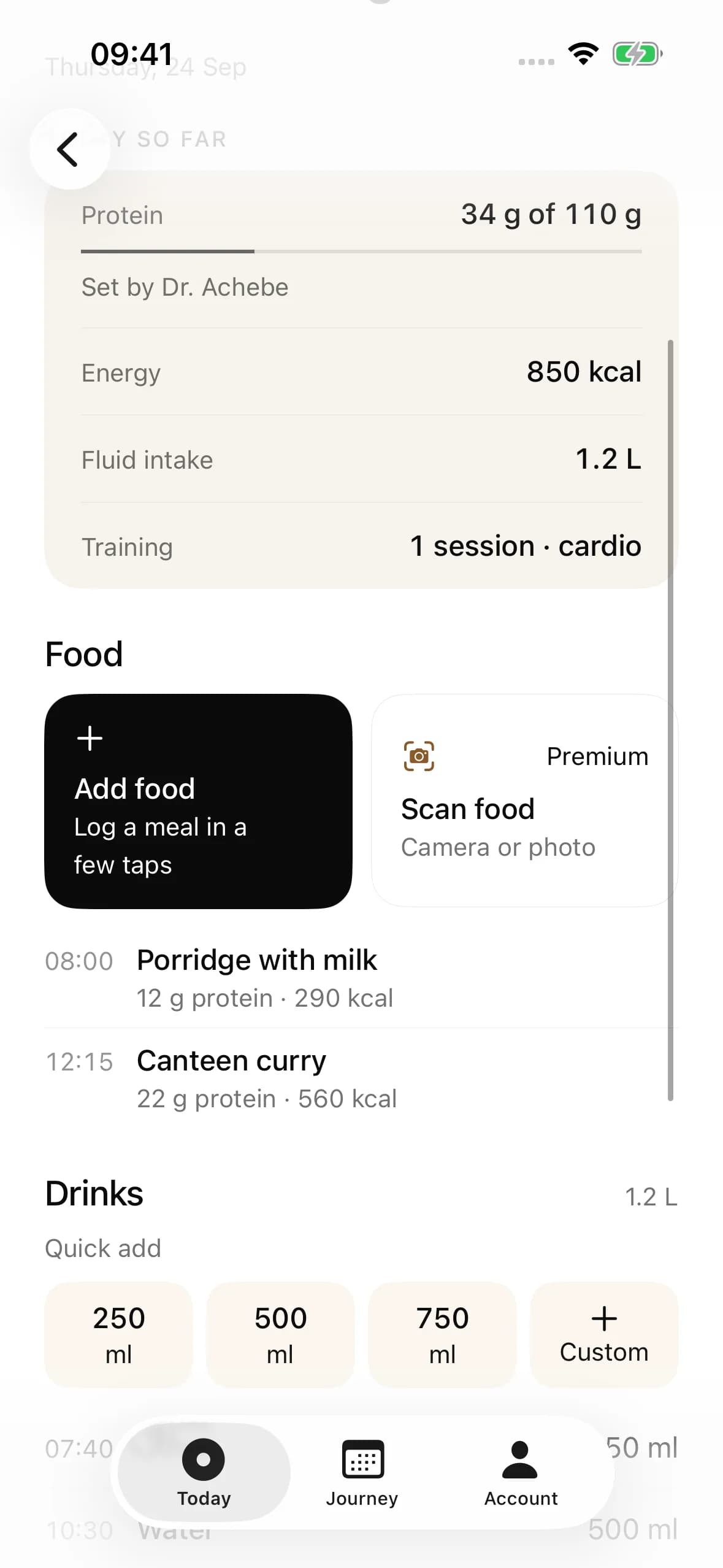
Look up foods from USDA data or type in your own, add drinks, and Handle totals the day's protein, calories and fluids. When your appetite is small, that gives you a record of how much you actually ate to show your care team. Handle never sets a protein, calorie or water goal of its own; if your clinician or dietitian gives you one, you record it with who set it. More in the GLP-1 food tracker guide.
- Daily totals for protein, calories and fluids
- Targets only when a clinician set them
- Resistance and cardio sessions kept separate
- Your Ozempic doses and check-ins on the same record
Constipation and diarrhea on Ozempic
Novo Nordisk's Ozempic page offers tips for nausea only.2 For constipation, the advisory says clinicians should encourage adequate fluids and fiber from foods, increasing foods such as prunes or other dried fruit gradually, and the ADA says encouraging enough fiber and water can be useful to prevent and manage constipation in people on very low-calorie diets.10,5 Because the advisory also suggests avoiding high-fiber foods during the first days of treatment to ease nausea, ask your care team what suits you now.10
For diarrhea, the advisory's suggestion is to avoid large or high-fat meals.10 Keep up your fluids, and tell your healthcare provider about stomach problems that are severe or won't go away; severe constipation, including fecal impaction, and bowel blockage have been reported since approval.1
Ozempic in the UK
The MHRA lists Ozempic as licensed to treat diabetes alongside a reduced-calorie diet and exercise, and not licensed for weight loss; Wegovy is the semaglutide brand licensed for weight management.9 It also notes that side effects such as nausea, vomiting and diarrhoea sometimes lead to severe dehydration needing hospital care.9 For UK readers, Diabetes UK points people taking GLP-1 medicines to the British Dietetic Association's guide to eating and living well.8
Handle PremiumPremium
Take the whole picture to your next diabetes appointment
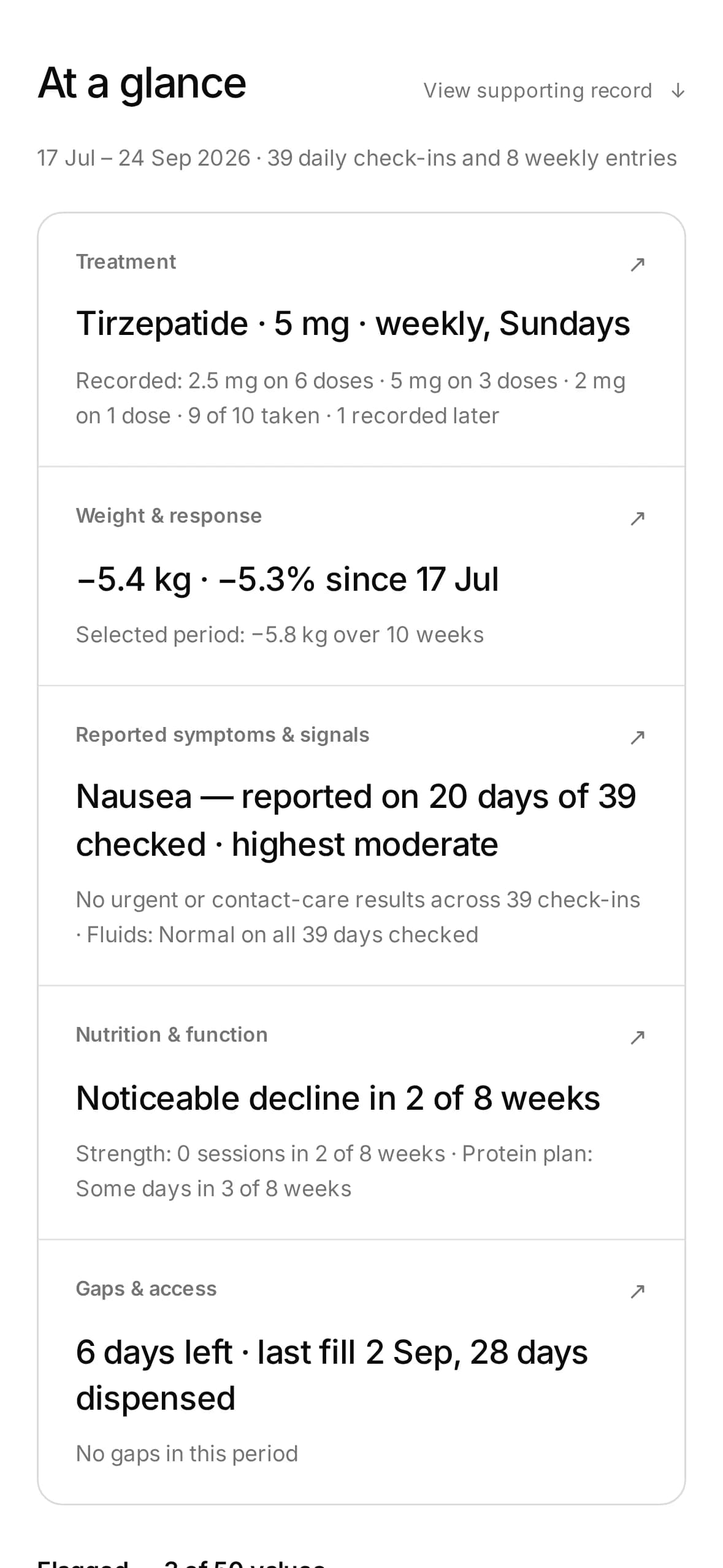
The consultation report, a Premium feature in the iPhone app, gathers your Ozempic record with symptom summaries, weight history, and nutrition and activity summaries, plus an optional note about what you want to discuss. Your clinician reads it from a secure link, with no account needed.
- Nutrition and activity beside your dose record
- Revoke the link whenever you like
- Your private daily notes are never included
Premium is an optional subscription in the iPhone app.
Questions to bring to your next diabetes appointment
For more on preparing, see our GLP-1 doctor appointment guide; the Ozempic tracker guide covers keeping doses, symptoms and food together.
- Now that I'm eating less, is my risk of low blood sugar different with my other medicines?
- What's my plan for sick days, including days I can't keep fluids down?
- How does alcohol fit with my medicines?
- Should I be aiming for a particular amount of protein, fluid or calories?
- Could I see a registered dietitian?
Questions people ask
What foods should you avoid on Ozempic?+
Ozempic's label doesn't ban any food. For nausea, Novo Nordisk suggests avoiding fried, greasy or sweet foods and not lying down after eating, and the ADA suggests smaller meals with less high-fat or spicy food.2,5 For diabetes generally, the ADA's eating pattern minimizes sugar-sweetened drinks, sweets, refined grains, red meat and ultraprocessed food.4 Your care team can say which matter most for you.
What should I eat on Ozempic when I feel nauseous?+
Novo Nordisk's Ozempic site suggests bland, low-fat foods like crackers, toast and rice, foods that contain water like soups and gelatin, eating more slowly, clear or ice-cold drinks, and fresh air, and says the bland diet isn't meant to last more than a couple of days.2 The Medication Guide asks you to tell your healthcare provider right away about nausea, vomiting or diarrhea that won't go away.1
Should Ozempic be taken with food?+
It doesn't need to be. The Medication Guide says Ozempic may be taken with or without food, once a week on the same day, at any time of day, and the label sets no special diet for injection day.1 Ozempic tablets, a separate daily pill for type 2 diabetes, come with their own rules about food and water; the Ozempic tracker guide covers them.
Can you drink alcohol on Ozempic?+
The 2025 advisory says alcohol may worsen nausea and reflux with GLP-1 medicines and should be minimized.10 If you take insulin or a sulfonylurea, alcohol can also cause low blood sugar, sometimes many hours later, and the NHS says not to drink without eating.6,7 The ADA advises staying within daily limits, and not starting if you don't drink.4 Ask your diabetes team what's safe for you.
Can Ozempic cause low blood sugar if you don't eat?+
On its own, Ozempic doesn't usually cause lows: in its monotherapy trial, 1.6–3.8% had documented symptomatic lows, against none on placebo.1 The risk is higher with insulin or a sulfonylurea, and the ADA says smaller portions and skipped or delayed meals can lead to a low for people taking those medicines.1,6 If your appetite has dropped, tell your diabetes team.
How much protein should I eat on Ozempic?+
There's no single figure. The ADA's 2026 Standards say protein goals "should be individualized", and the 2025 advisory, written for clinicians treating obesity, lists several figures but says there is "still no consensus on the optimal approach".4,10 Ask your clinician or dietitian what's right for you; any target they give you can go into Handle, labeled with who set it.
What should I eat on Ozempic when I'm not hungry?+
The advisory suggests small, frequent meals when hunger is low; smoothies, protein drinks, cottage cheese and soups, it says, are often more appealing than heavier food.10 If you take insulin or a sulfonylurea, eating much less can lead to a low, so tell your diabetes team.6 Eating very little can also leave gaps in vitamins and minerals, which the ADA asks clinicians to watch for.4
What should I eat on Wegovy?+
Wegovy is semaglutide, the same medicine as Ozempic, licensed for weight management.9 Novo Nordisk frames its Wegovy food tips as questions for your healthcare professional, such as whether frequent small meals would help, alongside eating more slowly, foods that contain water and fresh air.3 The low blood sugar advice here applies mainly to people taking insulin or a sulfonylurea. See Wegovy side effects.
Sources
- Novo Nordisk, via DailyMed (U.S. National Library of Medicine). Ozempic (semaglutide) injection — Prescribing Information and Medication Guide, effective June 1, 2026.
- Novo Nordisk, ozempic.com (US). Possible Side Effects of Ozempic (semaglutide) Injection, August 2026 (US26OZM00484).
- Novo Nordisk, wegovy.com (US). Common side effects | Wegovy (semaglutide), May 2026 (US26SEMO00199).
- American Diabetes Association Professional Practice Committee. Diabetes Care 2026;49(Suppl 1):S89–S131. 5. Facilitating Positive Health Behaviors and Well-being to Improve Health Outcomes: Standards of Care in Diabetes—2026, January 1, 2026.
- American Diabetes Association Professional Practice Committee. Diabetes Care 2026;49(Suppl 1):S166–S182. 8. Obesity and Weight Management for the Prevention and Treatment of Diabetes: Standards of Care in Diabetes–2026, January 1, 2026.
- American Diabetes Association. Causes and How to Prevent Hypoglycemia (Low Blood Glucose).
- NHS. Low blood sugar (hypoglycaemia), last reviewed August 3, 2023.
- Diabetes UK. GLP-1 agonists, content last reviewed July 28, 2026.
- Medicines and Healthcare products Regulatory Agency (UK). GLP-1 medicines for weight loss and diabetes: what you need to know, updated February 5, 2026.
- Mozaffarian D, et al. Obesity (Silver Spring) 2025;33(8):1475–1503; also published in The American Journal of Clinical Nutrition. Nutritional priorities to support GLP-1 therapy for obesity: A joint Advisory from the American College of Lifestyle Medicine, the American Society for Nutrition, the Obesity Medicine Association, and The Obesity Society, May 30, 2025.
- Dhurandhar EJ, et al. Letter, The American Journal of Clinical Nutrition 2025;122(5):1528–1530, followed by the advisory authors' reply. Calling guidance evidence-based when it is not is against the ethos of science, 2025.
- NHS. Water, drinks and hydration, last reviewed May 17, 2023.
Written by the Handle team from the sources above, last checked on September 24, 2026. How we write: our editorial policy. Spotted something out of date? Tell us at [email protected].
Handle supports recording and conversations with your care team. It does not diagnose, and it never tells you to start, change, skip or stop a dose. This page is general information, not medical advice. Always follow your prescriber and your medicine's instructions for use.