
Mounjaro vs Wegovy
Mounjaro vs Wegovy: two weight-loss jabs, side by side
Mounjaro vs Wegovy is a comparison of two weekly weight-loss jabs, both licensed in the UK and compared directly in one trial, SURMOUNT-5. Here is how they differ, from the medicine inside each to side effects, pens and NHS access, and how to keep a clear record of whichever you and your prescriber choose.
On this page
- Mounjaro vs Wegovy at a glance
- How Mounjaro and Wegovy work
- Mounjaro vs Wegovy for weight loss: the SURMOUNT-5 trial
- Mounjaro vs Wegovy side effects
- Pens, strengths and storage
- Oral Wegovy vs Mounjaro
- Mounjaro vs Wegovy in the UK
- Switching from Wegovy to Mounjaro: what to record
- Questions to ask your GP or prescriber
- Questions people ask
- Sources
In short
- Mounjaro (tirzepatide, made by Eli Lilly) and Wegovy (semaglutide, made by Novo Nordisk) are both once-weekly jabs licensed in the UK for weight management. Mounjaro acts on two gut-hormone receptors, GIP and GLP-1; Wegovy acts on GLP-1 alone.1,3,7,11
- In SURMOUNT-5, an open-label head-to-head trial, 751 adults with obesity but without type 2 diabetes lost 20.2% of their body weight on average over 72 weeks on the highest dose of tirzepatide they could tolerate, against 13.7% on semaglutide, counting everyone randomised.4
- Both mostly cause stomach side effects, such as nausea, diarrhoea, vomiting and constipation, mainly while the dose is being stepped up. In SURMOUNT-5, 6.1% on tirzepatide and 8.0% on semaglutide stopped because of side effects, though the trial was not designed to compare safety.4,5
- On the NHS in England, NICE recommends Mounjaro for adults with a BMI of at least 35 and a weight-related condition, introduced in phases, and Wegovy only through specialist weight management services, for up to two years.8,9
- Which jab suits you is for you and your prescriber to decide. Handle records either, including a switch between them, and never suggests a dose.
Mounjaro vs Wegovy at a glance
The key facts side by side. Strengths are what the pens are made in, not a dose to take; your prescriber decides that.
| Mounjaro | Wegovy | |
|---|---|---|
| Made by | Eli Lilly and Company | Novo Nordisk |
| Medicine | Tirzepatide1 | Semaglutide3 |
| How it works | Acts on two gut-hormone receptors, GIP and GLP-11 | Acts on the GLP-1 receptor3 |
| Licensed in the UK for | Type 2 diabetes and weight management, under one brand; the weight-management licence dates from 8 November 20237 | Weight management, and lowering the risk of serious heart problems11 |
| Weight trials | The SURMOUNT programme | The STEP programme |
| How it's taken | Once a week, any time of day, with or without meals, into the abdomen or thigh, or the back of the upper arm if someone else injects1 | Once a week on the same day, any time of day, with or without meals, into the abdomen, thigh or upper arm3 |
| Strengths | 2.5, 5, 7.5, 10, 12.5 and 15 mg1 | 0.25, 0.5, 1, 1.7, 2.4 and 7.2 mg3 |
| Head-to-head result (SURMOUNT-5, 72 weeks) | −20.2% body weight on average4 | −13.7% body weight on average4 |
| Tablet version | None: Mounjaro is made only as an injection1 | The Wegovy pill, approved in the UK on 11 June 2026 and not currently on the NHS10 |
| Half-life | About 5 days1 | About 1 week3 |
| Storage | Fridge (2–8 °C); a single-dose pen can be kept unrefrigerated, up to 30 °C, for up to 21 days in total1 | Fridge (2–8 °C); a single-dose pen can be kept at 8–30 °C for up to 28 days3 |
| Contraceptive pill | The label advises a non-oral method, or adding a barrier method, for 4 weeks after starting and after each dose increase1 | No such instruction in the label3 |
| US boxed warning | Thyroid C-cell tumours seen in rodents; not for people with a personal or family history of medullary thyroid cancer or MEN 21 | The same3 |
| NHS in England | NICE: a BMI of 35 or more with a weight-related condition, introduced in phases8 | NICE: only within specialist weight management services, for up to 2 years9 |
Label details are from the US prescribing information (Mounjaro effective 27 August 2026; Wegovy 18 June 2026). UK product information can differ in wording.1,3
How Mounjaro and Wegovy work
Both jabs act on receptors for gut hormones, but they are different medicines, not stronger and weaker versions of one. Wegovy's semaglutide acts on the GLP-1 receptor. Mounjaro's tirzepatide is a single molecule that acts on two receptors, GIP and GLP-1.1,3
The tirzepatide label describes GLP-1 as a natural regulator of appetite and food intake, and says non-clinical studies suggest adding GIP may contribute further.2 Both medicines slow the emptying of the stomach; for tirzepatide, the label says this effect is largest after the first dose and fades over time.2,3 Both labels also say the weight lost is more fat than lean mass.2,3
Tirzepatide has a half-life of about 5 days and semaglutide about a week, which is what allows a once-weekly jab.1,3 For every GLP-1 medicine side by side, see our guide to GLP-1 medications.
Mounjaro vs Wegovy for weight loss: the SURMOUNT-5 trial
SURMOUNT-5 is the trial that compared the two medicines directly for weight management. It randomised 751 adults with obesity, or overweight with a weight-related condition, and without type 2 diabetes, to the highest dose each person could tolerate of tirzepatide (10 or 15 mg) or semaglutide (1.7 or 2.4 mg), injected weekly for 72 weeks alongside lifestyle advice.4,5 In the US, tirzepatide for weight loss is sold as Zepbound, the same medicine as Mounjaro.2
| Tirzepatide (Mounjaro's medicine) | Semaglutide (Wegovy's medicine) | |
|---|---|---|
| Average change in body weight | −20.2%4 | −13.7%4 |
| Average weight lost | 22.8 kg5 | 15.0 kg5 |
| Average change in waist size | −18.4 cm4 | −13.0 cm4 |
| Lost at least 10% | 81.6%5 | 60.5%5 |
| Lost at least 15% | 64.6%5 | 40.1%5 |
| Lost at least 20% | 48.4%5 | 27.3%5 |
| Lost at least 25% | 31.6%5 | 16.1%5 |
| Stopped because of side effects | 6.1%5 | 8.0%5 |
| Serious adverse events | 4.8%6 | 3.5%6 |
Averages count everyone randomised, whether or not they kept taking the medicine (the treatment-regimen estimand). The threshold figures are Lilly's analysis on the same basis; ClinicalTrials.gov lists higher figures because it counts only people with week-72 data, so don't mix the two sets.5,6
What SURMOUNT-5 can and can't tell you
- It was open-label: participants and their doctors knew which medicine each person was taking.4
- It was not designed to compare safety, so the side-effect differences are descriptive.5
- Nobody in it had type 2 diabetes, and it took place in the US and Puerto Rico.4,6
- Semaglutide went up to 2.4 mg; Wegovy's higher 7.2 mg dose was not part of the trial.4
- The results are group averages, not a prediction for you. For the molecules in more depth, see semaglutide vs tirzepatide.
Mounjaro vs Wegovy side effects
In SURMOUNT-5, the most common side effects of both medicines were stomach-related, mostly mild to moderate and mainly while the dose was being stepped up.4 These are the figures posted on the trial registry: non-serious adverse events reported by at least 5% of either group (374 people on tirzepatide, 376 on semaglutide), leaving out infections such as COVID-19 and colds.
| Side effect | Tirzepatide | Semaglutide |
|---|---|---|
| Nausea | 43.6% | 44.4% |
| Constipation | 27.0% | 28.5% |
| Diarrhoea | 23.5% | 23.4% |
| Vomiting | 15.0% | 21.3% |
| Tiredness (fatigue) | 10.4% | 12.2% |
| Belching (eructation) | 9.9% | 7.7% |
| Injection-site reaction | 8.6% | 0.3% |
| Hair loss (alopecia) | 8.3% | 6.1% |
| Headache | 7.2% | 7.2% |
| Bloating (abdominal distension) | 7.2% | 6.4% |
| Abdominal pain | 6.4% | 6.9% |
| Dizziness | 6.4% | 4.8% |
| Reflux (GORD) | 6.1% | 10.6% |
| Indigestion (dyspepsia) | 5.9% | 7.4% |
| Decreased appetite | 4.5% | 5.1% |
From the SURMOUNT-5 results on ClinicalTrials.gov.6 The trial was open-label and not designed to compare safety, so treat small differences with caution.5 More detail: Mounjaro side effects and Wegovy side effects.
Both labels say hair loss on these medicines was associated with weight reduction.2,3 Both also carry the same serious warnings, including pancreatitis, gallbladder problems, kidney injury from dehydration and serious allergic reactions, and the risk of breathing in stomach contents during a general anaesthetic or deep sedation, so tell the team before any planned procedure that you are on one of these jabs.1,3
‘Sulphur burps’ is not a term either label uses; they record belching (eructation) and indigestion. The Wegovy label also carries a warning about increased heart rate, and at its 7.2 mg dose 22% of people reported dysaesthesia, an altered or painful sensation in the skin, against 6% on 2.4 mg and 0.3% on placebo.3
For everyday queasiness, simple measures can help: smaller meals, eating slowly, stopping when you feel full, going easy on greasy or very sugary food and keeping up your fluids, with fibre and fluids for constipation. More in our guides to what to eat on Mounjaro and what to eat on Ozempic and Wegovy. Tell your GP or care team if symptoms are severe, don't settle or stop you keeping fluids down.
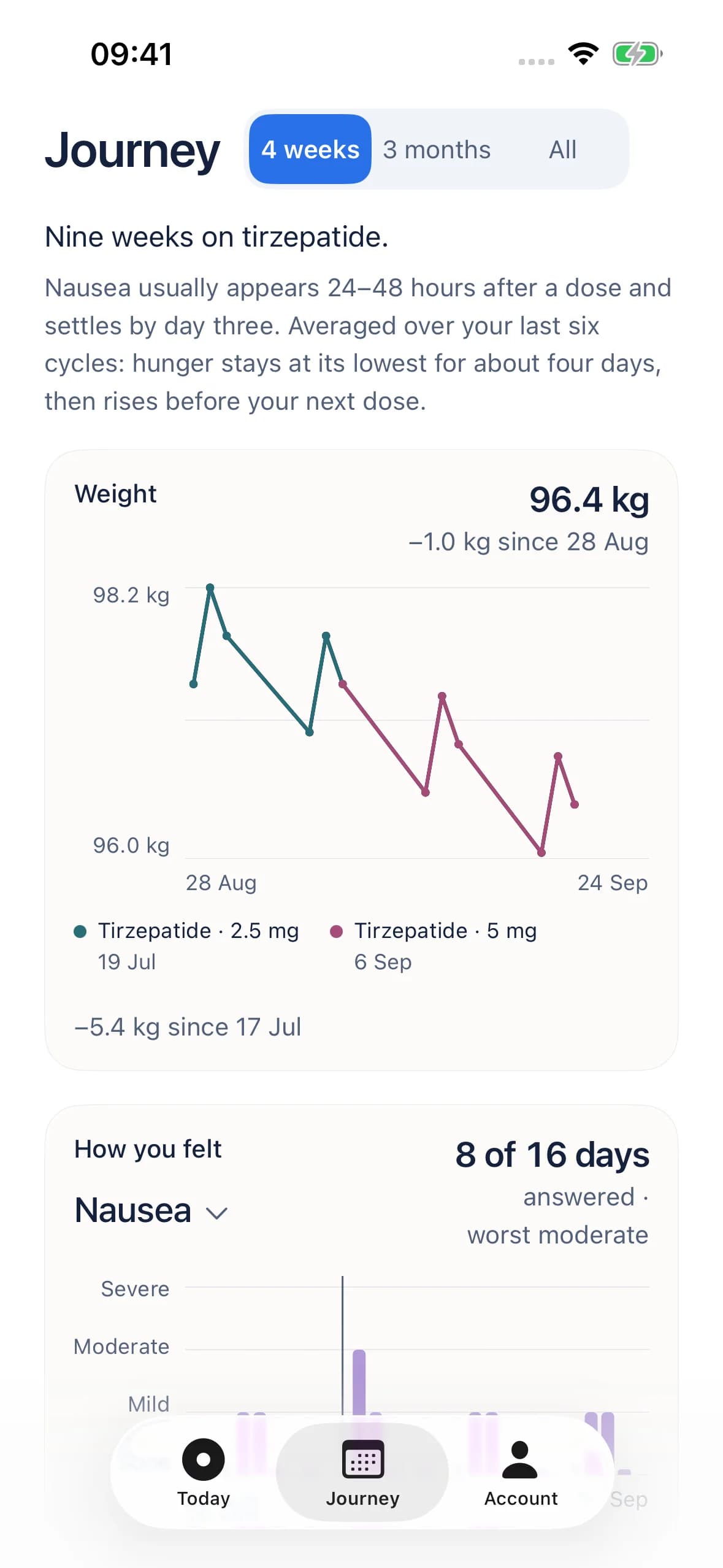
In Handle
Keep the early weeks on record
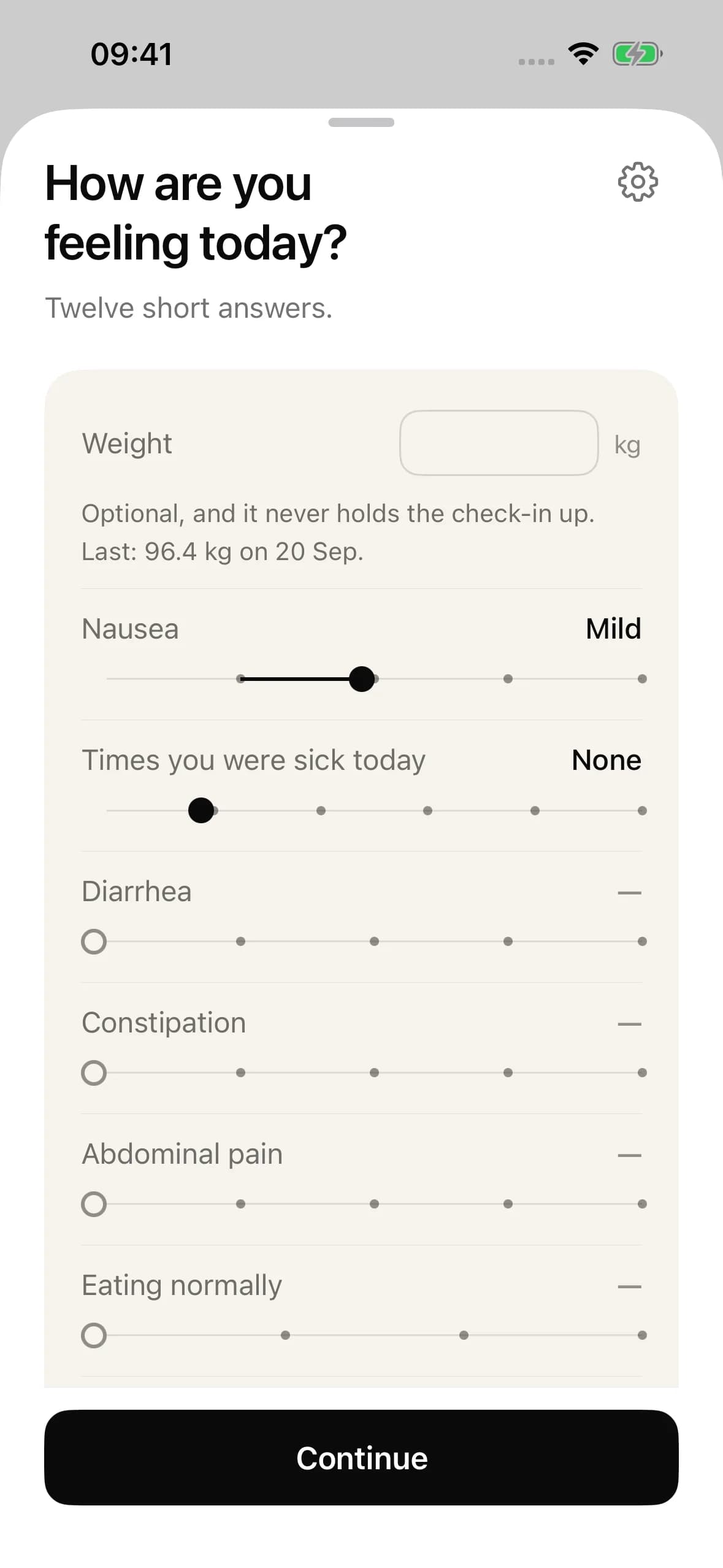
Whichever jab you're prescribed, the weeks after each dose increase are the ones worth writing down. Log each dose and where you injected it, then answer a short daily check-in: nausea every day, plus the symptoms you choose.
Some answers, such as severe nausea, come with a clear next step, like contacting your care team. Handle never diagnoses and is not a monitoring or emergency service, so if you feel very unwell, contact your GP, NHS 111 or the emergency services directly.
- Mounjaro and Wegovy are both listed by name
- Diarrhoea, constipation, vomiting and more if you switch them on
- Forgot to log? Add entries up to 30 days back
Pens, strengths and storage
Mounjaro is made in six strengths, from 2.5 mg to 15 mg, and Wegovy in six, from 0.25 mg to 7.2 mg (the 7.2 mg pen is sold as Wegovy HD in the US).1,3 Both labels start low and step up gradually to lower the risk of stomach side effects; your prescriber decides each step and when. A higher number on the pen is not a measure of how well you're doing.
The pens differ. In the US labels, Mounjaro's KwikPen holds four weekly doses and is thrown away 30 days after first use, or after four doses, even if medicine is left in it; the Wegovy FlexTouch pen holds four 2.4 mg doses, and both brands also come as single-dose pens.1,3 Our guide to Mounjaro injection sites covers where to inject and how to rotate.
If you miss a dose, each jab has its own rule in its instructions, and the two are different. Ask your GP, prescriber or pharmacist rather than guessing. Handle records what actually happened and never tells you to catch up.
Oral Wegovy vs Mounjaro
The Wegovy pill is oral semaglutide, taken once a day. The MHRA approved it on 11 June 2026 and it is not currently available on the NHS. The UK instructions are to take it on an empty stomach after fasting for at least 8 hours, with a sip of water, and then to wait at least 30 minutes before eating or drinking.10
In its main trial, OASIS 4, adults with overweight or obesity and without diabetes lost 13.6% of their body weight on average over 64 weeks on the 25 mg tablet, against 2.4% on placebo, counting everyone randomised.3 That was a separate trial from SURMOUNT-5, so the figures cannot be compared directly.
Mounjaro is made only as an injection, as our guide to whether there is a Mounjaro pill explains. Lilly's once-daily tablet is a different medicine, Foundayo (orforglipron); see Foundayo vs Zepbound. For the pill against the jab, see Wegovy pill vs injection.
Mounjaro vs Wegovy in the UK
Both are licensed in the UK for weight management. The MHRA authorised Mounjaro for weight management on 8 November 2023, so in the UK one brand covers both type 2 diabetes and weight loss.7 In the US the same medicine is sold for weight loss as Zepbound, which is why American articles compare Zepbound vs Wegovy instead; Mounjaro vs Zepbound explains the naming.2
On the NHS in England, NICE recommends tirzepatide for weight management in adults with a BMI of at least 35 and at least one weight-related condition, with a threshold usually 2.5 lower for people from South Asian, Chinese, other Asian, Middle Eastern, Black African or African-Caribbean backgrounds.8 It is being introduced in phases: first for people with a BMI of 40 or more and at least four of five listed conditions (high blood pressure, abnormal blood fats, obstructive sleep apnoea, cardiovascular disease and type 2 diabetes); from around June 2026, a BMI of 35 to 39.9 with at least four; and from around March 2027, a BMI of 40 or more with three.8
NICE recommends semaglutide (Wegovy) for weight management only within a specialist weight management service, for a maximum of two years, for adults with a weight-related condition and a BMI of at least 35, or 30 to 34.9 if they meet the criteria for referral, with lower thresholds for some ethnic backgrounds.9 Separately, the MHRA approved a weekly Wegovy dose of up to 7.2 mg on 6 January 2026, for adults with obesity (a BMI of 30 or more) only.11
If you pay privately, prices for both vary by pharmacy and change often.
Switching from Wegovy to Mounjaro: what to record
Moving from one jab to the other is your prescriber's decision, and they set the timing and the starting dose. This page does not cover either, or any waiting period. What you can do is keep a record that makes the change easy to review.
- Your last Wegovy dose. The date, the strength and where you injected it.
- Your first Mounjaro dose. The date, the strength and the pen, exactly as prescribed.
- What your prescriber said. The plan in their words, and when they want to review it.
- How the next few weeks feel. Nausea, appetite, bowel changes and anything new, especially after each dose increase.
- Your weight trend. Weekly averages across the switch, rather than any single morning.
- Contraception, if it applies. Mounjaro's label advises people on the pill to use a non-oral method, or add a barrier method, for 4 weeks after starting and after each dose increase, and the MHRA has highlighted the same point, so note those dates.1,12
Handle keeps both medicines on one record, so the switch sits in the same history as everything before it. The Mounjaro tracker and Wegovy tracker guides go into more detail.
Handle PremiumPremium
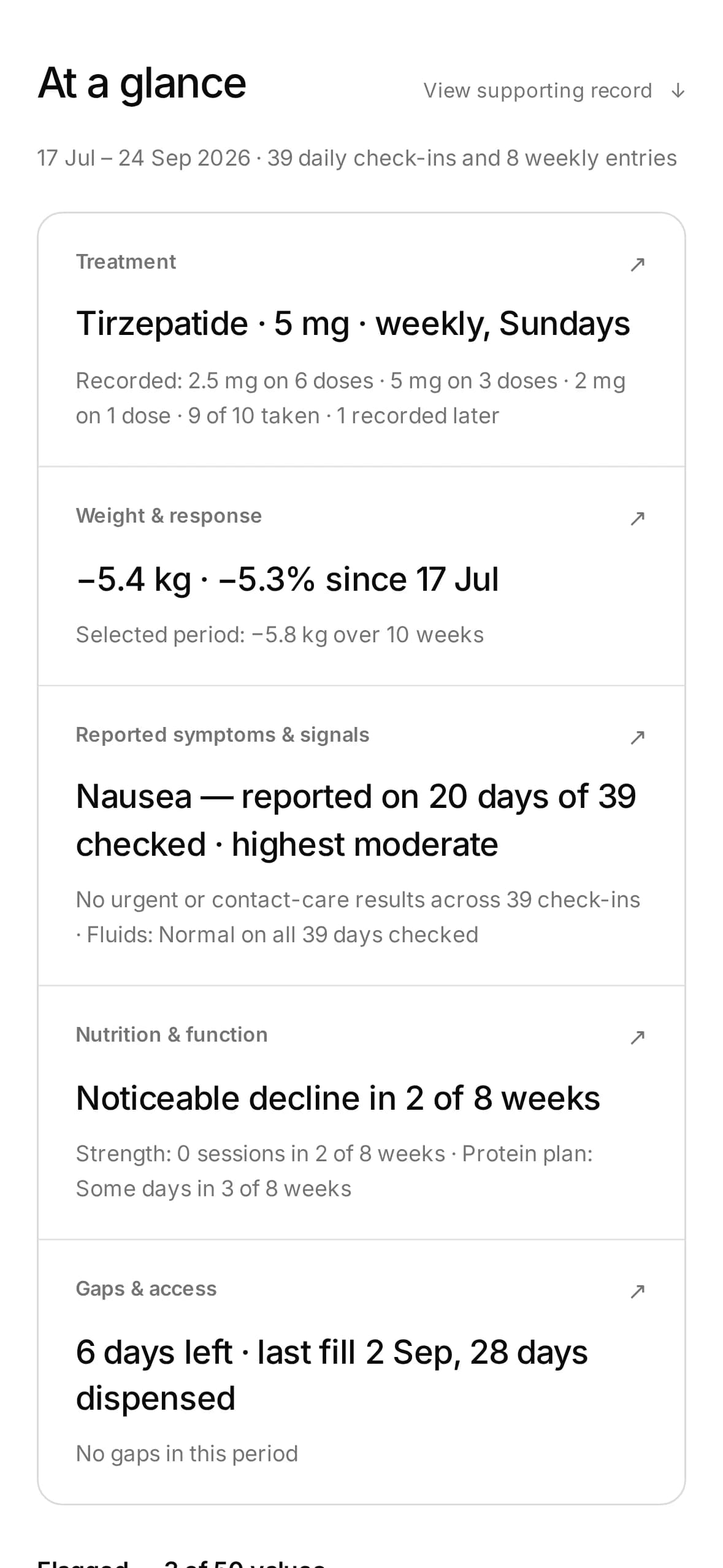
A summary your GP can read quickly
Before a review, the consultation report brings together your medication record, including a switch from one jab to another, your weight history, symptom summaries, nutrition and activity, and an optional note about what you want to discuss.
- Share a secure link, and revoke it whenever you like
- Your private daily notes are never included
- Your GP or prescriber needs no account to read it
Premium is an optional subscription in the iPhone app.
Questions to ask your GP or prescriber
Bring these to your next appointment; there is more in preparing for a GLP-1 appointment.
- Which of the two fits my health, my other medicines and my goals, and why?
- Is this an NHS or a private prescription, and does that change which jab I would have?
- What should I do if I miss a dose? (Mounjaro and Wegovy each have their own rule.)
- Which side effects should I contact you about, and which can I manage at home?
- I take the contraceptive pill: what should I do about contraception?
- If I switch jabs, how will we plan it, and when will we review it?
Questions people ask
Is Mounjaro better than Wegovy?+
In SURMOUNT-5, the open-label trial that compared them directly, adults with obesity but without type 2 diabetes lost 20.2% of their body weight on average over 72 weeks on tirzepatide (Mounjaro's medicine), against 13.7% on semaglutide (Wegovy's).4 But that is a group average, the side effects were broadly similar, and ‘better’ depends on your health, other medicines and goals. That judgement belongs to you and your prescriber.
What is the difference between Mounjaro and Wegovy?+
They are different medicines from different companies. Mounjaro is tirzepatide, from Eli Lilly, and acts on two gut-hormone receptors, GIP and GLP-1; Wegovy is semaglutide, from Novo Nordisk, and acts on GLP-1 alone.1,3 Both are weekly jabs licensed for weight management in the UK, but they come in different strengths and pens, and NICE sets different terms for each on the NHS.8,9
Which has more side effects, Mounjaro or Wegovy?+
In SURMOUNT-5, nausea was about equally common (43.6% on tirzepatide, 44.4% on semaglutide); vomiting and reflux were reported more often on semaglutide, and injection-site reactions more often on tirzepatide.6 Slightly fewer people stopped tirzepatide because of side effects (6.1% vs 8.0%), but the trial was not designed to compare safety.5
Can you switch from Wegovy to Mounjaro?+
Yes, if your prescriber decides it is right for you, and it is their job to set the timing and the starting dose; this page does not cover either. What helps is a good record: the date and strength of your last Wegovy dose and your first Mounjaro dose, and how you feel over the following weeks. Handle keeps both medicines on one record.
How much weight do people lose on Mounjaro compared with Wegovy?+
In SURMOUNT-5, the average loss over 72 weeks was 22.8 kg (20.2%) on tirzepatide and 15.0 kg (13.7%) on semaglutide, and 48.4% vs 27.3% of people lost at least a fifth of their body weight.4,5 These are averages for adults with obesity but without type 2 diabetes on the highest dose they could tolerate, counting everyone randomised; individual results varied widely.
Is there a Wegovy pill in the UK?+
Yes. The MHRA approved the Wegovy tablet, oral semaglutide, on 11 June 2026 as the UK's first GLP-1 tablet for weight loss, and it is not currently available on the NHS.10 The MHRA says it is taken whole on an empty stomach after at least 8 hours' fasting, with a sip of water, and then nothing to eat or drink for at least 30 minutes.10 Mounjaro is made only as an injection.1
Do Mounjaro and Wegovy affect the contraceptive pill?+
Mounjaro may. Its label advises people on oral contraceptives to switch to a non-oral method, or add a barrier method, for 4 weeks after starting and after each dose increase, and the MHRA has highlighted this.1,12 The Wegovy label has no such instruction.3 The MHRA also says these medicines must not be taken during pregnancy, while trying to get pregnant or while breastfeeding.12
Why is Mounjaro called Zepbound in the US?+
In the US, tirzepatide is sold under two names: Mounjaro for type 2 diabetes, and Zepbound for weight management and obstructive sleep apnoea.1,2 In the UK, Mounjaro carries both the diabetes and the weight-management licence, so there is no Zepbound brand.7 The medicine, the maker and the strengths are the same; see Mounjaro vs Zepbound.
Sources
- Eli Lilly and Company, via DailyMed (U.S. National Library of Medicine). Mounjaro (tirzepatide) injection — Prescribing Information (US), effective 27 August 2026.
- Eli Lilly and Company, via DailyMed (U.S. National Library of Medicine). Zepbound (tirzepatide) injection — Prescribing Information (US), effective 28 August 2026.
- Novo Nordisk, via DailyMed (U.S. National Library of Medicine). WEGOVY (semaglutide) injection and WEGOVY (semaglutide) tablets — Prescribing Information (US), effective 18 June 2026.
- Aronne et al., New England Journal of Medicine 393:26–36. Tirzepatide as Compared with Semaglutide for the Treatment of Obesity (SURMOUNT-5), published online 11 May 2025.
- Eli Lilly and Company (press release). Zepbound (tirzepatide) showed superior weight loss over Wegovy (semaglutide) in complete SURMOUNT-5 results published in The New England Journal of Medicine, 11 May 2025.
- ClinicalTrials.gov (U.S. National Library of Medicine). A Study of Tirzepatide (LY3298176) in Participants With Obesity or Overweight With Weight Related Comorbidities (SURMOUNT-5, NCT05822830): results.
- Medicines and Healthcare products Regulatory Agency (UK). MHRA authorises diabetes drug Mounjaro (tirzepatide) for weight management and weight loss, 8 November 2023.
- National Institute for Health and Care Excellence. Tirzepatide for managing overweight and obesity (TA1026), updated 1 September 2025.
- National Institute for Health and Care Excellence. Semaglutide for managing overweight and obesity (TA875), updated 4 September 2023.
- Medicines and Healthcare products Regulatory Agency (UK). First GLP-1 tablet for weight loss approved in the UK, 11 June 2026.
- Medicines and Healthcare products Regulatory Agency (UK). Medicines regulator approves up to 7.2mg dose of semaglutide (Wegovy) for patients with obesity only, 6 January 2026.
- Medicines and Healthcare products Regulatory Agency (UK). Women on ‘skinny jabs’ must use effective contraception, MHRA urges in latest guidance, 5 June 2025.
Written by the Handle team from the sources above, last checked on September 23, 2026. How we write: our editorial policy. Spotted something out of date? Tell us at [email protected].
Handle supports recording and conversations with your care team. It does not diagnose, and it never tells you to start, change, skip or stop a dose. This page is general information, not medical advice. Always follow your prescriber and your medicine's instructions for use.